
Deep Arrival original editorial illustration
Personal Item Rules
Is a Backpack a Personal Item? Airline Size Rules
A backpack is judged by its packed exterior size and stowage location, not by the label printed on the product.
A backpack is judged by its packed exterior size and stowage location, not by the label printed on the product.
Fast read
What matters first
Use this page as the practical filter before you open booking pages, maps, or official policy documents.
Direct answer
Yes, if the packed backpack fits the airline limit and under the seat
Measure
Include pockets, straps, handles, and any outward bulge
Recheck
Confirm the operating carrier and fare before departure
Decision system
The planning sequence
Use the sequence below to decide how this should shape the trip.
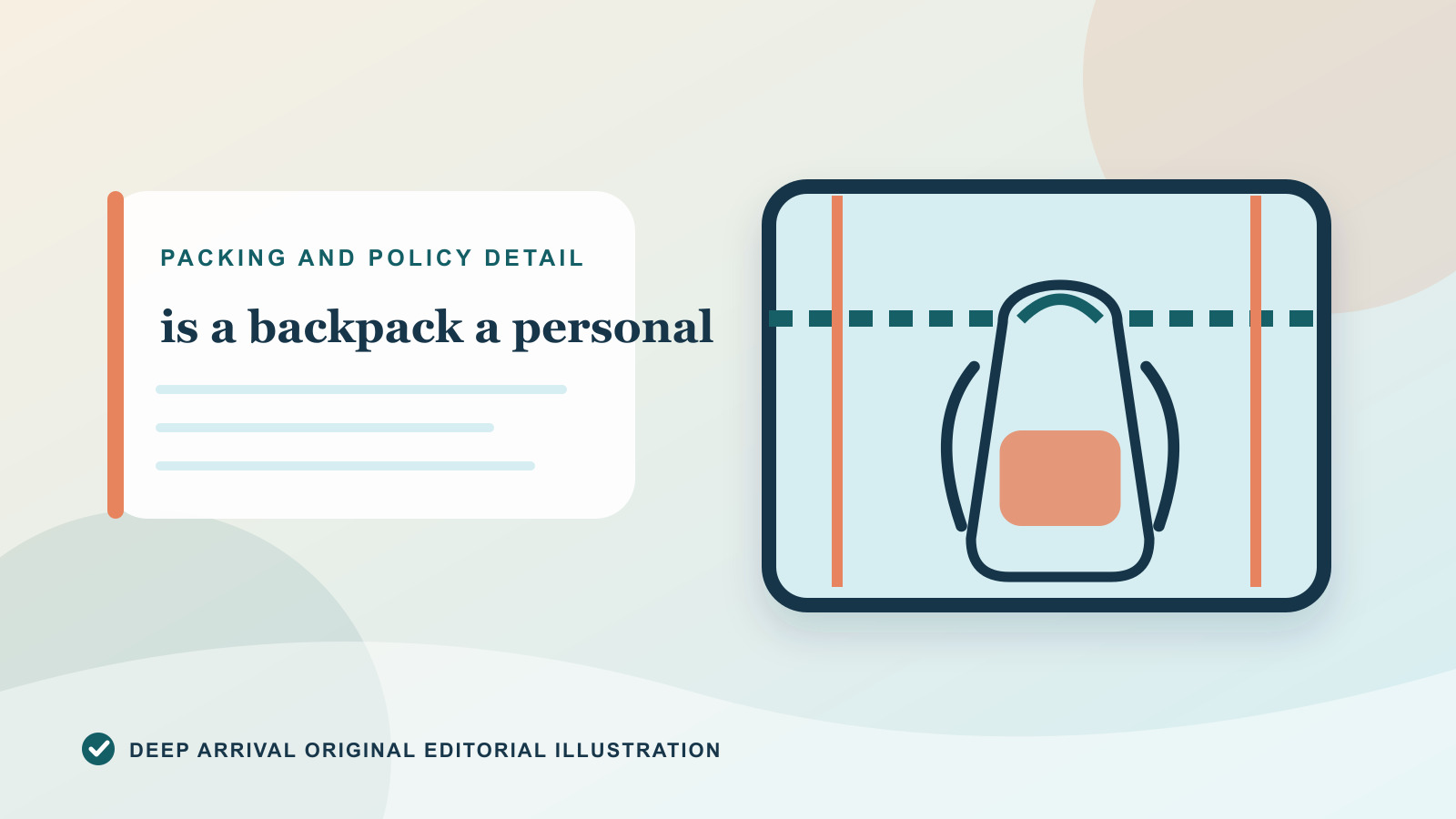
Measure the Packed Bag
The label does not decide where the backpack goes
A backpack marketed as a daypack can still exceed a carrier's personal-item limit after a water bottle, jacket, and laptop fill the outer pockets.
Measure the loaded shape at its widest points and confirm that it can slide completely beneath the seat without blocking the aisle or footwell.
The short answer
Yes. A backpack may be a personal item when the operating airline permits one personal item, the packed bag stays within any published dimensions, and it fits fully under the seat in front. A backpack that exceeds that boundary is a carry-on even if its manufacturer calls it a personal-item pack. American Airlines Carry-on Bags is the primary current reference for the rule described here.
Size matters more than bag type
Airlines describe purses, laptop bags, briefcases, and small backpacks as examples, but the category is functional. The bag must use the under-seat allowance rather than the overhead-bin allowance. Frames, rigid panels, stuffed front pockets, and side bottles can turn a nominally small backpack into a larger exterior package. The published details in JetBlue Main Fare and Bag Rules should be rechecked before departure.
Published limits are not uniform
American publishes an 18 x 14 x 8 inch personal-item maximum, while JetBlue publishes 17 x 13 x 8 inches. Delta and Southwest describe the required under-seat fit without publishing one universal numeric box on their current pages. Use the rule of the airline operating the flight, not only the company that sold the ticket. Delta Carry-On Baggage supplies the authoritative limit or procedure used in this section.
Under-seat space can still vary
A bag that meets a published limit is planned for under-seat stowage, but aircraft hardware can reduce usable room. Seat supports, entertainment boxes, bulkhead seating, and smaller regional aircraft can change the actual opening. A compliant soft backpack is easier to reposition than a rigid bag, but the crew controls final stowage. Use FAA Carry-On Baggage Tips to confirm the current version of this guidance.
Fare and itinerary checks
One personal item is commonly included, but the overhead carry-on allowance can still depend on the fare and operating carrier. Partner-operated and codeshare flights may apply a different carrier's rules, so verify the allowance for every segment in the booking details rather than relying on the marketing airline alone.
How to measure a backpack
Load the backpack, zip it closed, and set it upright without compressing it. Measure height, width, and depth across the furthest exterior points, including stuffed pockets, handles, buckles, and wheels if present. Do not rely on listed dimensions when an expandable zipper is open or flexible fabric is visibly bulging.
Prepare for a gate check
Overhead space can run out even when a traveler has a valid carry-on allowance. Keep medication, identification, keys, fragile electronics, and spare lithium batteries in a pouch that can be removed quickly. FAA guidance says spare batteries and power banks must remain in the cabin if a bag is taken at the gate.
Best final check
Open the operating carrier's baggage page within 24 hours of packing and compare it with the fare receipt. Repack if any dimension is over the limit or if the bag cannot sit flat beneath a chair of similar clearance. Airport agents and crew retain authority over safe stowage on the actual aircraft.
Planning traps
Mistakes to avoid
These are the small decisions that quietly derail an otherwise good plan.
Personal-item branding is not an airline guarantee. Compare the packed exterior measurements with the carrier's current rule.
A bottle, shoes, or rolled jacket can add several inches of depth and cause a bag to fail the sizer.
A partner may operate the flight and apply its own baggage program, especially on regional or international segments.
Spare lithium batteries and power banks cannot remain in a bag that is checked at the gate.
Sources checked
Official and supporting references
Use these references to confirm live prices, dates, rules, and operating details before money changes hands.
FAQ
Common planning questions
Can any backpack be a personal item?
Does a backpack count as a carry-on?
Can I bring a backpack and a carry-on suitcase?
Do wheels and handles count?
What if the backpack fits the limit but not the seat?
Continue planning