
Deep Arrival original editorial illustration
Travel Gear Guide
Duffel Bag vs Suitcase: Which Fits Your Trip?
Choose a duffel when flexible packing, compact empty storage, or carrying over short rough sections matters most. Choose a wheeled suitcase when rolling on smooth routes, structured organization, and setting the bag down upright matter more. Construction, load, route, and traveler ability can reverse either starting point.
Choose a duffel when flexible packing, compact empty storage, or carrying over short rough sections matters most. Choose a wheeled suitcase when rolling on smooth routes, structured organization, and setting the bag down upright matter more. Construction, load, route, and traveler ability can reverse either starting point.
Fast read
What matters first
Use this page as the practical filter before you open booking pages, maps, or official policy documents.
Duffel starting point
Flexible load, odd-shaped gear, compact storage, and short carries
Suitcase starting point
Smooth rolling routes, structured layout, and frequent setting down
Always verify
Loaded weight, dimensions, handles, wheels, access, and current carrier conditions
Decision system
The planning sequence
Use the sequence below to decide how this should shape the trip.
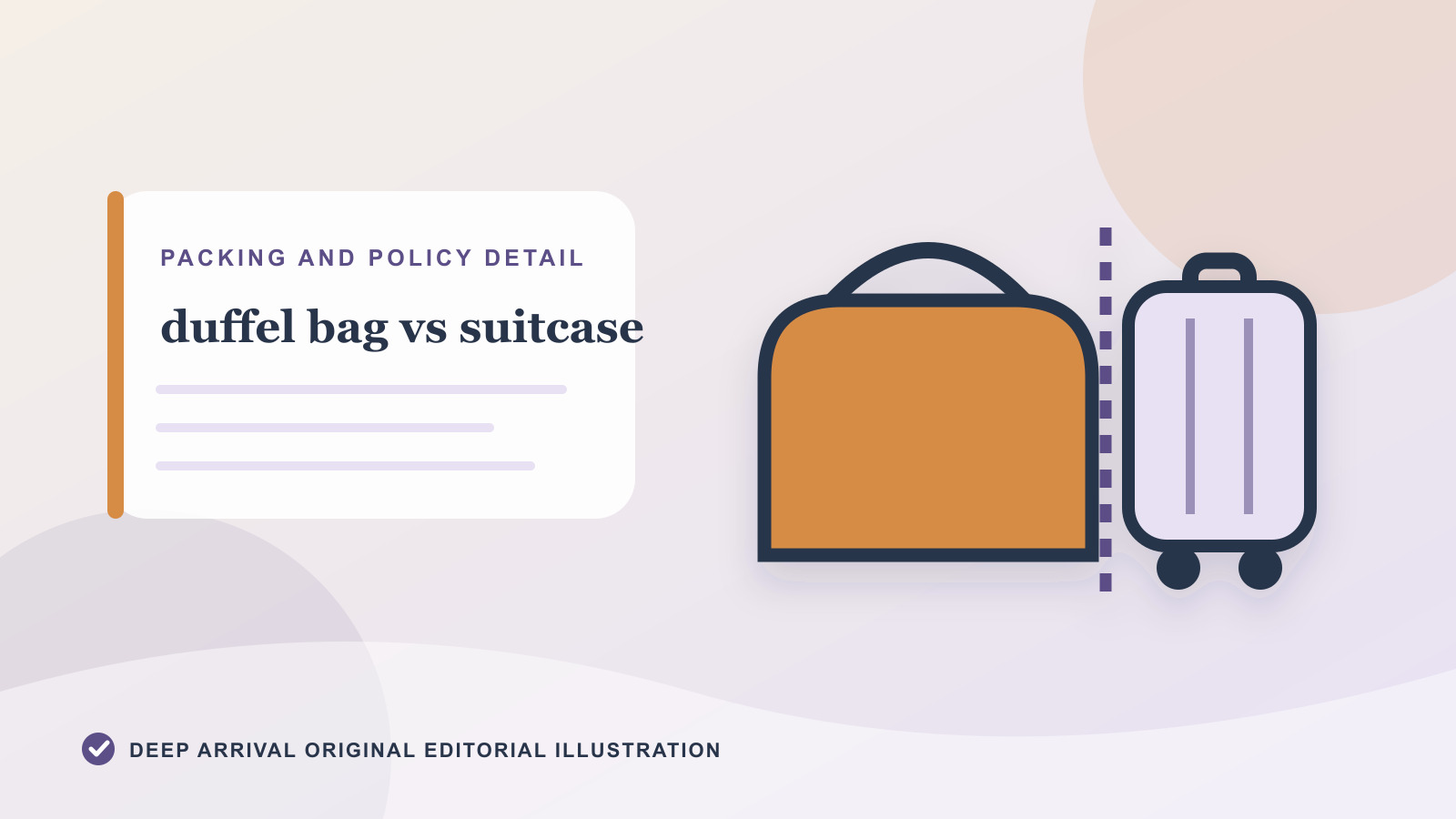
One Load, Two Formats
Make the route and packing tradeoffs visible without declaring a winner
Create a bright exact 1600×900 side-by-side packing scene using one identical neutral travel load, a generic soft duffel, and a generic structured wheeled suitcase. Show opening style, internal movement control, handles, wheels, and empty-storage footprint without logos or durability scores.
The second frame should be a route matrix for a car trunk, smooth terminal, stairway, rough sidewalk, and small hotel room. Use balanced labels for carry burden, rolling access, structure, and storage, and avoid suggesting that the illustration represents a physical comparison test.
Begin with the route, not the bag label
Map the trip from home to room: vehicle loading, terminal distance, stairs, curbs, rough pavement, rail aisles, and storage. REI separates wheeled luggage from traditional duffels because they solve different mobility problems. A suitcase can reduce carrying on smooth surfaces, while a duffel avoids managing a wheelbase when the route requires repeated lifting. Travelpro: Duffel Bag vs Rolling Suitcase is the primary current reference for the rule described here.
Count the minutes the load stays on your body
A nonwheeled duffel transfers its packed weight through handles or a shoulder strap. That can work for short transfers, but a heavy or unbalanced load may become awkward. A suitcase places much of the moving load on its wheels, yet still needs lifting into vehicles, racks, or stairs. Test the exact packed weight and every required lift rather than assuming either format is effortless. The published details in REI Expert Advice: How to Choose Luggage, Packs and Bags should be rechecked before departure.
Match structure to the contents
Soft duffel walls can flex around clothing or irregular gear, while a structured suitcase keeps a more consistent shape. Structure may help control movement, but it does not guarantee protection from drops, crushing, or poor packing. Fragile items still need internal cases, cushioning, and separation. Inspect the exact shell, base, seams, and compression system instead of judging protection from the category name. Samsonite Ultimate Luggage Guide supplies the authoritative limit or procedure used in this section.
Compare access and organization before packing
Many duffels use one large compartment, which accepts varied shapes but can hide a small item under the load. Suitcases often divide a clamshell opening into panels, straps, or pockets and require floor or bed space to open fully. These are common patterns, not rules. Compare the actual opening, pocket layout, compression, and access needed during transit. Use Eagle Creek: Packable Duffel Uses to confirm the current version of this guidance.
Plan for rough surfaces and stairs
REI notes that traditional duffels avoid wheels on bumpy, unpaved routes, while wheeled luggage is useful through airports and smooth streets. The route may include both. A duffel must be carried, and a suitcase must be lifted or negotiated over obstacles. Check grip locations, strap adjustment, wheel clearance, and whether the traveler can safely manage the loaded bag through each segment.
Measure storage at the destination
Many soft duffels collapse or fold after unpacking, which can help in a small room, vehicle, or cruise cabin. A structured suitcase keeps much of its footprint but may provide a stable open packing station. Measure the actual closet, under-bed clearance, or luggage-rack surface. Expansion panels, rigid bases, and wheeled duffels can change the expected storage advantage.
Keep airline acceptance separate from format
Neither a duffel label nor a suitcase label guarantees cabin or checked acceptance. Soft walls can bulge beyond a nominal measurement, and wheels, handles, pockets, or expansion can enlarge a suitcase. Pack first, measure the farthest exterior points, and check the operating carrier's current conditions for every segment. Avoid choosing by an unverified carry-on claim printed in a listing.
Run a loaded home test before choosing
Pack the real list, secure internal movement, and close the bag without forcing it. Carry or roll it indoors, lift it to the height of a vehicle or rack, turn through a narrow doorway, and open it in a suitcase-sized floor area. This user test reveals balance, handle reach, opening space, and access without claiming that one format universally performs better.
Planning traps
Mistakes to avoid
These are the small decisions that quietly derail an otherwise good plan.
Two trips of equal length can have different stairs, surfaces, vehicle transfers, storage space, and fragile-item needs.
Shell construction is only one factor; fragile items still need cushioning, movement control, and careful handling.
A flexible duffel may pack easily but become awkward when weight, balance, handle reach, or carrying distance changes.
Measure the packed exterior, including bulges, wheels, handles, and pockets, then check the operating carrier's current conditions.
Sources checked
Official and supporting references
Use these references to confirm live prices, dates, rules, and operating details before money changes hands.
FAQ
Common planning questions
Is a duffel bag better than a suitcase?
Which format is easier on stairs?
Does a suitcase protect fragile items better?
Which bag stores more easily in a small room?
Can a duffel bag count as carry-on luggage?
Continue planning