
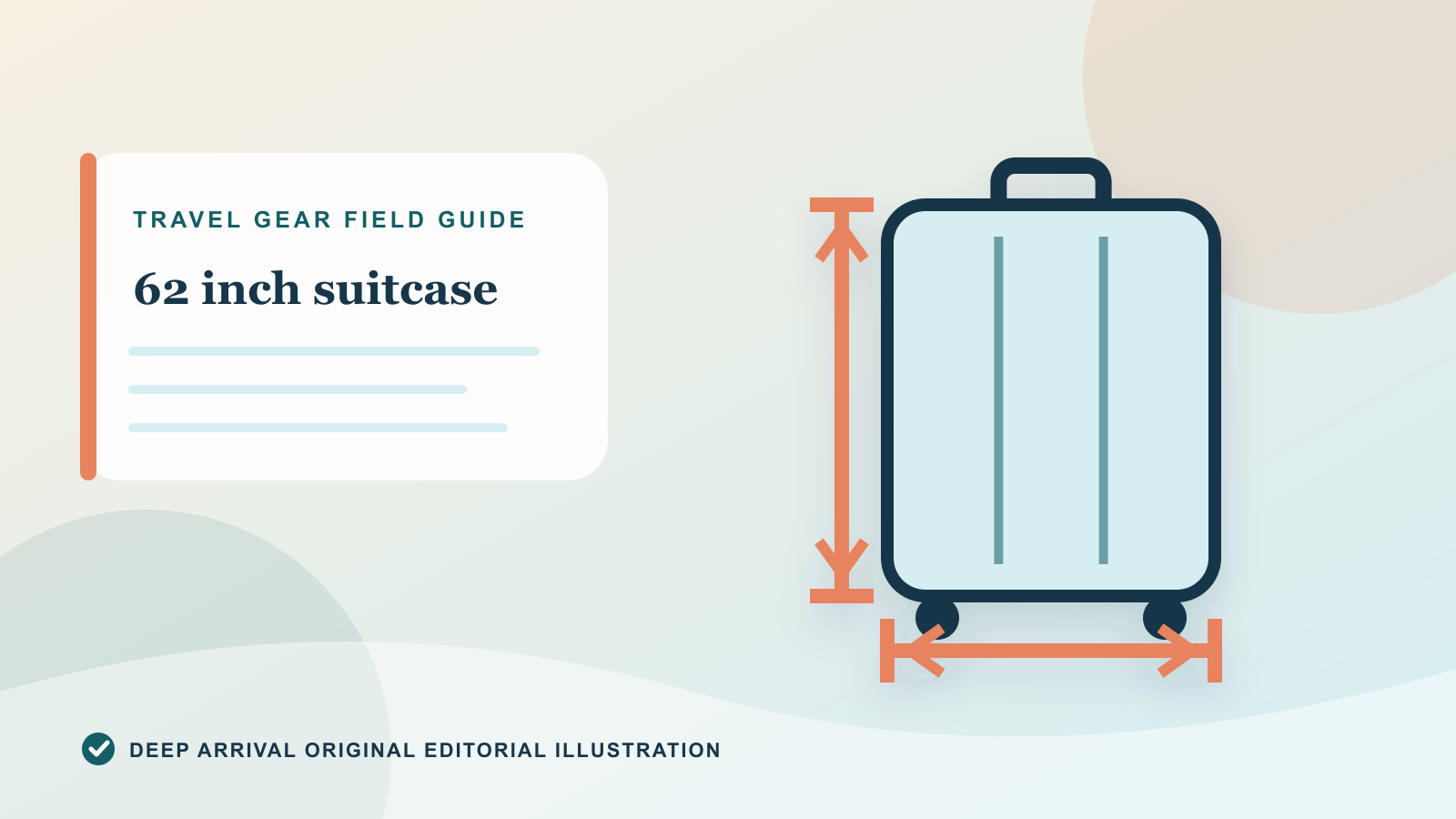
Deep Arrival original editorial illustration
Checked-Bag Arithmetic
What Does 62 Linear Inches Mean for Checked Luggage?
The 62-inch rule is a three-side exterior sum, not the suitcase height, screen size, or cubic capacity.
The 62-inch rule is a three-side exterior sum, not the suitcase height, screen size, or cubic capacity.
Fast read
What matters first
Use this page as the practical filter before you open booking pages, maps, or official policy documents.
Formula
Length + width + height
Common reference
62 in or about 157 to 158 cm
Separate test
A common standard weight is 50 lb or 23 kg
Decision system
The planning sequence
Use the sequence below to decide how this should shape the trip.
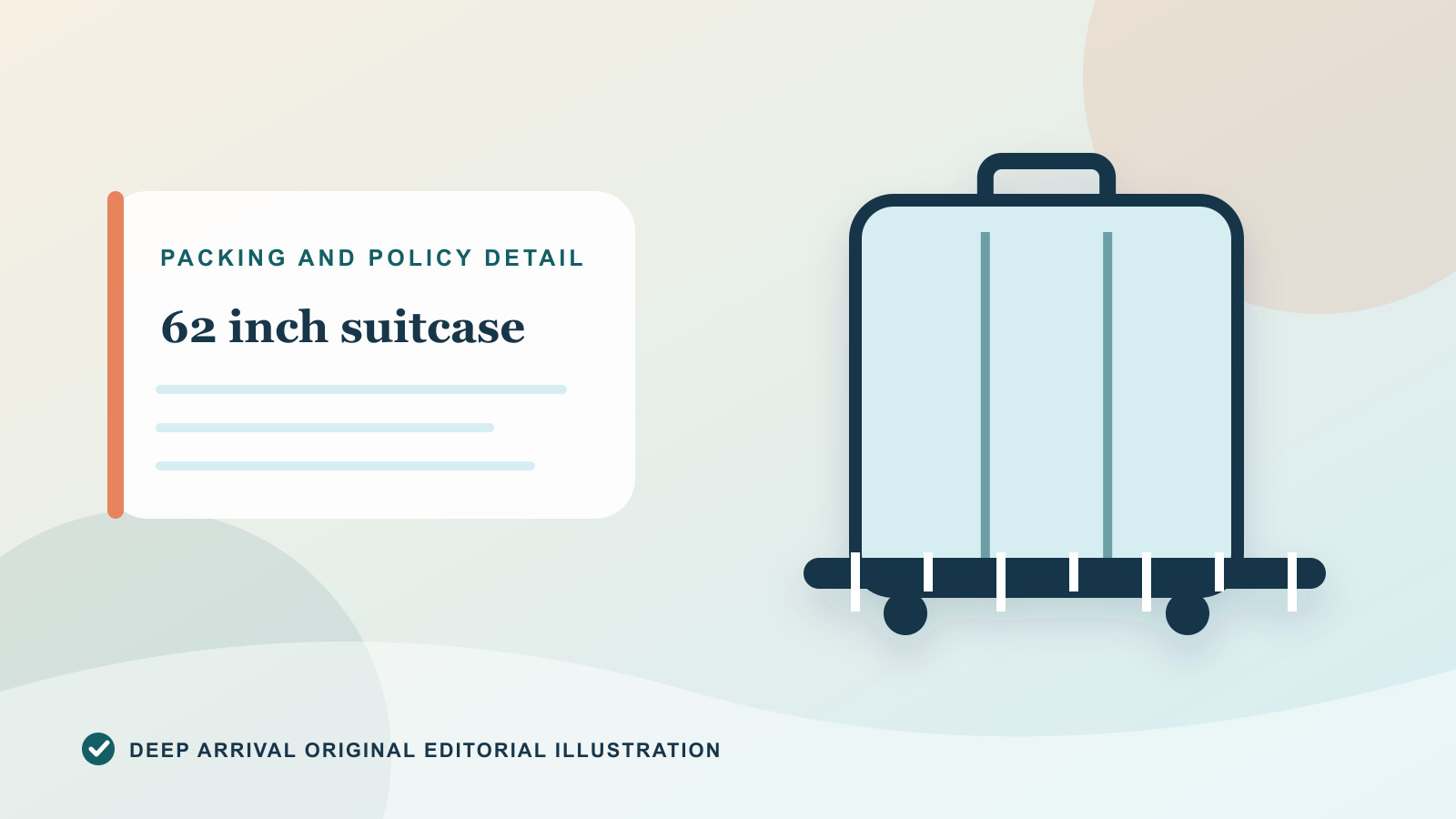
Add, Do Not Multiply
Three outside measurements produce one linear total
A suitcase measuring 28 x 20 x 14 inches totals exactly 62 linear inches because 28 plus 20 plus 14 equals 62.
That result says nothing about weight, so a separate packed-bag scale reading is still required.
The direct definition
Sixty-two linear inches means the suitcase's greatest exterior length, width, and height add to no more than 62 inches. American and Southwest publish 62 inches, while Delta currently presents 62 inches or 157 centimeters and American also shows 158 centimeters. The slight metric presentation does not change the need to check the carrier's page. American Airlines Checked Bag Policy is the primary current reference for the rule described here.
Use exterior measurements
Measure the bag presented to the airline, not the interior packing cavity. Wheels, feet, fixed handles, shell corners, side grips, and filled pockets all belong in the exterior size. Retract the telescoping handle, close all zippers, and keep any expansion panel in the position that will be used for travel. The published details in Delta Baggage Overview should be rechecked before departure.
The calculation
Write down the three longest exterior dimensions and add them. A 28 x 20 x 14 inch suitcase equals 62 linear inches. A 29 x 21 x 13 inch suitcase equals 63 and is over a 62-inch standard even though no single side appears dramatically larger. Southwest Checked Baggage Policy supplies the authoritative limit or procedure used in this section.
Why orientation does not help
Rotating a suitcase changes which side is called length, width, or height, but it does not change the sum. Measure the greatest extent along three perpendicular axes. Do not omit a protruding wheel because the bag can be turned sideways in the measuring area. Use JetBlue Select-Market Bag Limits to confirm the current version of this guidance.
Weight is independent
A suitcase can meet 62 linear inches and still be overweight. American, Delta, Southwest, and JetBlue use 50 pounds or 23 kilograms as a common standard reference on the pages checked, with fare, cabin, route, status, and special-item exceptions. Weigh the final packed bag and leave a margin.
Exactly 62 versus below 62
A true exterior total of exactly 62 inches meets a rule written as 62 inches maximum, but it offers no buffer for measurement differences, bulging fabric, or an open expansion zipper. A bag several inches below the ceiling reduces uncertainty and is easier to keep within the weight limit.
Oversize does not always mean accepted
Some airlines price bags above the standard dimension, but acceptance can still depend on maximum dimensions, aircraft, destination, seasonal embargo, and item type. American publishes route-specific oversize fees and limits. Never assume that paying a fee guarantees a very large case will travel.
Recheck the actual itinerary
The operating carrier controls handling on its flight, and partner itineraries can apply different rules. Confirm the exact fare and route shortly before departure. A standard allowance may differ for premium cabins, status benefits, military travel, special equipment, and travel to or from Australia or New Zealand.
Planning traps
Mistakes to avoid
These are the small decisions that quietly derail an otherwise good plan.
The number is the sum of three sides, not the height.
Multiplication calculates volume, while airline linear size uses addition.
The full exterior bag, including wheels and handles, is measured.
A dimensionally compliant bag can still trigger an overweight rule.
Sources checked
Official and supporting references
Use these references to confirm live prices, dates, rules, and operating details before money changes hands.
FAQ
Common planning questions
How do I calculate 62 linear inches?
Do wheels count toward 62 inches?
Is a 28-inch suitcase automatically under 62 linear inches?
Can a 62-inch bag weigh more than 50 pounds?
Are 62 inches and 158 centimeters the same?
Continue planning