
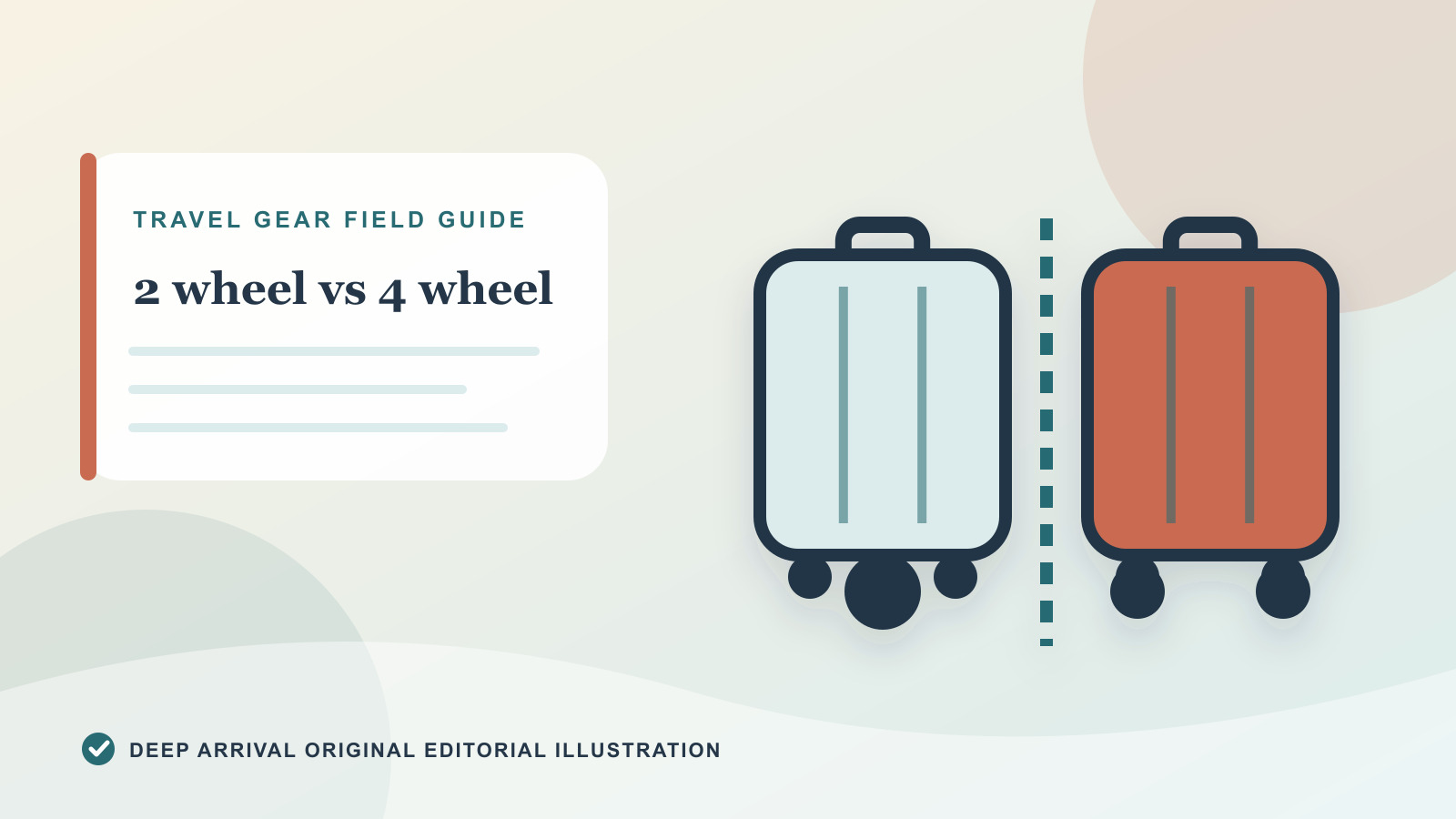
Deep Arrival original editorial illustration
Travel Gear Guide
2-Wheel vs 4-Wheel Luggage: Which Rolls Better?
Start with 2-wheel luggage for straight pulling across mixed or rough surfaces and 4-wheel luggage for upright movement and lateral turns on smooth floors. Wheel diameter, mounting, bearings, load balance, handle geometry, and the route can outweigh the wheel count, so there is no universal winner.
Start with 2-wheel luggage for straight pulling across mixed or rough surfaces and 4-wheel luggage for upright movement and lateral turns on smooth floors. Wheel diameter, mounting, bearings, load balance, handle geometry, and the route can outweigh the wheel count, so there is no universal winner.
Fast read
What matters first
Use this page as the practical filter before you open booking pages, maps, or official policy documents.
2-wheel starting point
Straight pulling, larger recessed wheels, curbs, and mixed surfaces
4-wheel starting point
Upright steering, lateral movement, smooth terminals, and narrow turns
Always verify
Wheel diameter, mounting, case dimensions, balance, handle, and parts path
Decision system
The planning sequence
Use the sequence below to decide how this should shape the trip.
Wheel Count Is Only the Start
Compare equal-size generic cases across the same travel route
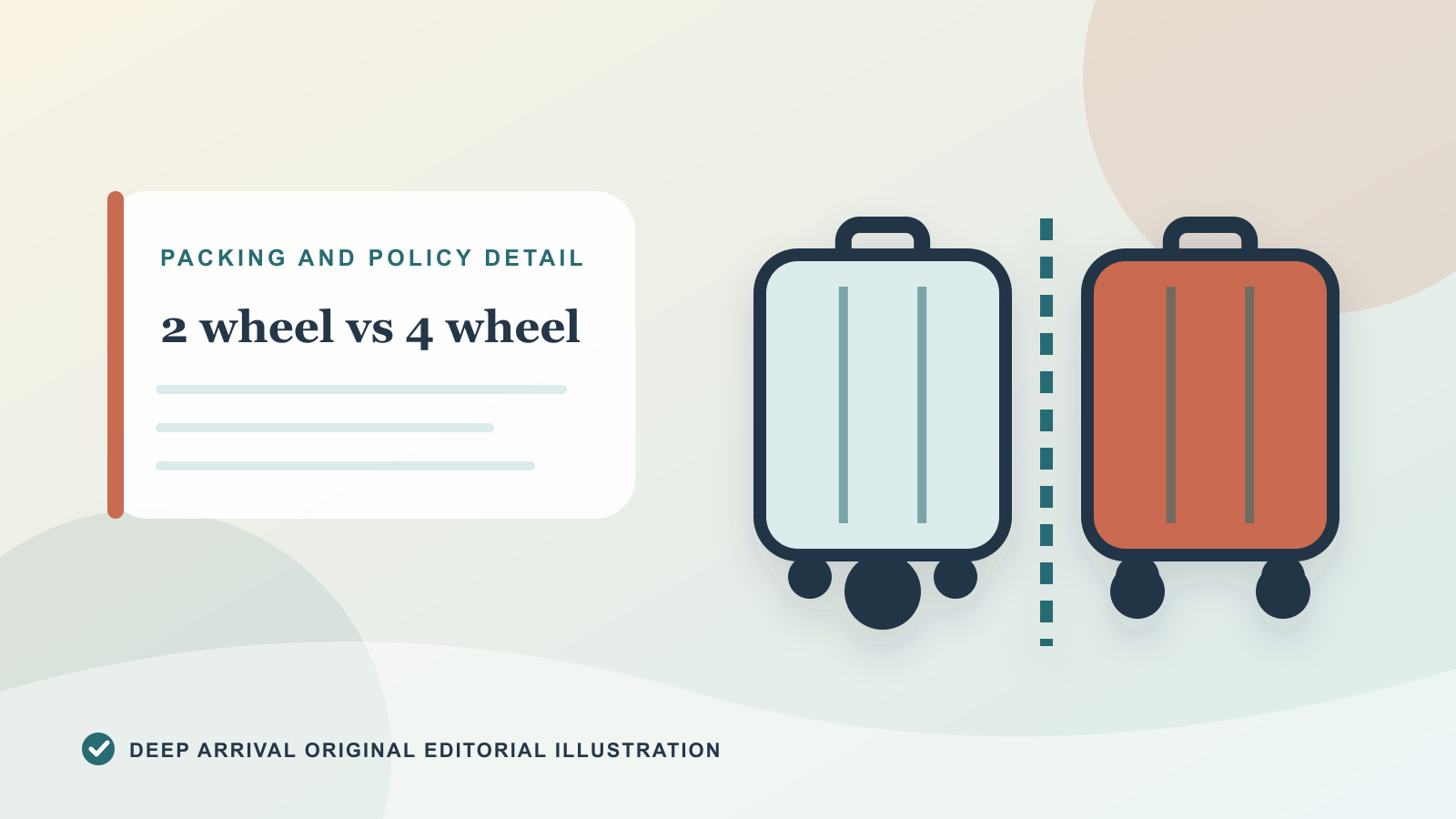
Create a bright exact 1600×900 underside studio comparison of two generic same-size suitcases, one with two larger recessed wheels and fixed front feet and one with four exposed swivel casters. Label wheel direction, tilt angle, protrusion, and stance without logos or durability scores.
The second frame should show both cases on smooth terminal flooring, carpet, a narrow aisle, a curb edge, and uneven pavement. Present movement options and obstacles as an instructional route diagram, not a physical test or proof that one layout always performs better.
Understand how each wheel layout moves
Two-wheel luggage is normally tilted and pulled behind the traveler on wheels that move forward and backward. Four-wheel spinner luggage can remain upright and move forward, backward, sideways, or around a turn. Travelpro and Briggs and Riley describe these different handling patterns, but wheel count alone does not determine rolling quality, comfort, stability, or durability. Travelpro: 2-Wheel vs 4-Wheel Luggage is the primary current reference for the rule described here.
Match wheel diameter to the surface
Two-wheel cases often use larger, recessed wheels, while spinner casters are commonly smaller and exposed at the corners. Larger diameter can help a wheel cross gaps or uneven surfaces, but material, bearings, axle support, clearance, and load also matter. Compare the exact models on carpet, thresholds, pavement, and curb approaches instead of assuming every two-wheel case rolls better. The published details in Briggs and Riley: Spinner vs Upright Luggage should be rechecked before departure.
Use lateral movement where space is narrow
A spinner can move beside the traveler without the trailing angle required by a typical two-wheel case. That can be useful in queues, elevators, train aisles, or hotel corridors. The advantage depends on the loaded case steering predictably and fitting the space. A wide shell, loose handle, uneven load, or resisting caster can erase the expected maneuvering benefit. Samsonite Ultimate Luggage Guide supplies the authoritative limit or procedure used in this section.
Check pull angle, handle height, and body position
A two-wheel case places the bag behind the traveler at an angle, while a spinner can be pushed or steered upright. These positions load the hand, arm, and shoulder differently, but no layout is universally more comfortable. Compare handle height, grip shape, case weight, wheel resistance, route length, and personal mobility. Stop if the loaded case causes pain or unsafe control. Use REI Expert Advice: How to Choose Luggage, Packs and Bags to confirm the current version of this guidance.
Treat slopes and moving floors as separate tests
Four freely swiveling casters can let an upright suitcase move on a slope, train, bus, or moving walkway unless the traveler holds or restrains it. A two-wheel case usually stands on fixed feet plus its wheels, yet balance still varies. Check brakes if present, loaded center of mass, stance width, tipping behavior, and how the case is secured during stops.
Measure wheels inside the exterior envelope
Protruding spinner casters and recessed two-wheel housings use space differently, but neither layout guarantees more usable capacity. Shell shape, handle tubes, wheel wells, lining, and internal hardware all affect the packing area. Compare published interior and exterior dimensions where available, then measure the loaded case at its farthest wheels, handles, pockets, and expansion points.
Inspect exposure and the service path
Recessed wheels may have less external exposure, while corner-mounted spinners add more swivel assemblies and mounting points. That geometry does not prove which exact case will last longer. Inspect fasteners, housings, wheel material, clearance, warranty terms, and whether replacement parts or authorized service exist. The separate replaceable-wheel guide owns the detailed repair decision.
Test the loaded case on the real route
Load the intended contents and check straight tracking, starts, stops, tight turns, thresholds, carpet, tilting, and upright stability in a safe area. Repeat with any companion bag attached. This is the traveler's fit check, not evidence of universal performance. Choose the layout that remains controllable across the actual route, then verify full dimensions and current carrier conditions.
Planning traps
Mistakes to avoid
These are the small decisions that quietly derail an otherwise good plan.
Wheel diameter, material, bearings, mounting, clearance, load balance, handle geometry, and route can matter as much as the layout.
Lateral movement can help on smooth floors, but rough surfaces, slopes, caster resistance, and load balance can change control.
Recessed geometry may reduce exposure, but construction, mounting, materials, use, service, and handling determine an exact case's durability.
Carrier sizing uses the full exterior, so include wheels, handles, pockets, and expansion when checking the loaded case.
Sources checked
Official and supporting references
Use these references to confirm live prices, dates, rules, and operating details before money changes hands.
FAQ
Common planning questions
Is 2-wheel or 4-wheel luggage better?
Which wheel layout works better on rough pavement?
Do spinner wheels reduce packing space?
Which layout is easier in a narrow aisle?
Are two-wheel suitcases more durable?
Continue planning