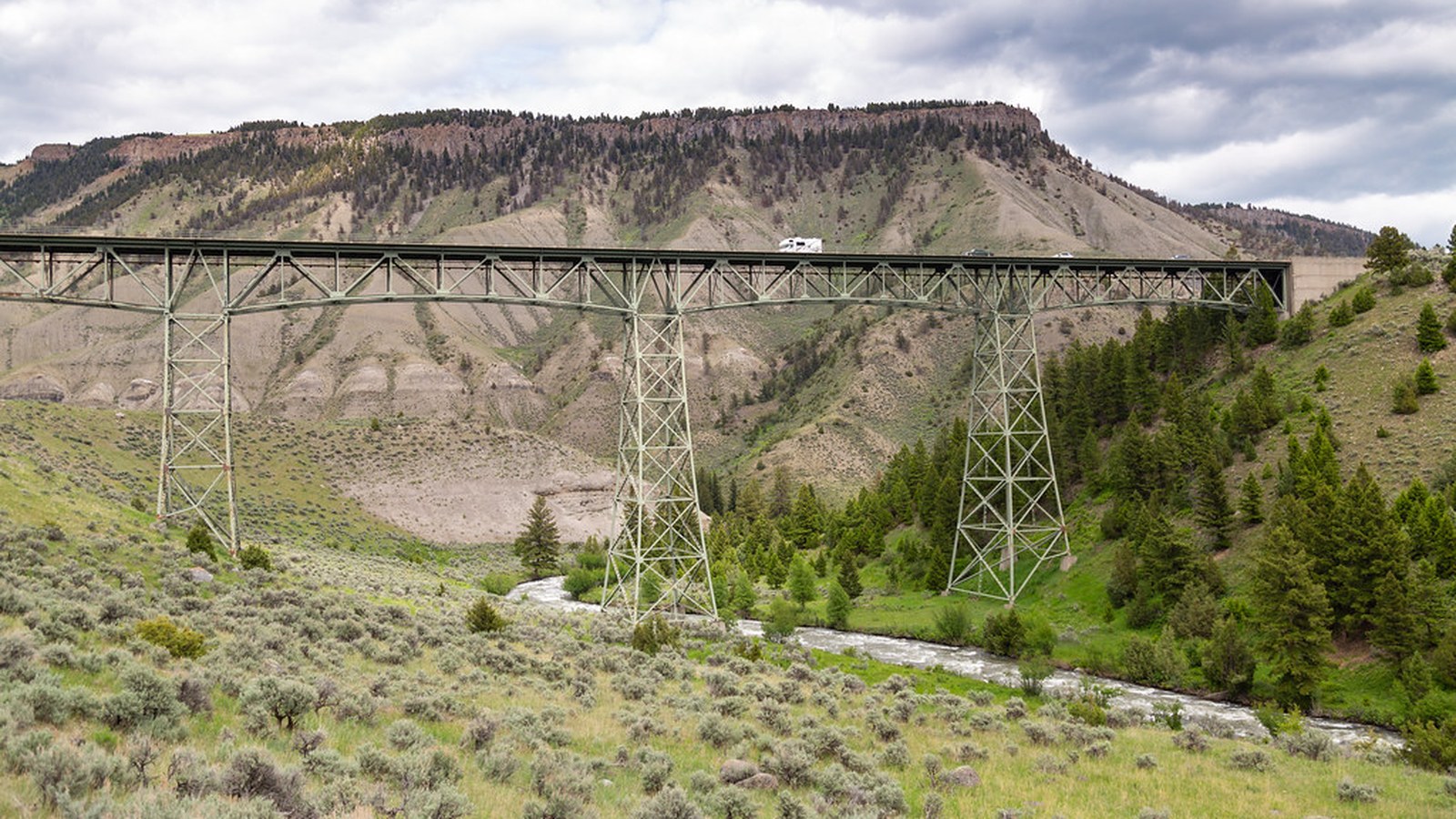
Yellowstone’s North Entrance at Gardiner, Montana, is the park’s only year-round gateway, and in 2026 a bridge project just past Mammoth Hot Springs is slowing the drive into the North Loop. Work on the Gardner River High Bridge means single-lane travel and short holds that run into late October.
The delay is real but very manageable. It sits about half a mile from Mammoth toward Tower Junction, so it does not block reaching Mammoth itself, and a little routing sense keeps it from spoiling a North Loop day.
- The project: rehabilitation of the Gardner River High Bridge, about half a mile southeast of Mammoth Hot Springs.
- The delay: a single lane with holds of up to 15 minutes, around the clock.
- The window: roughly mid-April to late October 2026, subject to change.
- Who feels it: drivers heading from Mammoth toward Tower Junction, Lamar Valley, or the full North Loop.
- Not blocked: the drive from Gardiner up to Mammoth Hot Springs, which does not cross this bridge.
- Big rigs: oversized and overweight vehicles cannot cross during the work.
What the bridge work actually does
The delay is a metered single lane, not a closure. The National Park Service lists the Gardner River High Bridge near Mammoth Hot Springs among 2026’s traffic-delay projects, with one lane open and waits of up to 15 minutes, 24 hours a day.
The scope is heavy but routine. Crews are replacing expansion joints, patching approach spans, repairing the steel truss, and adding concrete guard walls, which is why the holds stretch into late October.
Where the delay sits, and what it spares
Location matters more than the headline. The bridge is about half a mile southeast of Mammoth toward Tower Junction, so getting from the North Entrance at Gardiner up to Mammoth Hot Springs does not cross it.
The pinch is on the Tower leg. You meet the hold once you leave Mammoth heading east toward Tower Junction, Lamar Valley, or around the North Loop, not on the climb up from Gardiner.
Planning a North Entrance day around it
Front-load Mammoth, then time your crossing. See the Mammoth terraces first, then cross toward Tower early or late when the queue is shortest, since the single lane runs at all hours but stacks up most at midday.
Drive the loop in one direction. On a full North Loop you cross the bridge only once, so commit to a clockwise or counterclockwise plan rather than doubling back over it.
Before you reach the single lane
Treat the hold like a mountain pass. Fuel up in Gardiner or at Mammoth, use the restroom before you roll toward Tower, and top off water, because a wait with a warm car and restless kids feels far longer.
Watch for wildlife in the queue. This stretch runs through prime bear and elk country, so keep a safe distance, stay in the vehicle during holds, and never stop in the single lane for a photo.
When another entrance makes more sense
Match the gate to your targets. If your trip centers on geysers like Old Faithful and Grand Prismatic, the West Entrance at West Yellowstone reaches the lower loop without touching this bridge at all.
Southern and eastern gates skip it too. The South Entrance from Grand Teton and the East Entrance from Cody over Sylvan Pass both feed the lake and canyon areas, avoiding the Mammoth to Tower stretch.
The Northeast Entrance and the other bridge
Lamar Valley carries its own construction story. Near Tower Junction, the new Yellowstone River Bridge has opened to vehicles after a $118 million replacement of a structurally deficient 1961 span, though finishing work continues in 2026.
Reach it by mountain highway. The Northeast Entrance at Cooke City is served by the Beartooth Highway, open from Memorial Day weekend to mid-October, plus the year-round Chief Joseph Scenic Byway.
Timing to shrink the wait
Off-peak crossings clear faster. The 15-minute figure is a maximum, and early morning or evening trips through the single lane usually move quicker than a midday summer surge.
Wildlife hours pay off twice. A dawn run toward Lamar Valley for wolves and bison also means crossing the bridge before the day’s traffic builds, so you save time and see more.
What it means for a North Loop itinerary
Budget the delay, do not dread it. The North Loop runs about 70 miles through Mammoth, Norris, Canyon, and Tower, and this project adds one short hold rather than a detour, so a well-planned loop loses only minutes.
Consider your base carefully. Staying in Gardiner or Mammoth lets you catch the terraces and Lamar wildlife at their best hours and cross the bridge when it is quietest.
Other 2026 roadwork to expect
Chip sealing is the wildcard. The park also lists parkwide chip sealing among 2026’s delay projects, which can appear on segments with little warning, so check the live conditions and road map the day you drive.
The North Entrance road still stays open. This Gardiner to Cooke City route is the only one open to regular vehicles all year, so even with the work it remains the reliable all-season way in.
Building Yellowstone into a wider trip
Few travelers see only Yellowstone. If Grand Teton, the Beartooths, or a Montana loop join the plan, map the pieces on our destinations hub so entrance choice and drive times fit around the bridge window.
Let routing pick your gate. When the schedule is flexible, entering at West or South and saving Mammoth for last can sidestep the delay entirely.
How far apart the entrances really are
Yellowstone is huge, so gate choice shapes the whole drive. The park spans three states with five entrances, and the Park Service notes it takes several hours to drive between them, so the nearest gate to your must-see sights saves more time than dodging one bridge.
Position tells the story. The West Entrance sits closest to the geyser basins, the North and Northeast gates open the Mammoth and Lamar country, and the South and East gates land you near Yellowstone Lake and the canyon.
Gateway towns differ too. Gardiner at the North Entrance and West Yellowstone at the West Entrance both offer fuel, food, and lodging right at the gate, which makes either a practical base for an early start and a quick first crossing.
The new Yellowstone River Bridge, by the numbers
The Tower project is the bigger build of the two. The replacement span runs about 1,285 feet, and the work realigns roughly a mile of the Northeast Entrance Road while shifting the Tower Junction intersection about 700 feet to the southeast.
It is nearly wrapped. The old 1961 bridge was structurally deficient, the new one now carries traffic, and remaining 2026 work covers overlooks, demolition of the old span, and restoration around the site.
Overnight closures and the fine print
The Gardner River hold changed shape over the season. Earlier in 2026 the project included five full overnight closures between late May and July 1, but from summer into late October the pattern is single-lane travel rather than full stops.
Read the vehicle limits before you tow. Oversized or overweight rigs cannot cross during the work, so anything wider, longer, or heavier than the posted limits needs a different route entirely.
Why the bridge needed the work
This is maintenance the park has flagged for years. The Gardner River High Bridge repairs are part of Yellowstone’s push to chip away at a deferred maintenance backlog on aging roads and structures.
Short-term pain buys long-term gain. A season of single-lane holds delivers a rebuilt truss, fresh expansion joints, and new guard walls that should keep this stretch of the North Loop solid for years.
Decision matrix
| If you… | What to do |
|---|---|
| Are staying in Gardiner or Mammoth | See Mammoth first, then cross toward Tower early or late to dodge the queue. |
| Mainly want geysers and the lower loop | Enter at West Yellowstone and skip the Gardner River bridge entirely. |
| Are driving the full North Loop | Plan one direction so you cross the bridge just once. |
| Want Lamar Valley wildlife | Go at dawn, when the single-lane hold is shortest and animals are active. |
| Drive an oversized or overweight rig | Reroute, since large vehicles cannot cross the bridge during the work. |
- Expect: single-lane travel and holds of up to 15 minutes, around the clock, into late October.
- Avoid it: reach Mammoth from Gardiner freely, since that climb does not cross the bridge.
- Reroute option: West, South, or East entrances skip the Mammoth to Tower pinch for lower-loop plans.
- Best timing: cross early or late, because midday summer traffic stacks the wait.
- Check daily: parkwide chip sealing and weather can add delays, so read the live road map first.
The takeaway is planning, not panic. One short hold near Mammoth does not close the North Entrance, and choosing your gate, direction, and hour keeps Yellowstone’s north country wide open this fall.
Is the North Entrance to Yellowstone closed in 2026?
No. The Gardiner entrance and the road to Mammoth stay open, and the delay is on the bridge just past Mammoth toward Tower.
How long are the bridge delays?
Traffic drops to a single lane with waits of up to 15 minutes, and the holds run around the clock into late October.
Does the work block Mammoth Hot Springs?
No. Reaching Mammoth from Gardiner does not cross the Gardner River High Bridge, since the hold sits on the Tower side.
Which entrance avoids the delay?
The West, South, and East entrances all reach the lower loop without crossing this bridge.
Can large RVs cross the bridge?
Oversized and overweight vehicles cannot cross during the work and should plan an alternate route.