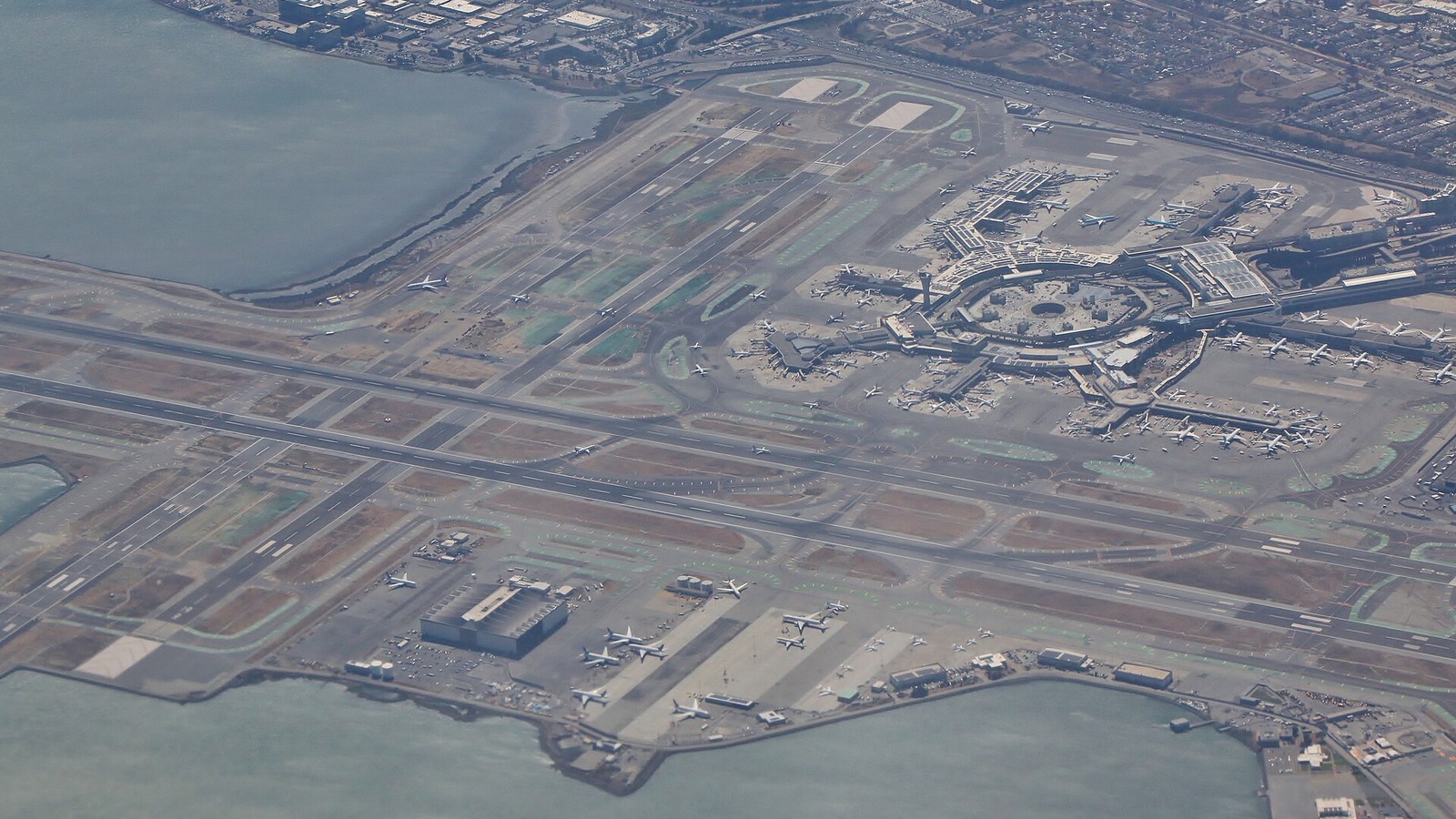
Image credit: 4300streetcar via Wikimedia Commons. License: CC BY 4.0 (https://creativecommons.org/licenses/by/4.0); author: 4300streetcar; source page: https://commons.wikimedia.org/wiki/File:United_Airbus_A321neo_N54552_landing_at_San_Francisco_January_2026.jpg.
San Francisco International Airport is still missing Runway 1R, and delays are running far above the airport’s original forecast. On September 3, 2026, CBS News Bay Area reported that about 40 percent of flights are delayed while the six-month repaving closure continues and a Federal Aviation Administration limit on side-by-side landings stays in force. When the project began in March, SFO had estimated that about 15 percent of flights would be late.
Do not book a tight connection at SFO before early October. The airport still dates the Runway 1R reopen to October 2, 2026, and told CBS the paving work is on schedule. If a missed bank would leave you overnight, keep a hotel option ready and compare neighborhoods in our San Francisco stay guide before you fly.
- Status: Runway 1R has been closed since March 30, 2026. SFO still dates the reopen to October 2, 2026, and told CBS the work is on schedule.
- Delay rate: About 40 percent of flights are delayed, versus SFO’s March estimate of about 15 percent, according to CBS on September 3.
- Main driver: Spokesperson Doug Yakel told CBS the FAA landing-procedure change has a greater impact than the runway project itself.
- Airfield: All takeoffs and landings use 28 Left and 28 Right. Runway 1 Left is being used as a taxiway.
- Next step: Avoid minimum connections, recheck airline apps on travel day, and treat October as the planning reset, not a same-week guarantee.
Runway 1R Is Still Closed Through October 2
SFO’s own December 30, 2025 notice remains the dated schedule. In that airport announcement, officials said Runway 1 Right would close on March 30, 2026, and was expected to reopen on October 2, 2026, so crews could repave the surface and rebuild nearby taxiways, lighting, signage, and drains.
CBS reported on September 3 that the paving job is still on that timetable. Crews are placing more than 2,000 tons of asphalt a day on a runway last rebuilt about 15 years ago. Airfield program manager Daniel Lee told CBS the point is to stop potholes and cracks from forcing surprise closures later. SFO put the current cost at about $215 million, with roughly half coming from the FAA.
That calendar is the traveler fact that matters. Anyone connecting or originating at SFO between now and early October is still inside the reduced-runway window. Anyone flying after October 2 should recheck the airport and their airline the week prior, because “on schedule” is a status, not a boarding pass.
FAA Landing Limits Outweigh the Asphalt Work
The runway closure is visible. The larger delay engine is not. Yakel told CBS, “That FAA procedural change is a far greater impact than this runway project.” The FAA restricted side-by-side landings as the airfield shifted all arrivals and departures onto the 28 pair, which cut how many aircraft SFO can land in an hour.
In August, the San Francisco Chronicle reported that the FAA would allow staggered parallel arrivals beginning August 12, 2026, with one aircraft kept ahead of the other. The agency told the Chronicle that arrivals would rise to 40 airplanes an hour on August 12, then 42 by the end of that month, up from 36 under the full ban. Yakel called that a step toward a more normal rate, not a return to true side-by-side landings.
The Chronicle recorded that more than a third of flights since March had been delayed 15 minutes or more, compared with about one-fifth in 2025. CBS’s September 3 figure of about 40 percent shows relief is still incomplete. In low visibility, the FAA said the stricter no-parallel rule can return.
Tight Connections at SFO Need Extra Slack
If your itinerary uses SFO as a hub this month, the minimum connection your airline sells is the wrong planning number. A 40 percent delay rate means the inbound leg is often the problem, not the security line. Build a longer layover, especially on separate tickets, and do not count on a same-day recover if the last bank of the evening is already tight.
The delay share CBS cited is airport-wide, not a single-carrier waiver. Check the operating carrier app the morning of travel, then again before you leave for the airport. If you are originating in the Bay Area, add road time. If you are inbound from the East Coast or overseas, assume the first domestic connection needs a spare hour, not a spare minute.
Travelers who turn a broken connection into an unplanned night in the city should already know where they would sleep. Neighborhood tradeoffs, transit time back to SFO, and last-room pricing all change after 10 p.m. Use the stay guide above, then keep a short list of things to do if you inherit a daylight spare hour from our San Francisco shortlist.
Peak Hours and the 28 Left and 28 Right Pattern
SFO’s December notice said all arrivals and departures would use 28 Left and 28 Right, a layout the airport called common on clear, windy days and preferred by airlines and controllers. Runway 1 Left, parallel to the work zone, is not used for takeoffs or landings. It is a taxiway meant to keep ground traffic from stacking behind the paving site.
That pattern also changes what “on time” looks like at the peaks. The original SFO notice said delays, when they happened, were most likely around 9 a.m. and between 8 p.m. and 9 p.m., and would average under 30 minutes. CBS’s later reporting did not repeat that 30-minute cap. Treat those banks as the hours when a missed inbound is hardest to repair, because the next bank may already be full.
SFO also warned nearby communities of more departing traffic overhead while every takeoff uses the 28 pair. That does not change a passenger’s gate. It does explain why a ground hold can linger even after your aircraft is boarded: the airport is sequencing a denser stream onto two runways instead of four.
Overnight Buffers Help When a Same-Day Bank Breaks
Yakel told CBS that operations should be much closer to normal by October: “When we get to October we’ll be returning to a much more normal arrival rate.” He also said this is the last major runway closure SFO expects for a while. Those are planning statements, not a promise that September 30 will look like October 3.
If a same-day meeting, cruise embarkation, or international departure sits on the other side of SFO, do not make the airport the only buffer. Move the meeting, fly the day before, or hold a cancellable hotel. Earlier this year the airport also described faster customs processing for U.S. citizens in our SFO customs update, which helps arrivals but does not cancel a late inbound from the runway queue.
Recheck the week of September 29. If Runway 1R reopens on October 2 as dated, the FAA landing rate still has to catch up, and fog season does not end on a construction calendar. Leave slack in the itinerary rather than betting on a 40-minute connection.
Through October 2, 2026 is the reduced-runway window. Avoid minimum connections at SFO. CBS says about 40 percent of flights are delayed, so the inbound leg is the usual break point.
9 a.m. and 8 to 9 p.m. remain the peak-risk hours. SFO originally flagged those banks. Leave extra road and terminal time, and do not count on a same-evening recover.
October 2 is the dated Runway 1R reopen. Recheck SFO and your airline that week. Fog and FAA landing limits can still slow arrivals after the asphalt work ends.
| If you… | What to do |
|---|---|
| Connect at SFO before October 2 | Drop minimum connections. CBS says about 40 percent of flights are delayed. |
| Fly around 9 a.m. or 8 to 9 p.m. | Leave extra road and terminal time. SFO originally flagged those hours as delay peaks. |
| Arrive in fog or low visibility | Do not count on staggered-arrival relief. The stricter parallel-landing ban can return. |
| Travel after October 2 | Recheck SFO and your airline that week. The airport still dates the Runway 1R reopen to that day. |
When does SFO Runway 1R reopen?
SFO’s December 30, 2025 announcement still dates the reopen to October 2, 2026. CBS reported on September 3 that the paving project remains on schedule, with operations expected to look closer to normal in October.
Why are SFO delays worse than the airport predicted?
SFO estimated about 15 percent of flights would be delayed when the March closure began, and its December notice had forecast less than 10 percent. CBS now cites about 40 percent. Yakel said the FAA’s limit on side-by-side landings is a greater factor than the runway work.
Are SFO flights being cancelled, or only delayed?
The current official and local reporting describes delay rates, not a mass cancellation order. Check your operating carrier for the specific flight. A high delay share still breaks short connections even when the aircraft eventually departs.
What should connecting passengers do through early October?
Book a longer layover, avoid last-bank connections, and recheck the airline app on travel day. If a missed flight would strand you overnight, keep a San Francisco hotel option ready rather than relying on a same-evening recover.