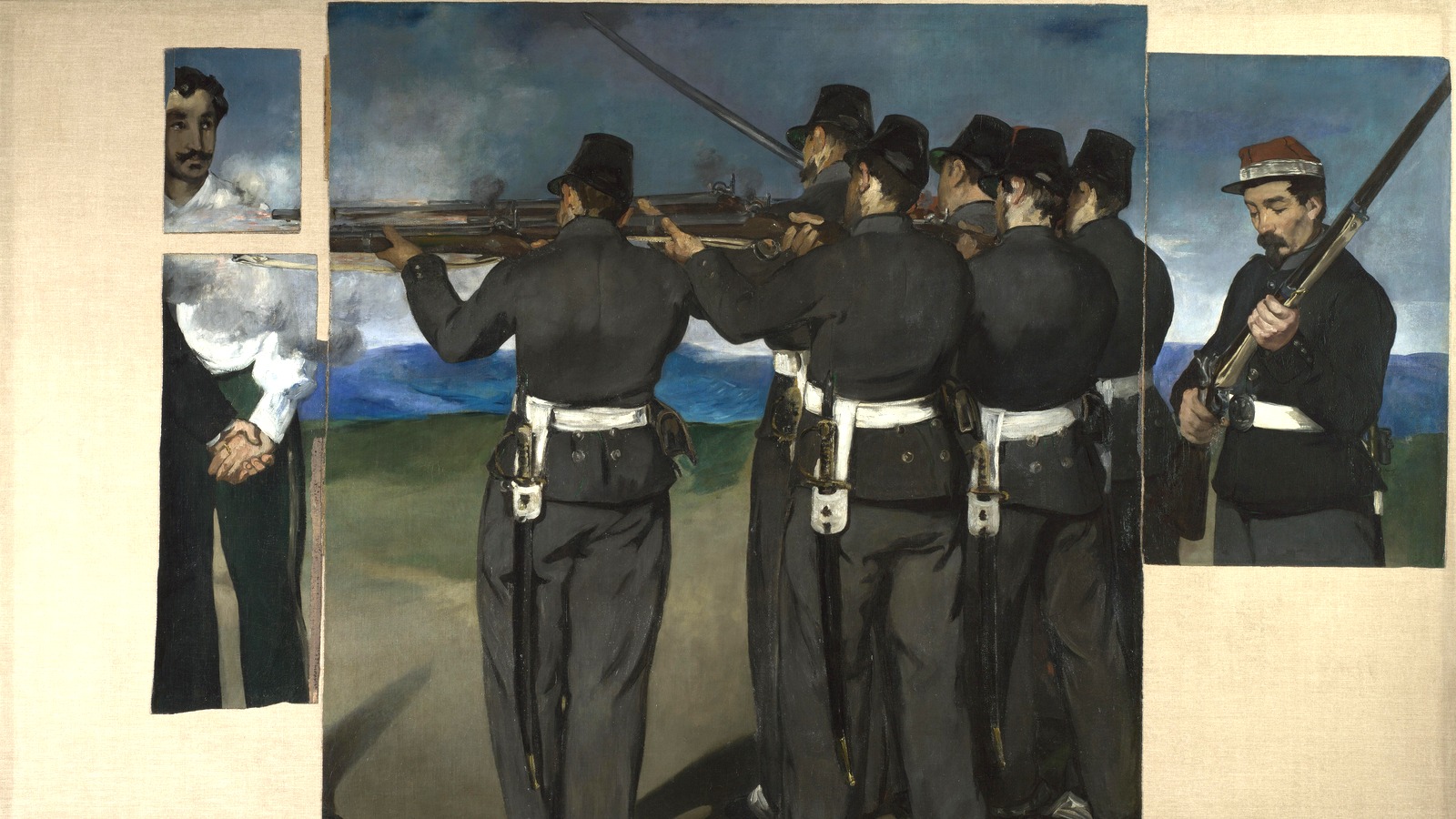
The blank patches are part of the story. Norton Simon Museum in Pasadena will show Manet’s The Execution of Maximilian, on loan from London’s National Gallery, from November 13, 2026 through March 1, 2027, according to the museum’s current exhibition listing.
For anyone wondering about the gaps, the National Gallery’s account supplies the answer: the damaged canvas was cut up after Manet’s death, its surviving fragments acquired by Degas and eventually combined again. That makes the forthcoming visit an opportunity to look at a painting’s turbulent physical history alongside the event it depicts.
- Opens: November 13, 2026.
- Ends: March 1, 2027.
- Venue: Norton Simon Museum, Pasadena.
- Loan: The National Gallery’s fragmented Manet canvas.
The image is a cropped, brightness-adjusted detail of Manet’s painting from about 1867 to 1868, reproduced from a public-domain file; it is not an installation photograph.
A Painting That Carries Its Scars
The surviving image makes its incompleteness immediately visible: a small detached portrait, a clasp of hands, a line of uniformed figures and broad areas of bare-looking support interrupt one another. Rather than trying to mentally fill everything in at once, spend a moment noticing how those interruptions change the way your eye moves across the scene.
Look first at the relationship between the small pieces on the left and the much larger central group. Then follow the long horizontal line of weapons; the contrast between that forceful direction and the broken image gives a visitor a specific visual question to pursue, even without arriving as a Manet specialist.
This is also why a cropped reproduction is only a starting point. The full arrangement matters to the argument of the picture, and seeing how much survives can be more revealing than concentrating on a single recognizable face or a familiar artist’s name on an exhibition label.
Two Histories in One Frame
The subject is the execution of Mexico’s Emperor Maximilian and two generals on June 19, 1867. The National Gallery explains that Manet was outraged by the emperor’s fate after Napoleon III withdrew French support; the London painting dates from about 1867 to 1868.
Its later story is a different kind of drama: the National Gallery bought the surviving pieces in 1918, and they were combined on one canvas in the late 1970s. The museum’s modern summary distinguishes that surviving object from the other versions of the scene that Manet made.
Keep those two timelines in mind when looking. One concerns the historical event the artist chose to represent; the other concerns what later owners and institutions did with the material object, and the gaps are a visible reminder that an artwork’s life continues after the painter stops working.
There is room for a useful disagreement here, too: a visitor might initially find the missing areas distracting, then become more interested in them than in the complete-looking passages. Treat that change of attention as a way into the painting, rather than feeling obliged to recognize a prescribed masterpiece immediately.
Put the Loan on a Pasadena Itinerary
Wallpaper’s November Los Angeles exhibition guide also lists the loan and its dates. For travelers choosing when to visit, the opening is the meaningful boundary: a trip scheduled before it will not include this exhibition, so check the actual museum calendar before shifting an otherwise suitable itinerary.
A single work can provide a satisfying anchor for a museum stop without becoming the whole day’s assignment. Allow yourself time to compare the areas that first caught your attention, read the accompanying interpretation and return to the picture once those details have changed what you notice.
For companions with different levels of interest in art, make the visit a conversation rather than a test. One person can follow the composition while another concentrates on the historical account, then compare which part of the work stayed with each of you before moving on.
Keep the Visit and the Interpretation Separate
The published exhibition window establishes when to plan around this loan, but does not itself settle a particular day’s entry arrangements. Use the museum’s current visitor and ticket information for the date you select; this report does not supply an independently verified admission price or promise an unrestricted walk-in visit.
The practical payoff is a more deliberate museum stop: arrive with one real question about the object, rather than a checklist of famous names to collect. A painting with conspicuous gaps is unusually well suited to that approach, because the image itself gives everyone something concrete to ask about.
| If you… | What to consider |
|---|---|
| Visit before the opening | Keep this loan out of that trip’s expectations. |
| Build a visit around the work | Check your chosen day’s museum and entry arrangements. |
| Know the historical event | Look at what the surviving composition does with it. |
| Are new to Manet | Start with the visible fragments and your own questions. |
Before changing travel dates: Recheck the exhibition listing and the museum’s visitor information together.
At the painting: Compare the surviving image with the explanation of its physical history.