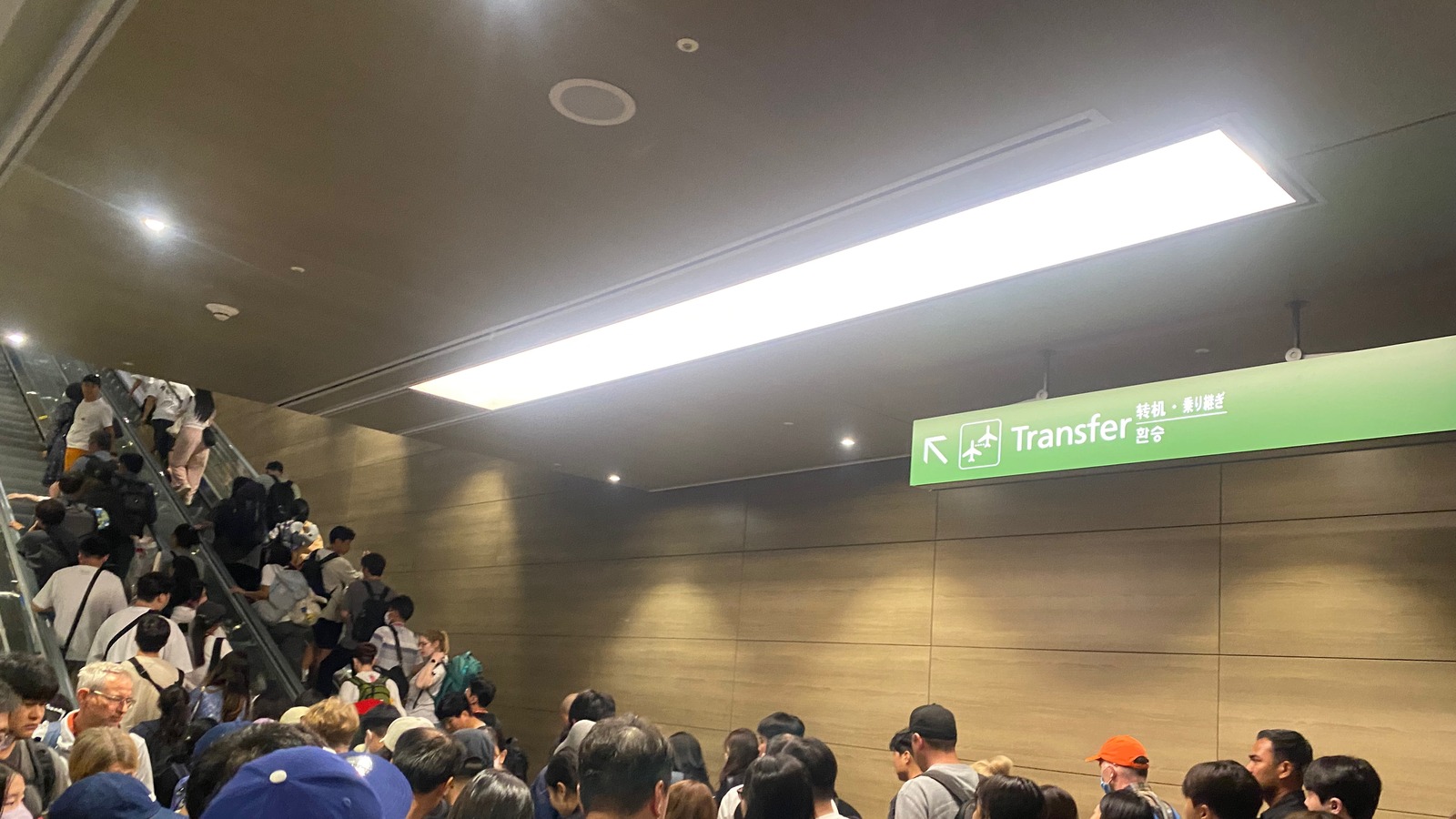
Sgroey · CC BY-SA 4.0 · cropped
Incheon International Airport is preparing for as many as 60,000 foreign arrivals in a single day on October 2, 2026, around China’s National Day holiday. The Incheon Airport Immigration Office, under the Ministry of Justice, told The Korea Times it will run emergency measures from September 30 through October 3 and put more officers into arrival and departure halls.
If you fly into or out of Seoul through Incheon in late September or early October, the useful work is to add time at immigration, use the earlier departure-hall openings, and treat October 2 as the heaviest foreign-arrival day. Deep Arrival’s airlines hub is the place to keep other operating notes while this window is live. Seoul Economic Daily, citing the same office on September 17, sets the broader special-duty calendar from September 23 through October 11.
- Peak day: up to 60,000 foreign arrivals on October 2, 2026, slightly above this year’s one-day record of 59,000.
- Four-day surge: 198,000 to 220,000 foreign arrivals from September 30 to October 3, or about 49,500 to 55,000 a day.
- Staffing: arrival officers rise from 128 on a normal day to 188 in the emergency window; departure officers rise from 38 to 54.
- Earlier halls: selected departure halls open 30 minutes early for 12 days from September 30 through October 11.
- Chuseok: total passenger traffic is forecast to peak at 245,318 on September 27.
October 2 Is the Foreign Arrival Peak
The Korea Times, translating a Hankook Ilbo report, says more than 50,000 foreign nationals a day are expected through Incheon from September 30 to October 3, around China’s October 1 National Day. Over those four days the office expects 198,000 to 220,000 foreign arrivals. That is an average of 49,500 to 55,000 a day, above last year’s 45,640 daily average for September 30 to October 4.
October 2 is the day the office is planning against a 60,000-person foreign-arrival count. Seoul Economic Daily says October 1 could reach 55,000 and October 2 could reach 60,000, compared with a National Day peak of 40,767 foreign arrivals last year. Those figures are forecasts from the immigration office, not a cap on who may enter. They are a reason to land with extra time, not a reason to skip the trip.
Office head Kim Jeong-do said the agency will shift commuting schedules and move people from document inspection and other support desks onto screening lines to avoid gaps. He also said supervisors in the halls will increase and that the office will watch incoming flights in advance to limit crowding. That is a staffing plan. It is not a promise that waits will stay inside a published number of minutes.
Earlier Departure Halls From September 30
Departure halls will open earlier for 12 days from September 30 through October 11, the last day of the Hangeul Day holiday period. The Korea Times lists Terminal 1 Hall No. 2 at 5:30 a.m., Terminal 1 Hall No. 4 at 6 a.m., and Terminal 2 Hall No. 2 at 5 a.m. Seoul Economic Daily describes the same three halls moving 30 minutes earlier than their usual 6 a.m., 6:30 a.m., and 5:30 a.m. openings.
If you have a dawn departure, those 30 minutes are the difference between a closed hall and a usable one. Check which terminal your airline uses. Incheon still splits carriers across Terminal 1 and Terminal 2, and the early openings are hall-specific, not a blanket 5 a.m. unlock of the entire airport. A passenger in the wrong hall at 5:15 a.m. can still be standing in front of a closed door.
Departure staffing also rises from 38 officers to 54 during the emergency window. That helps outbound screening. It does not move your airline’s check-in cutoff, bag drop, or security line. Treat the earlier hall as extra access, then keep the rest of the departure process on the airline’s own clock.
Chuseok Traffic Peaks on September 27
Before China’s holiday, Korea’s Chuseok period loads the same airport with residents leaving and returning. The Korea Times says special Chuseok measures run from September 24 to 27, with daily passenger traffic forecast to hit 245,318 on September 27. Seoul Economic Daily, briefing the same office two days earlier, lists Chuseok measures from September 23 to 27 and the same 245,318 peak on the 27th.
Seoul Economic Daily also splits that Chuseok week: about 131,154 departures on September 24 and about 138,658 arrivals on September 27, with a daily average around 225,899 people, up 6.3 percent from last year. If you are a visitor arriving into that weekend, you are sharing halls with a domestic holiday return, not only with Golden Week tourists. Build more time on September 27 than on a midweek September day.
The office’s longer calendar, per Seoul Economic Daily, runs in three blocks: September 23 to 27 for Chuseok, September 30 to October 5 for China’s National Day and Korea’s National Foundation Day, and October 9 to 11 for Hangeul Day. The four-day emergency staffing window of September 30 to October 3 sits inside the middle block, when foreign arrivals are expected to concentrate.
Immigration Staffing During the Emergency Window
On a normal day the arrival halls run 128 officers. During ordinary special measures, such as other holiday periods, that number is 166. For the four emergency days starting September 30 it rises to 188, a 47 percent increase from the baseline, according to both the Korea Times and Seoul Economic Daily. Departure officers move from 38 to 54, a 42 percent increase.
Those extra people are meant to keep lines moving when foreign arrivals cluster on specific flights. They do not add a new visa class, a new e-gate nationality list, or a new way around inspection. Eligible automated-clearance travelers should still use those lanes if they already qualify. Everyone else should assume a longer foreign-arrivals hall, especially in Terminal 1, which the office says has been carrying more of the foreign inbound load.
Seoul Economic Daily notes that this past summer, from July 22 to August 15, Korean departures fell 4.4 percent while foreign arrivals rose 23.5 percent. Kim said the old pattern of a Korean-outbound summer no longer holds, which is why the office is writing a foreign-arrival plan into a holiday that used to be treated mainly as a Korean departure problem. That is context for the staffing numbers, not a new rule at the counter.
What Travelers Should Recheck Before They Fly
Confirm your terminal, your airline’s bag-drop close, and which departure hall actually opens early. Then add time for immigration on arrival, especially on October 2 and on the Chuseok return of September 27. A connection that looked legal on a quiet Tuesday can fail if the foreign-arrivals hall is holding 50,000 to 60,000 people that day.
Keep hotel pickups and rail tickets flexible on those peak dates. AREX and other city transfers still run, but a late walk-out from immigration will miss a timed train more easily than a taxi queue. If you hold a same-day domestic connection after an international landing, that is the itinerary to unbundle first. This site’s earlier Incheon wait-time note was Terminal 2 weekend security delays, a different screening layer than this immigration holiday plan.
| If you… | What to do |
|---|---|
| Arrive on October 2 | Plan for up to 60,000 foreign arrivals. Add immigration time. Do not stack a tight same-day connection. |
| Depart at dawn Sep. 30 to Oct. 11 | Use the hall that opens 30 minutes early. Confirm T1 Hall 2, T1 Hall 4, or T2 Hall 2 against your ticket. |
| Travel during Chuseok, Sep. 24 to 27 | Expect the heaviest total traffic on September 27, when 245,318 passengers are forecast. |
| Land in Terminal 1 as a foreign visitor | The office says T1 is carrying more foreign inbound demand. Budget a longer arrivals hall. |
September 27 is the Chuseok passenger peak. Total traffic is forecast at 245,318. Visitors arriving that day share halls with a domestic holiday return.
September 30 to October 3 is the emergency staffing window. Arrival officers rise to 188 and departure officers to 54. Foreign arrivals are forecast at 49,500 to 55,000 a day.
October 2 is the 60,000 foreign-arrival plan day. Land with extra time. Treat a tight connection as a risk, not a schedule.
When could Incheon see 60,000 foreign arrivals in one day?
The immigration office is planning against that count on October 2, 2026, during China’s National Day travel period.
Which departure halls open earlier?
For 12 days from September 30 through October 11, Terminal 1 Hall No. 2 opens at 5:30 a.m., Terminal 1 Hall No. 4 at 6 a.m., and Terminal 2 Hall No. 2 at 5 a.m.
How many extra immigration officers will be on duty?
Arrival staffing rises from 128 on a normal day to 188 during the September 30 to October 3 emergency window. Departure staffing rises from 38 to 54.
Is Chuseok a separate problem from Golden Week?
Yes. Chuseok loads the airport with Korean holiday traffic, peaking on September 27. The 60,000 foreign-arrival plan is for October 2, after Chuseok.