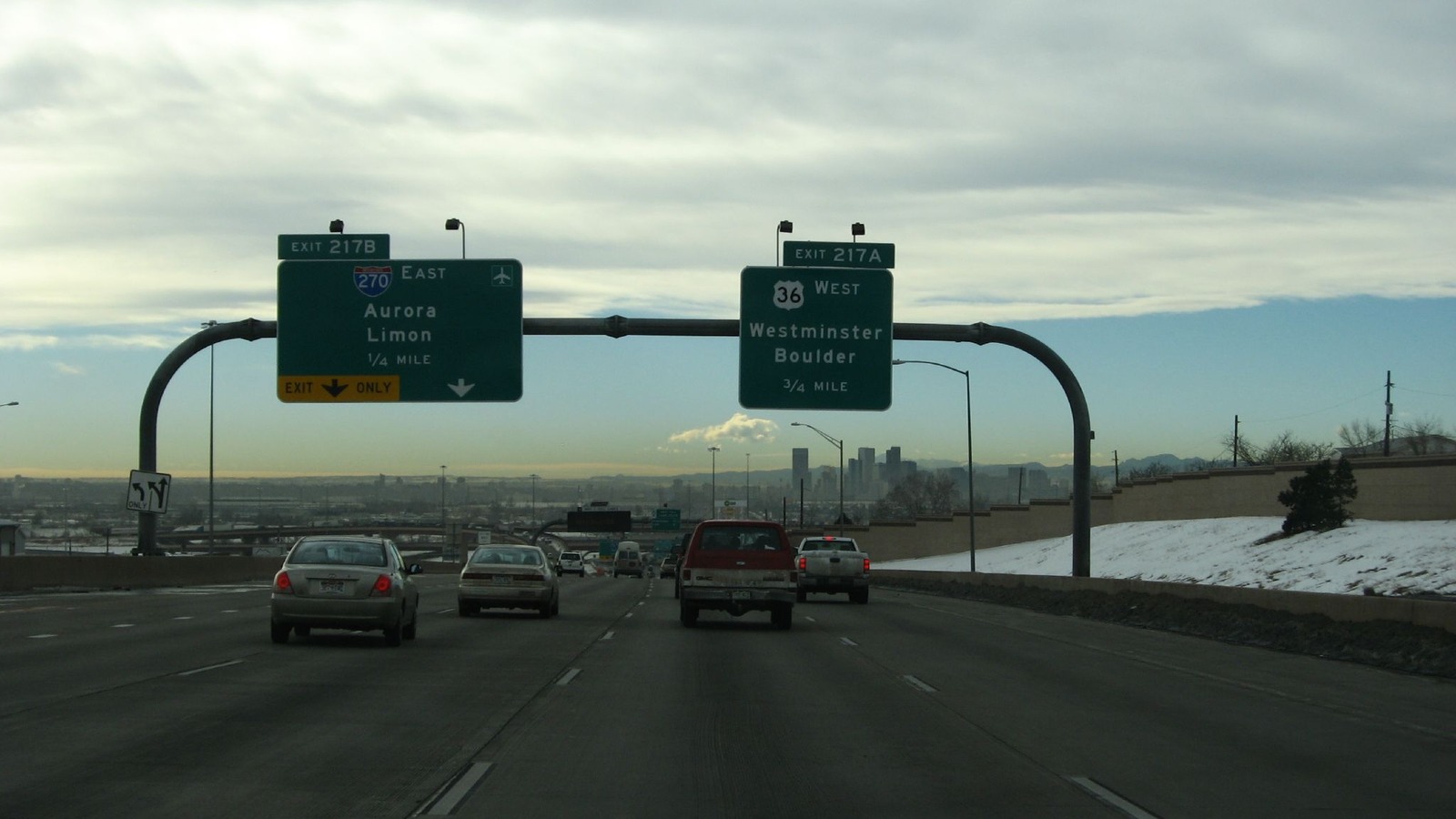
View of Denver Skyline from Exit 217B at Junction with Interstate 270 and U.S. 36, Interstate 25, Denver, Colorado (2379614796) · Ken Lund · CC BY-SA 2.0 · edited
The lane restriction on eastbound US 36 approaching the I-25 interchange in Denver has moved from the right lane to the left, and a new right lane restriction has appeared on eastbound I-270.
Both took effect on 10 September as the Colorado Department of Transportation began the second and final phase of preventative maintenance on the I-270 and US 36 bridge over I-25, work the department expects to finish by early November.
This is the interchange where the Boulder and Westminster traffic meets the Denver ring, so it sits on the commute for a large share of the north metro and on the approach for anyone driving in from the north side of the city.
- Eastbound US 36: one lane from MP 57, and the restriction has switched from the right lane to the left.
- Eastbound I-270: one lane between I-25 and Washington Street, right lane restricted.
- Southbound I-25 off ramp to eastbound I-270: single lane restrictions at MP 217.
- Always open: a minimum of one lane throughout the project.
- Expected finish: early November 2026.
Which Lane Moved, and Why It Matters
The department’s phase two notice describes the change plainly: the existing right lane closure on eastbound US 36 moves to the left lane as drivers approach the interchange.
A lane restriction that swaps sides is a different hazard from a new one. A driver who has been taking this road for six months has built a habit around keeping left, and the habit is now wrong.
The department also adds a new right lane restriction on eastbound I-270 between I-25 and Washington Street, and single lane restrictions on the southbound I-25 off ramp to eastbound I-270 at mile point 217.
Taken together that is three separate changes inside one interchange, arriving on the same day. The department asks drivers to use extreme caution because the travel lanes are narrowed with crews and heavy equipment working alongside them.
Crucially, a minimum of one lane of traffic stays open throughout the project. This is a narrowing, not a closure, and nothing in the notice removes a route.
Minor Delays Is the Department’s Own Wording
The notice says minor traffic delays are expected, and it is worth taking that at face value rather than inflating it.
Preventative maintenance on a bridge is not the same animal as a reconstruction. The work here is ground stabilisation beneath the roadway and bridge embankments, plus sawcutting, removing deteriorated bridge deck and approach slab concrete, and installing protection for bridge inlets.
None of that requires taking the structure out of service, which is why the lanes narrow rather than close. The department frames the whole project as extending the bridge’s service life, and the first phase, which ran from March, already replaced key components.
The honest planning conclusion is modest. Add a few minutes at peak, and expect the lane you want to be on the other side of the road from where it was in August.
The Work Runs Day and Night, on Different Hours
Two separate schedules apply, and they do not overlap in the way most drivers assume.
Night work runs 10 p.m. to 6 a.m., Sunday through Thursday. Day work runs 7 a.m. to 7 p.m., Monday through Friday, continuing through October 2026.
That leaves Friday nights and Saturdays as the quietest window, which is the opposite of the pattern on most highway projects, where weekends are when the heavy closures land.
The lane restrictions themselves are not described as coming and going with the shifts. The department presents them as the traffic configuration for the phase, so the sensible assumption is that the narrowed lanes are there whether or not crews are visible.
The Point of Replacing a Bridge Joint
It is reasonable to ask why a structure that is carrying traffic perfectly well needs eight months of lane restrictions, and the department’s own stated benefits answer it better than the work description does.
Two of the three are about water. The department lists better drainage and weather resilience, specifically preventing clogging from debris and helping avoid water pooling, hydroplaning risks or flooding, and a smoother road surface that makes travel safer in inclement weather.
That reframes the whole project for a driver. This is not cosmetic resurfacing. It is the difference between a bridge deck that sheds a Colorado downpour and one that holds it in the wheel tracks.
The third benefit is the unglamorous one: extending the lifespan of the existing structures, which the department says reduces the need for more extensive and disruptive replacements later. A phase of narrowed lanes now is the cheap version of a closed bridge in a decade.
The scale is modest by interstate standards. The project is costed at just over five million dollars, runs from March 2026 to October 2026 across Adams and Denver counties, and covers the structures on US 36 from mile point 57 over I-25 along with the ramp at mile point 217.
Phase one, which began in March, handled ground stabilisation and replaced key bridge components. Phase two is the finishing half of the same job, which is why the traffic pattern shifted rather than intensified.
Where the Alternatives Actually Are
For a single lane restriction with minor delays, rerouting is usually the wrong instinct. The detour around a metro interchange costs more than the interchange does.
The exception is anyone whose trip is Boulder or Longmont to the airport, because that journey crosses this work twice and has a genuine alternative. Deep Arrival covered the RTD Route AL change from 27 September, which is the bus running that corridor.
The department points drivers to COtrip for live conditions rather than to the project page, and that is the right call here. A lane configuration that changed once in September can change again, and the state traveller information site carries real time road conditions and closures rather than a schedule written in advance.
For anything large, the narrowed lanes are the part to plan around rather than the delay. Our Denver RV parks and campgrounds guide covers the approaches from the north, which is the side of the city this work sits on.
What the Notice Leaves Open
Three things a commuter would want are not in the record.
There is no figure attached to minor delays, no statement of whether the lane restrictions lift outside working hours, and no date for when the eastbound US 36 restriction returns to normal rather than simply ending with the project.
The department also gives two different end points without reconciling them: day work continuing through October, and the project anticipated complete by early November.
What is fixed is enough to drive on. Three named restrictions, a named interchange, a minimum of one lane open at all times, and a live conditions page for the days when the plan and the road disagree.
| If you… | What to do |
|---|---|
| Drive eastbound US 36 toward I-25 | The restriction has switched to the left lane from MP 57. Keep right, which is the opposite of the old pattern. |
| Drive eastbound I-270 from I-25 to Washington Street | New right lane restriction. Move left before the interchange rather than at it. |
| Use the southbound I-25 ramp to eastbound I-270 | Single lane restrictions at MP 217. Expect the merge to come earlier than usual. |
| Commute from Boulder or Longmont to the airport | You cross this twice. The RTD bus on that corridor is a real alternative for the airport leg. |
| Are driving something wide or towing | The lanes are narrowed with crews working alongside. Plan for width, not for delay. |
The lane switched sides. Eastbound US 36 moved from a right lane restriction to a left lane one on 10 September.
Nothing closes. A minimum of one lane stays open throughout the project.
Weekends are the quiet window. Night work is Sunday to Thursday, day work Monday to Friday.
Is I-270 closed in Denver?
No. Eastbound I-270 between I-25 and Washington Street has a right lane restriction. A minimum of one lane stays open throughout.
What changed on eastbound US 36?
The lane restriction moved from the right lane to the left lane as drivers approach the interchange, effective 10 September.
How long will this last?
The department lists day work continuing through October 2026 and anticipates the project complete by early November 2026.
How bad are the delays?
The department says minor traffic delays are expected. It does not attach a figure to that.
When do crews work?
Night work runs 10 p.m. to 6 a.m. Sunday through Thursday, and day work 7 a.m. to 7 p.m. Monday through Friday.