Europe’s new Entry/Exit System caused only limited flight delays across the network this summer, but morning departures to destinations outside the Schengen area were hit hardest, according to a new data snapshot from Eurocontrol, Europe’s air traffic management agency.
The study compared June to August 2026 with the same months in 2025 in six core Schengen countries. Germany and France saw the largest increases in immigration-related delays on morning flights, while Portugal improved. Our guide to Europe’s EES and ETIAS rules explains how the system works.
- Study: Eurocontrol Data Snapshot 62, Oct. 30, 2026.
- Period: June to August 2026 vs. 2025.
- Network impact: Limited, and eased over summer.
- Worst: Non-Schengen departures, 07:00 to 11:00 UTC.
- Germany and France: Up about 5.3 and 4.2 points.
The Numbers
Eurocontrol measured the share of departure delays that airlines attributed to immigration, customs and health checks, coded as IATA delay code 86, and compared it with the previous summer.
Flights to non-Schengen destinations were more affected than flights within Schengen, and the effects were larger before midday. Non-Schengen departures were most variable between 07:00 and 11:00 UTC, the snapshot says.
Flight delayed or cancelled? AirHelp can check whether your trip may qualify for compensation. Check a flight with AirHelp Disclosure: Deep Arrival may earn a commission.
In the morning, the share of delays from border checks rose by about 5.3 percentage points in Germany and about 4.2 points in France. Portugal saw a drop of 6.9 points at 08:00, Eurocontrol reports.
A Rough June, a Better August
Results worsened sharply in June, were mixed in July, and showed several improvements over 2025 in August, the snapshot says. EES became mandatory on April 10, 2026, but implementation has been uneven across Schengen airports, Travel Extra reports.
Eurocontrol cautioned that other factors could affect the results, including operational changes, other delay causes and faster processing. Large differences between individual airports should be read with care, since small samples or one-off events can drive them.
Eurocontrol also published an airport-level and monthly data file alongside the snapshot. It shows uneven impacts that largely reflect local operations and border control arrangements, the agency says, which is why the experience at one airport can differ sharply from another in the same country.
Plan Extra Time at the Border
If you are leaving the Schengen area on a morning flight, especially from Germany or France, build in extra time for passport control. Morning departures are when long-haul flights to the U.S. and other non-Schengen destinations bunch together.
Non-EU travelers register their fingerprints and a facial image the first time they cross a Schengen external border under EES. That first registration usually takes longer than later crossings, so allow the most time on your first trip since the system began.
Check your airport’s advice before you go. Some airports have added self-service kiosks and extra staff, while others still rely mostly on manned booths, so waiting times can differ widely.
Use the airline’s app to track boarding times, and head to passport control as soon as you have checked your bags rather than waiting landside. Our tips on how to avoid EES border delays cover more ways to save time.
If you have a tight connection between a Schengen and a non-Schengen flight, for example in Frankfurt or Paris, choose a longer layover where you can. Border checks happen between the two flights, and a short connection leaves little margin.
Winter Should Be Quieter
The data covers the busy summer season. Winter traffic is usually lighter, which may ease pressure at border checks, although holiday peaks around Christmas and New Year can still bring long lines at some airports.
The EU’s ETIAS travel authorization, a separate pre-travel requirement for visa-exempt visitors, has not yet launched. We covered its timing in our ETIAS launch report.
Planning another trip? Review Travel Guard plan terms for delays, cancellations, and baggage before choosing coverage. Review Travel Guard plans Disclosure: Deep Arrival may earn a commission.
What It Means for Travelers From the U.S.
Americans are covered by EES and register on their first entry to the Schengen area. When flying home from Germany or France on a morning flight, arrive early enough to clear passport control, especially if this is your first trip under the new system. Our guides to Lufthansa and Air France cover their U.S. routes from Frankfurt, Munich and Paris.
| If you… | What to do |
|---|---|
| Fly home on a morning flight | Arrive early for passport control. |
| Enter Schengen for the first time | Expect a longer registration. |
| Connect Schengen to non-Schengen | Choose a longer layover. |
| Depart from Portugal | Still allow normal margins. |
Limited network impact. Easing over summer.
Mornings are worst. For non-Schengen flights.
Germany and France. Biggest increases.
Did EES cause big flight delays in Europe this summer?
Eurocontrol found limited impacts at network level, easing over the summer.
Which flights were most affected?
Non-Schengen departures before midday, between 07:00 and 11:00 UTC.
Which countries saw the biggest increases?
Germany, up about 5.3 points, and France, up about 4.2 points, in the morning.
Did any country improve?
Portugal saw a reduction of 6.9 points at 08:00.
Do Americans have to register under EES?
Yes. Non-EU travelers register fingerprints and a photo on first entry.
Image Credits
- Lead Photo
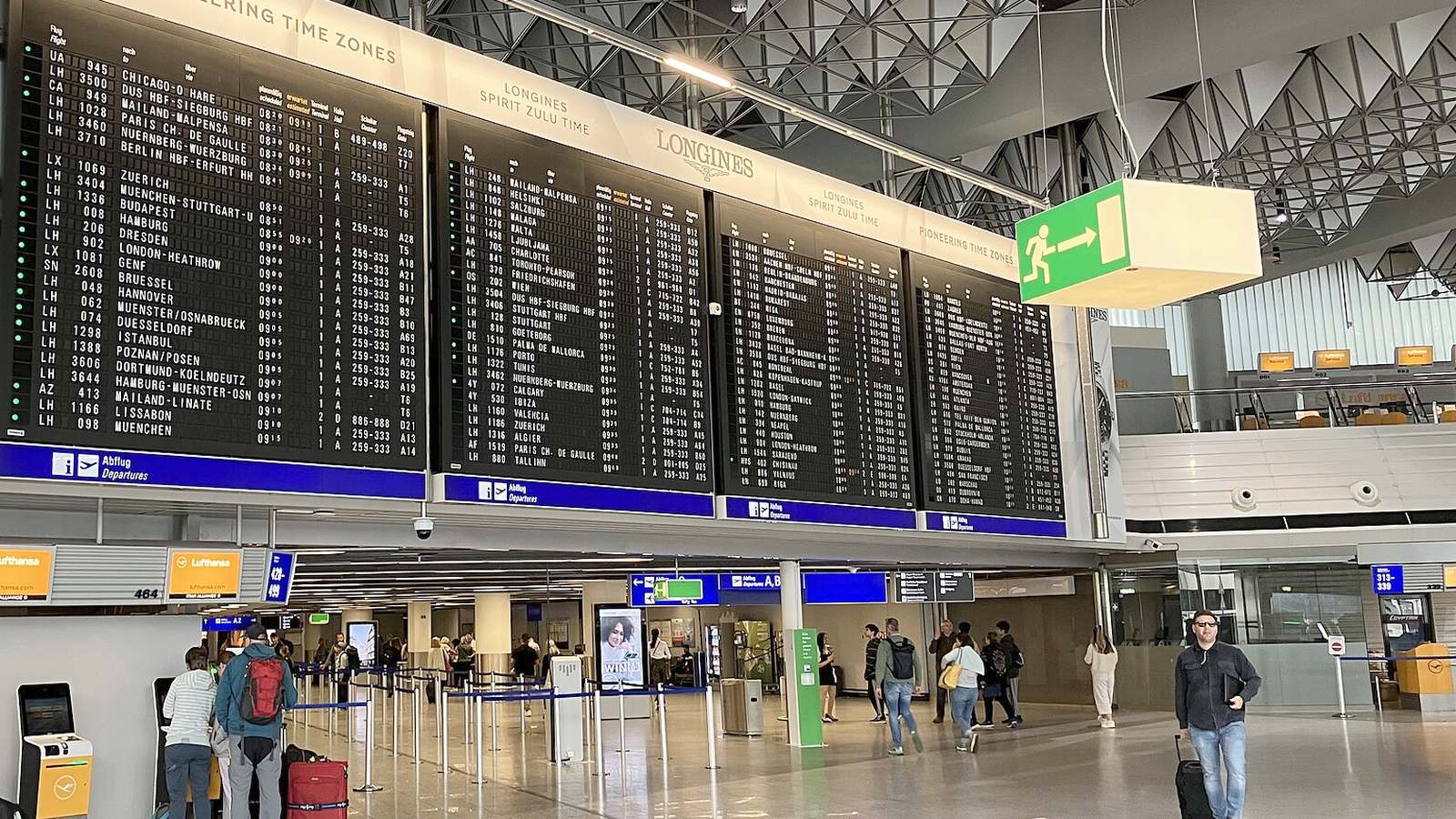
Departures board, Flughafen, Frankfurt am Main, July 2023 · Erica Fischer · CC BY 2.0 · cropped