EuroAirport is putting more than €157 million into the terminal experience, not into handling more aircraft. Swiss cantonal authorities and France’s civil aviation authority have approved a landside extension that would bring security checks into a central building and simplify the path through Basel Mulhouse Freiburg Airport.
The important date is not this winter. The airport’s October 27, 2026 notice puts the construction start in the third quarter of 2027 and expected completion toward the end of 2031, so this approval should not be mistaken for a new checkpoint opening or an immediate change to a booked flight.
For broader flight planning, Deep Arrival’s airline hub provides the wider carrier context. This development answers a different question from a route announcement: how the airport intends to reorganize the terminal that departing and arriving passengers use, rather than where airlines will fly next.
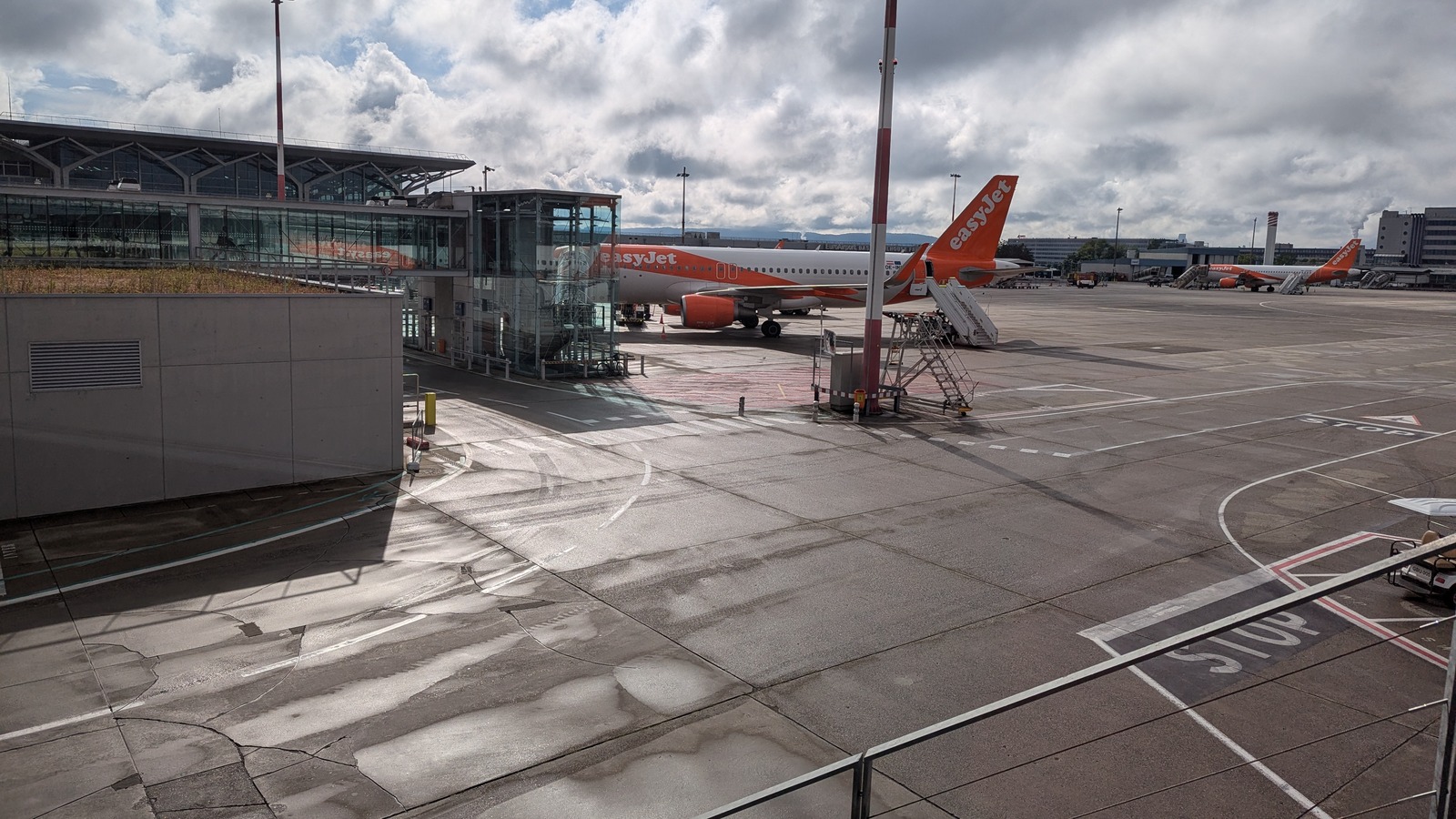
The photograph shows the EuroAirport apron and terminal on June 23, 2024, with an easyJet aircraft. It does not show the planned landside extension or its future central security building.
- New decision: Swiss cantonal and French DGAC approval for a landside terminal extension.
- Investment: Just over €157 million, funded by EuroAirport.
- Passenger change: Centralized security checks, simpler routes and reorganized terminal access.
- Not included: Additional capacity to handle aircraft.
A Bigger Terminal Project, Not a Bigger Flight Schedule
The terminal investment is part of more than €600 million planned across different infrastructure projects over seven years; that larger figure is not the price of this extension alone.
Swissinfo’s October 28 report, from Keystone-SDA, separately confirms the cantonal approval and airport financing. It also makes the operational boundary clear: the extension is meant to improve passenger handling, without adding aircraft-handling capacity.
That distinction matters when reading expansion headlines: better circulation inside a terminal is a different benefit from a new destination, extra weekly departures or a larger aircraft, and none of those airline changes follows automatically from this building decision. A traveler still needs the actual airline schedule to establish a flight option.
Security and Access Are the Passenger-Facing Changes
The physical plan combines a new building of roughly 14,000 square meters on the publicly accessible eastern facade with renovation of about 15,000 square meters in the existing terminal. Those are two different work areas, not a claim that the airport is adding 29,000 square meters of entirely new building.
Security checks would be brought together in a central building, while routes through the terminal would become simpler and more intuitive. The airport also plans to reorganize terminal access and prepare for a more appealing catering and duty-free offer, changes that affect the journey around the flight rather than the seat onboard.
The notice does not give a measured reduction in security waiting time or a new passenger screening rule. Centralizing a checkpoint is not, by itself, a reason to assume a different liquids allowance, skip an existing screening step or shorten the time allowed before departure.
Why the Airport Is Using Separate Modules
The airport’s EMT project explanation describes a modular approach, with infrastructure work divided into independent elements that can be prioritized as requirements change. It identifies peak-time congestion and increasingly complex passenger routes as reasons for the program.
For the reader, that means keeping the full program separate from this approved landside module. One announcement does not establish that every terminal improvement is being delivered on the same date, or that a smaller change noticed on a recent visit is evidence that the central security building has already opened.
The practical test will be the instructions attached to each phase: which entrance to use, where screening takes place and whether a normal path through the building changes.
What the 2027 to 2031 Timeline Means for Trips
For a trip this winter, the terminal approval is not a replacement for current airport wayfinding or the operating airline’s departure instructions. If the question is flight choice, the airport’s separate winter program is covered in our EuroAirport winter schedule report; its dates should not be mixed with the construction timetable.
| Your question | What this decision establishes |
|---|---|
| Is a new checkpoint open now? | No opening is announced; construction is planned from the third quarter of 2027. |
| Does the project add flights? | It does not add aircraft-handling capacity or establish an airline schedule. |
| Is the entire wider program priced at €157 million? | No. That figure covers this terminal extension, within a larger investment program. |
| Will my entrance change during construction? | Access is to be reorganized, but the notice does not supply phase-by-phase passenger instructions. |
Watch for the next concrete notice. A dated entrance, checkpoint or access instruction will matter more to an individual departure than the project total.
When is EuroAirport’s terminal work expected to finish?
Construction is scheduled from Q3 2027; completion is expected toward late 2031.
Will the extension increase aircraft capacity?
No. The stated focus is terminal quality and passenger handling, not additional capacity to handle aircraft.
Does this announce a new security rule for my next flight?
No. It describes a future centralized checkpoint layout, not a change to the screening rules passengers must follow now.
Image Credits
- Lead Photo
elisfkc2 · CC BY-SA 4.0 · cropped