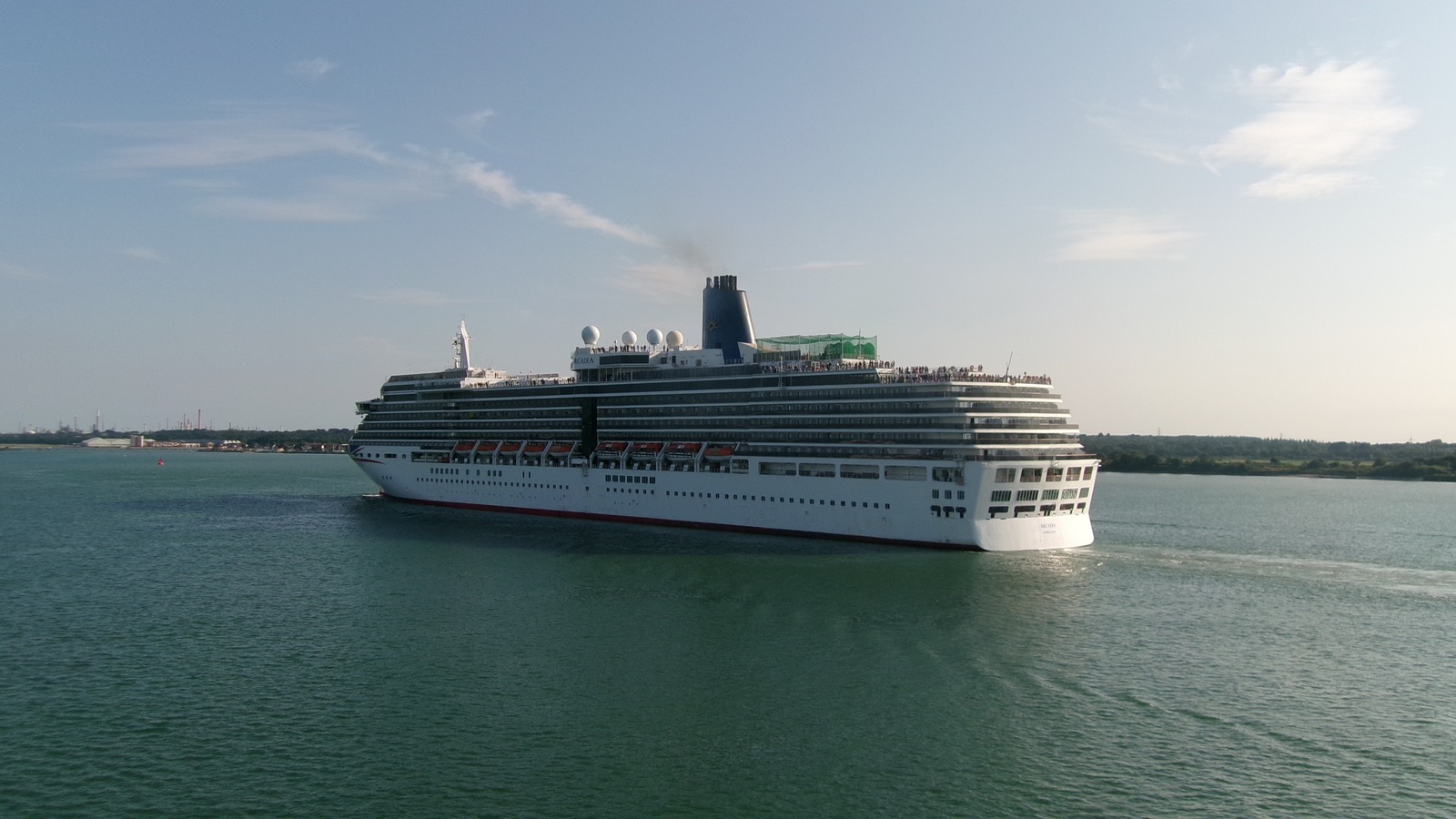
A cruise ship built for 2,500 passengers sits in Abu Dhabi right now with 59 people on board. No guests. No bartenders or cabin stewards. Just a skeleton crew of engineers and deck officers, keeping the lights on and the engines ready for a departure window that hasn’t opened yet.
Mein Schiff 4 is one of six vessels stuck in the Persian Gulf, unable to leave because the only way out, the Strait of Hormuz, has been effectively closed since late February. The conflict between the United States, Israel, and Iran turned one of the world’s busiest maritime corridors into one of its most dangerous, and cruise ships were caught on the wrong side of the door when it shut.
The International Maritime Organization confirmed that roughly 15,000 cruise passengers and 20,000 seafarers were stranded across the region at the peak of the crisis. Most of the passengers have since been flown home on charter flights and emergency airline arrangements. The ships, though, remain exactly where they were.
One Exit, No Way Through
Look at a map of the Persian Gulf and the problem becomes immediately clear. Dubai, Abu Dhabi, Doha. Every major cruise port in the region sits inside a body of water with a single maritime exit. The Strait of Hormuz is only 21 miles wide at its narrowest point. Under normal conditions, roughly 138 vessels pass through it daily. In late March, that number dropped to four.
Iran has deployed naval assets capable of laying mines, and reports indicate at least a dozen have been placed in and around the waterway. Iranian forces warned that any vessel attempting to transit could be attacked. Maritime insurers responded by pausing coverage for ships operating in the conflict zone. Without insurance, cruise lines cannot legally sail.
For cargo ships, the calculus involves cost and delay. For cruise ships, it involves thousands of civilians in an unarmored vessel. The threshold for acceptable risk is zero. So the ships stayed.
The Repositioning Problem
Stranding passengers was the immediate crisis. But the longer-term disruption is structural, and it reaches well beyond the Gulf.
Every year, the cruise industry runs on a seasonal migration. Ships spend the winter in warm-weather regions like the Caribbean, the Gulf, and Southeast Asia. In March and April, they reposition to Europe and Alaska for the summer. These are not optional voyages. They are the logistical backbone of the global cruise schedule. A ship that misses its repositioning window doesn’t just skip one sailing. It breaks the chain.
MSC Euribia, the largest of the six trapped ships at over 181,000 gross tons, is scheduled to begin a Northern Europe season from Kiel, Germany on May 2. It was supposed to spend these weeks sailing toward the Norwegian fjords. Instead, it has been docked in Dubai since February 27.
TUI Cruises has cancelled both of its ships’ repositioning voyages entirely. Mein Schiff 4’s 20-night sailing from Cape Town to Barcelona, which was set to begin April 11, is gone. Mein Schiff 5’s repositioning from Cape Town to Palma de Mallorca was scrapped weeks ago. TUI has now cancelled Mediterranean sailings well into late April, including itineraries through Greece, Turkey, and Malta that had nothing to do with the Gulf.
Celestyal Cruises, a Greek operator with its entire fleet trapped in the region, has cancelled its spring Mediterranean program. Sailings through the Aegean, the Adriatic, and the Greek islands scheduled for March and April are gone. The company has offered full refunds or future cruise credits.
Aroya Cruises, backed by Saudi Arabia, cancelled the remainder of its Arabian Gulf winter season outright.
Ghost Ships and the Waiting Game
The human scale of this is worth sitting with. TUI repatriated roughly 10,000 guests using 12 scheduled airline flights and 26 charter flights. MSC launched its own dedicated flight operation, chartering at least five aircraft to move close to 1,500 passengers out of Dubai.
Once the passengers were gone, the ships went quiet. TUI reduced Mein Schiff 4’s crew from over 1,000 to just 59, a 95 percent reduction. The remaining crew, led by Captain Jan Fortun, are engineers and navigation officers tasked with keeping critical systems alive so the ship can move the moment a safe transit window appears.
Vessel tracking services describe Mein Schiff 4 as “temporarily laid up.” That language, borrowed from commercial shipping, isn’t supposed to apply to a cruise ship in the middle of what should be its operating season. But there it is.
What This Means for Travelers
If you booked a repositioning cruise from the Gulf to Europe this spring, you already know your plans changed. But the ripple effect extends further than most travelers realize.
A ship that can’t leave the Gulf can’t start its European season. The voyages that follow, the Mediterranean loops, the Norwegian fjord itineraries, the Greek island sailings, all depend on that ship being physically present at its starting port. Unlike airlines, cruise lines cannot substitute capacity. A specific ship is tied to a specific itinerary and a specific port infrastructure. If it isn’t there, the sailing doesn’t happen.
The operators most affected, TUI, Celestyal, and Aroya, are mid-sized companies without the fleet depth to absorb a loss of multiple ships for weeks. Larger lines like Royal Caribbean and Carnival, which didn’t have vessels in the Gulf during the crisis, are unaffected for now. But the precedent matters.
The Gulf was an emerging winter cruise market. Cruise lines had been adding seasonal capacity to Dubai and Abu Dhabi for years, betting that the region’s luxury infrastructure and warm-weather appeal would make the Gulf a reliable alternative to the Caribbean. That bet was always a geopolitical wager, even if no one described it that way.
Six ships behind a closed strait is what it looks like when the wager doesn’t pay. The question cruise planners will be asking for years is whether the Gulf is a seasonal market worth the risk, or whether this month just answered that question for them.