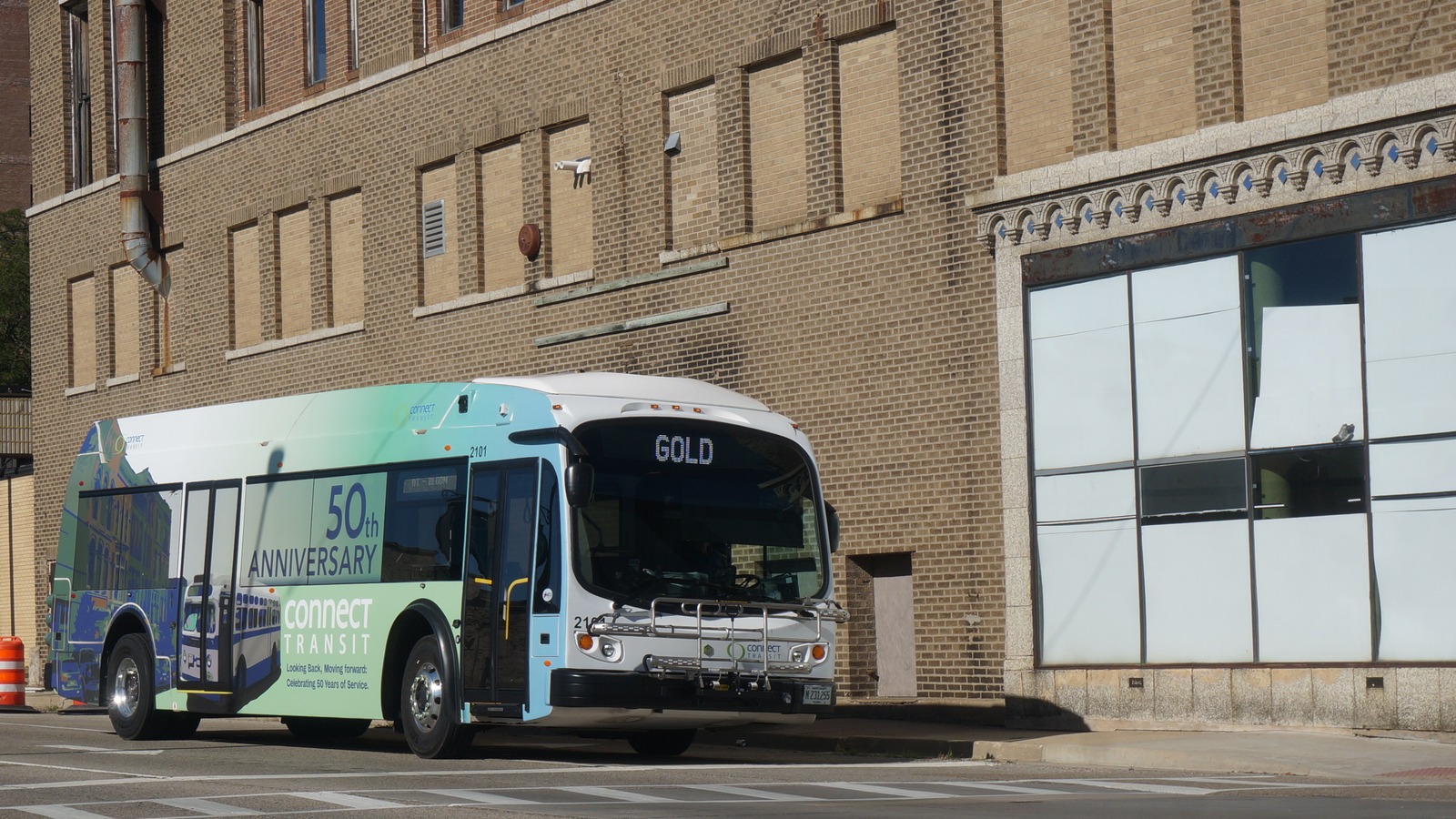
Photo: A Connect Transit bus in downtown Bloomington, Illinois, in September 2023. It illustrates the operator, not the new fare equipment.
Connect Transit replaced its old passes with a contactless payment system on October 1, 2026, keeping the regular fare at $1.25 but changing how riders receive transfers and fare caps. For visitors and repeat passengers in Bloomington and Normal, Illinois, the most important distinction is that cash paid on board does not qualify for either benefit.
That does not mean a rider needs a bank card or smartphone to save money. A reloadable Connect Ride card can be loaded with cash, while unused old passes can be exchanged for card credit during October; choosing the right payment method now matters more than buying a daily pass in advance.
- Change: Old daily, weekly, monthly and single ride passes stopped being accepted October 1.
- Fixed route and Flex caps: $3 daily, $10 Monday through Sunday, and $40 per calendar month.
- Cash on board: Exact change only, without transfers or fare capping.
- October action: Bring unused passes to Connect Transit for credit on an eligible new card.
What the $3 Fare Cap Actually Saves
The official contactless payment rules make the daily cap automatic when riders use the same eligible payment method throughout their journeys. Once a fixed route or Flex passenger reaches $3 in a day, further qualifying rides are at zero fare rather than another $1.25 each.
For example, three separately chargeable rides would cost $3.75 without the cap, compared with $3 using a qualifying method. Four would cost $5 without it; the capped total stays at $3, making the difference $2 for that particular pattern of travel.
These examples assume the rides are outside any free transfer window. Do not multiply every boarding by $1.25 when a transfer would already make the next boarding free, because that would overstate what the daily cap alone saves.
Two separately chargeable rides total $2.50, below the daily limit. For a simple out and back trip, the cap may not reduce the price at all, although an eligible payment method can still provide a transfer benefit if the journey requires changing buses.
The same system applies a $10 weekly limit from Monday through Sunday and a $40 limit within a calendar month. These are fixed periods, not seven or thirty rolling days beginning whenever you first tap, so a visitor crossing a week or month boundary should not assume one continuous allowance.
Keep the same payment method for all rides you want counted together. Switching between a Connect Ride card, a bank card and a phone wallet should not be treated as one shared fare account unless the operator expressly confirms otherwise.
Cash Is Accepted, but Reloading a Card Is Different
25News’ October 1 report confirms that the regular fare remains $1.25 and lists the new electronic options: contactless credit or debit cards, Apple Pay, Google Pay, the Umo app and reloadable Connect Ride cards. Cash remains an option, not a route to the capped fare.
The practical alternative for a cash user is to load a Connect Ride card before boarding. Connect Transit says those cards receive fare capping and transfers, so the distinction is between cash inserted into the farebox and value already loaded onto a supported card.
That is particularly useful for a visitor who does not want to install another app or depend on a charged phone. Check the current card and reload locations before setting off, rather than assuming every bus stop has somewhere to obtain a card.
Unused Passes Can Become Card Credit During October
Connect Transit’s current pass conversion instructions say to bring unused passes to the agency Monday through Friday, 8 a.m. to 5 p.m., during October 2026. The value can become credit on a Connect Ride, Discount or Mobility card, subject to the eligibility rules for the latter two.
The notice covers the old thirty day, seven day, one day and one ride passes. It is not a reason to throw away unused travel value, but it is a reason to stop relying on the old pass as a boarding credential.
Allow time for the office visit rather than leaving the exchange until a weekend departure. The published instructions give weekday hours, so a traveler arriving outside that window should arrange another valid payment method for immediate journeys.
Discount and Mobility passengers need the new photo ID cards issued by Connect Transit. Do not assume an older card or a discounted fare claim will work automatically in the replacement system; confirm the agency’s application and acceptance requirements before the trip.
| Your situation | What to do |
|---|---|
| Several separately chargeable fixed route rides in a day | Use one eligible payment method so spending can reach the $3 cap. |
| No bank card or smartphone | Consider a Connect Ride card loaded with cash before boarding. |
| Unused old pass | Visit Connect Transit during its October weekday conversion hours. |
| Connect Mobility passenger | Use the required new photo ID card and check Mobility’s separate rules. |
Transfers and Extra Passengers Need a Separate Check
Eligible electronic payment methods provide zero fare rides within the operator’s sixty minute transfer window. Use the same supported card or app when boarding again; cash payments on board do not include a transfer.
Connect Mobility is different: the operator lists a $40 calendar month cap but no transfers for that service. The fixed route and Flex daily and weekly limits should not be carried over to Mobility simply because the regular single ride fare is also $1.25.
The agency also warns against an accidental immediate second tap. That charges another passenger, and the additional passenger does not receive fare capping; someone paying for a companion should not assume both travelers share the first rider’s limit.
Before your first bus: Choose one supported payment method and check where to obtain or reload a card.
During October: Convert unused passes within the published weekday office hours.
Before estimating savings: Separate paid rides from transfers and check whether your trip crosses a weekly or monthly boundary.
Does cash qualify for Connect Transit’s $3 daily cap?
No. Cash paid on board requires exact change and does not include fare capping or transfers. A Connect Ride card loaded with cash is a different eligible payment option.
Can old Connect Transit passes still be used?
The old passes stopped being accepted October 1, 2026. Unused passes can be converted to eligible card credit at Connect Transit during October, Monday through Friday, 8 a.m. to 5 p.m.
What are the fixed route and Flex fare caps?
The limits are $3 per day, $10 from Monday through Sunday, and $40 per calendar month. Riders must use the same eligible payment method for their rides.
Does Connect Mobility offer the same transfers?
No. Connect Transit lists no transfers for Mobility and a separate $40 calendar month cap. Mobility riders need the new Connect Transit photo ID card.