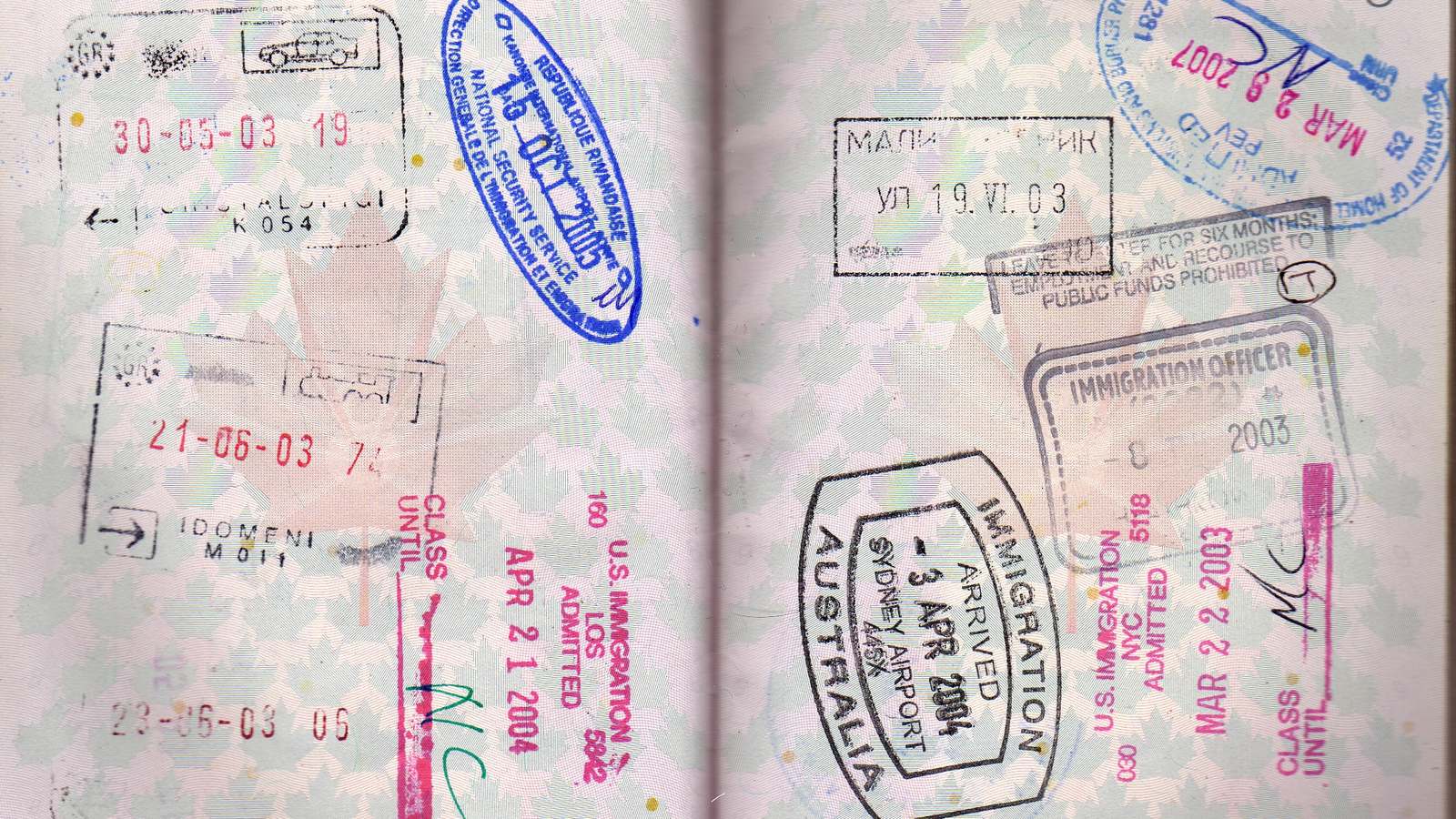
Stamps in Canadian passport (pages 8 to 9) · Jon Evans · CC BY 2.0 · edited
U.S. Customs and Border Protection (CBP) will stop routinely stamping passports when travellers are admitted at primary inspection, the first check at the border, according to a Carrier Liaison Program bulletin dated Thursday 1 October 2026, VisasNews reports. Travellers can still ask an officer for a stamp.
The change means your electronic Form I-94 becomes the main record of when you entered and how long you may stay, and immigration lawyers are advising visitors and visa holders to check it after every arrival, RJ Immigration Law says. The bulletin does not give a separate start date.
- What changes: no routine admission stamp at primary inspection.
- Still stamped: secondary inspection, immigrant visa processing and some other primary cases.
- On request: travellers can ask the CBP officer for a stamp.
- Proof of entry: the electronic I-94 record, on the I-94 website or the CBP Link app.
- ESTA rules: unchanged; Visa Waiver visitors still get up to 90 days.
CBP Passport Stamp Changes at the Border
CBP says ending routine stamping is part of its wider modernisation of border processing, which already includes automated forms, expanded mobile services and facial biometric comparison, and that it should cut both inspection times and costs, VisasNews reports. The agency has already moved most arrivals by air and sea from a paper I-94 to an electronic record, and its Simplified Arrival system uses facial comparison during primary inspection.
Officers may still stamp passports during secondary inspection, when a traveller is referred for extra checks, and in certain primary inspection cases, including immigrant visa processing. If you want a physical record of entry, ask the officer at the booth.
For frequent visitors, the visible difference is mostly cosmetic: a passport may fill up more slowly, and there is no ink record to point to. The legal record has been electronic for years, so a missing stamp does not mean you were not admitted, and it does not shorten or extend the stay CBP grants you at the border.
Checking Your I-94 After You Land
Your admission details, including your class of admission and the date you must leave by, are held in the electronic I-94. You can look it up and print it on the official CBP I-94 website or through the free CBP Link app, and use it whenever a government agency, school or employer asks for proof of lawful admission.
Check it within a few days of arrival. If the admit-until date, your name or your visa class is wrong, contact CBP to have it corrected, as VisasNews notes the agency advises. Errors are easier to fix early than when you are trying to leave or extend a stay.
What It Means for ESTA and Visa Holders
For visitors from the 42 Visa Waiver Program countries, nothing changes about the rules: you still need an approved ESTA before travelling and can stay up to 90 days for tourism or business. You may simply leave border control with no new stamp in your passport. The ESTA fee rises to $40.62 for applications from 16 October, as Deep Arrival reported.
Workers on visas such as TN, L-1 and E, including Canadians who enter without a visa foil, should not rely on a stamp as the main evidence of their status, RJ Immigration Law advises, and employers should ask staff to verify their electronic I-94 after each trip rather than checking passports.
Why Airline Booking Details Matter More
In the same bulletin, CBP reminded airlines that passenger data they send through the Advance Passenger Information System feeds directly into entry records and the I-94. Incorrect or late information can affect the record you see later, VisasNews reports. Make sure the name, date of birth and passport number on your booking match your passport exactly, and update them with the airline before you fly if anything has changed.
Keep a copy of your boarding pass and travel itinerary as well. Without a stamp, these and your I-94 printout are the simplest way to show when you arrived if a question comes up later.
| If you are | What to do |
|---|---|
| Visiting on an ESTA | Check your I-94 after arrival to confirm your admit-until date. |
| On a work or study visa | Save or print your I-94 after every entry. |
| Wanting a stamp | Ask the CBP officer at the booth. |
| Booking flights to the U.S. | Make sure booking details match your passport. |
No routine stamp. Most arrivals will leave border control without one.
I-94 is the record. Check it online or in the CBP Link app.
Stamps on request. Officers can still stamp if you ask.
Does CBP still stamp passports?
Not routinely at primary inspection. Stamps are still used in secondary inspection and some other cases, and you can ask for one.
How do I prove when I entered the United States?
Use your electronic I-94 record from the CBP I-94 website or the CBP Link app.
Does this change ESTA rules?
No. You still need an approved ESTA and can stay up to 90 days under the Visa Waiver Program.
What if my I-94 is wrong?
Contact CBP to have the record corrected, ideally soon after you arrive.