The Government of the Northwest Territories said on September 23, 2026, that territorial clocks will not fall back on Sunday, November 1, 2026. The new year-round standard is Northwest Territories Time at UTC-06:00. That is the hour when most of eastern Canada, and the United States, still turn clocks back one hour at 2 a.m. local, under the first-Sunday-in-November rule.
The traveler decision is which clock to trust on a connection, a hotel check-in, or a border drive that morning. The GNWT notice is the current territorial rule. Deep Arrival’s US November 1 fall-back post covers the American side of the same weekend. Do not assume Yellowknife, Toronto, and New York share one overnight shift.
- When: Sunday, November 1, 2026, at 2 a.m. local where clocks still change.
- NWT: No change. Permanent Northwest Territories Time, UTC-06:00, after August 21, 2026, regulations.
- Still falling back: NRC’s 2020-pattern table still lists Newfoundland through Manitoba, Ontario, and Quebec as changing that morning.
- Already year-round: Yukon stays on UTC-07:00; most of Saskatchewan stays on Central Standard Time.
- Next step: Recheck every November 1 itinerary that crosses a provincial or US border.
NWT Stops Changing Clocks on November 1
Yellowknife’s release is dated and specific. Seasonal time change ends on November 1, 2026. After that date the territory observes Northwest Territories Time, UTC-06:00, all year, which the GNWT describes as keeping Mountain Daylight Time year-round. Regulations came into force on August 21, 2026, under 2022 amendments to the Interpretation Act.
Premier R.J. Simpson said residents had asked to stop changing clocks twice a year. A 2022 survey of more than 3,500 residents found over 87 percent supported ending the twice-yearly shift. Phones on current software should pick up the zone once vendors ship it; older Windows machines may need a manual update at GNWT.ca/time.
The notice says NWT is making the change alongside Alberta so the two stay aligned, and that NWT time will now match both Alberta and Saskatchewan. Treat that as the territorial government’s stated reason. If you fly Calgary or Edmonton, confirm Alberta’s posted rule with the province or the airport, then match it to the NWT clock.
Most Eastern Provinces Still Fall Back at 2 a.m.
Canada’s National Research Council time-zone page still states the North American pattern in force since 2007: clocks that follow that pattern spring forward on the second Sunday in March and fall back on the first Sunday of November. The first Sunday of November 2026 is November 1. The NRC table, which it says has been in effect since 2020, still lists Newfoundland, Nova Scotia, Prince Edward Island, New Brunswick, Quebec, Ontario, and Manitoba as changing at 02:00 local.
Read the date on that page. It was last modified on November 1, 2025, and it still shows the Northwest Territories on the old March-to-November change pattern. The GNWT notice of September 23, 2026, is the later territorial instrument. Until NRC reprints the table, use the GNWT URL for Yellowknife and the NRC URL for the provinces that still publish a 2 a.m. fall-back.
The US rule matches the old Canadian pattern. NIST’s 2026 daylight saving page says US daylight time runs from March 8 at 2 a.m. local to November 1 at 2 a.m. local. A New York to Toronto flight that morning still has both ends falling back. A Yellowknife to Toronto flight does not.
Yukon, Saskatchewan, and Local Exceptions Stay Put
The NRC footnotes catch bookings that are not “most of Canada.” Yukon has used UTC-07:00, Yukon Standard Time, all year since 2020. Most of Saskatchewan uses Central Standard Time all year. Areas around Lloydminster are in the Mountain zone and, on the 2025 NRC footnote, change at 2 a.m. local as Alberta does. Confirm Lloydminster against Alberta’s current posted rule.
Some areas of Quebec east of 63 degrees west longitude use Atlantic Time for all or part of the year. Ontario west of 90 degrees west is on Central Time and still changes at 2 a.m. local on the NRC table. Nunavut spans three zones, all changing at 02:00 local on that table, except Southampton Island, which remains on Eastern Standard Time all year. Municipal exceptions can sit inside a province that otherwise changes; check the town on a driving route, not only the provincial row.
Cross-Border Flights Meet a Split US Deadline
The useful test is the city pair, not the word “Canada.” Toronto Pearson, Montreal, Ottawa, Halifax, and St. John’s still sit on the NRC fall-back list. Yellowknife does not. A US itinerary into those eastern airports still lines up with NIST’s November 1, 2 a.m. local end of daylight time. A US itinerary into Yellowknife does not pick up an extra hour on the Canadian side.
Hotels print local time. If you land in Toronto after the fall-back, that city repeated 1 o’clock. Yellowknife did not. Build the buffer on the end that still changes. Night trains and airport coaches that publish “2 a.m. Sunday” need the same check: which province printed the timetable? If a connection is under 90 minutes and only one airport fell back, rebook that itinerary first.
Devices and Tickets Need a Manual Check
The GNWT warns that some older devices and Windows computers will not pick up Northwest Territories Time automatically. Travelers who keep a second phone in airplane mode, a rental car clock, or a paper itinerary should set those by hand on Saturday night, November 1’s eve, using the city they will be in at 2 a.m. A camera or a parking meter that is still on last year’s zone is how people miss a boarding group.
Airlines, rails, and hotels will not reprint every ticket. If a confirmation email still says “arrives 1:55 a.m.,” ask whether that stamp is local time after the change. Keep the GNWT URL with any Yellowknife booking and the NRC URL with any Toronto, Montreal, or Halifax booking so a later table update is easy to compare. A later provincial revocation or a later NRC reprint belongs as an update to this post, not as a second Canada-clocks URL.
| If you… | What to do |
|---|---|
| Fly or stay in Toronto, Montreal, Ottawa, Halifax, or St. John’s on November 1 | Expect a 2 a.m. local fall-back on the NRC 2020-pattern table. Recheck hotel and transfer times. |
| Fly or stay in Yellowknife on November 1 | Do not turn clocks back. GNWT says NWT stays on UTC-06:00 year-round. |
| Connect Yellowknife to an eastern Canadian or US city that morning | Treat it as a split: NWT did not fall back; the other airport likely did. Add buffer. |
| Drive from the US into Ontario or Quebec | Both sides still fall back at 2 a.m. local per NIST and the NRC table. Watch the extra hour, not a zone skip. |
November 1, 2026, at 2 a.m. local is the change hour where clocks still move. Write the city name on the alarm, not only the hour.
The GNWT September 23 notice is the NWT gate. Yellowknife does not fall back. Confirm Alberta on Alberta’s own page if Calgary or Edmonton is on the ticket.
The NRC page date of November 1, 2025, is the watch item. It still lists NWT as changing. Prefer the later territorial notice until NRC reprints the table.
When do clocks change in Canada in 2026?
Where the North American pattern still applies, they fall back at 2 a.m. local on Sunday, November 1, 2026, the first Sunday in November.
Does the Northwest Territories change clocks on November 1?
No. The GNWT said on September 23, 2026, that NWT clocks stay on Northwest Territories Time, UTC-06:00, year-round from that date.
Does Saskatchewan fall back on November 1, 2026?
Most of Saskatchewan stays on Central Standard Time all year, per the NRC footnote. Lloydminster follows the Mountain pattern used in Alberta.
Does Yukon change clocks in November 2026?
No. NRC says Yukon has used UTC-07:00, Yukon Standard Time, all year since 2020.
Do US clocks fall back on the same morning?
Yes. NIST says US daylight time ends November 1, 2026, at 2 a.m. local, except in places that do not observe DST, such as most of Arizona and Hawaii.
Why does the NRC table still show NWT changing?
That page was last modified November 1, 2025. The GNWT notice of September 23, 2026, is the later territorial rule for Yellowknife.
Image Credits
- Lead Photo
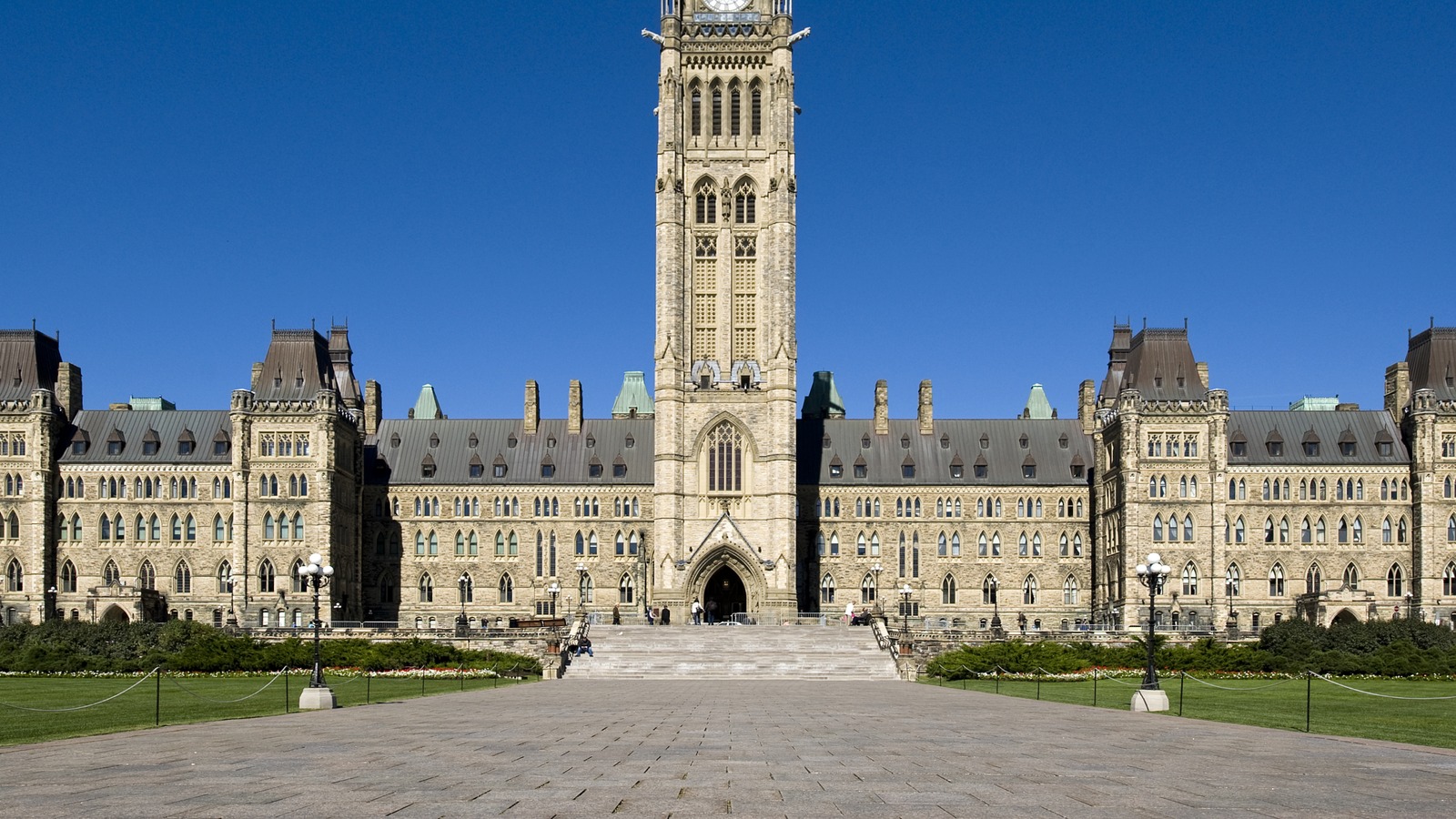
Centre Block – Parliament Hill · Saffron Blaze · CC BY-SA 3.0 · cropped