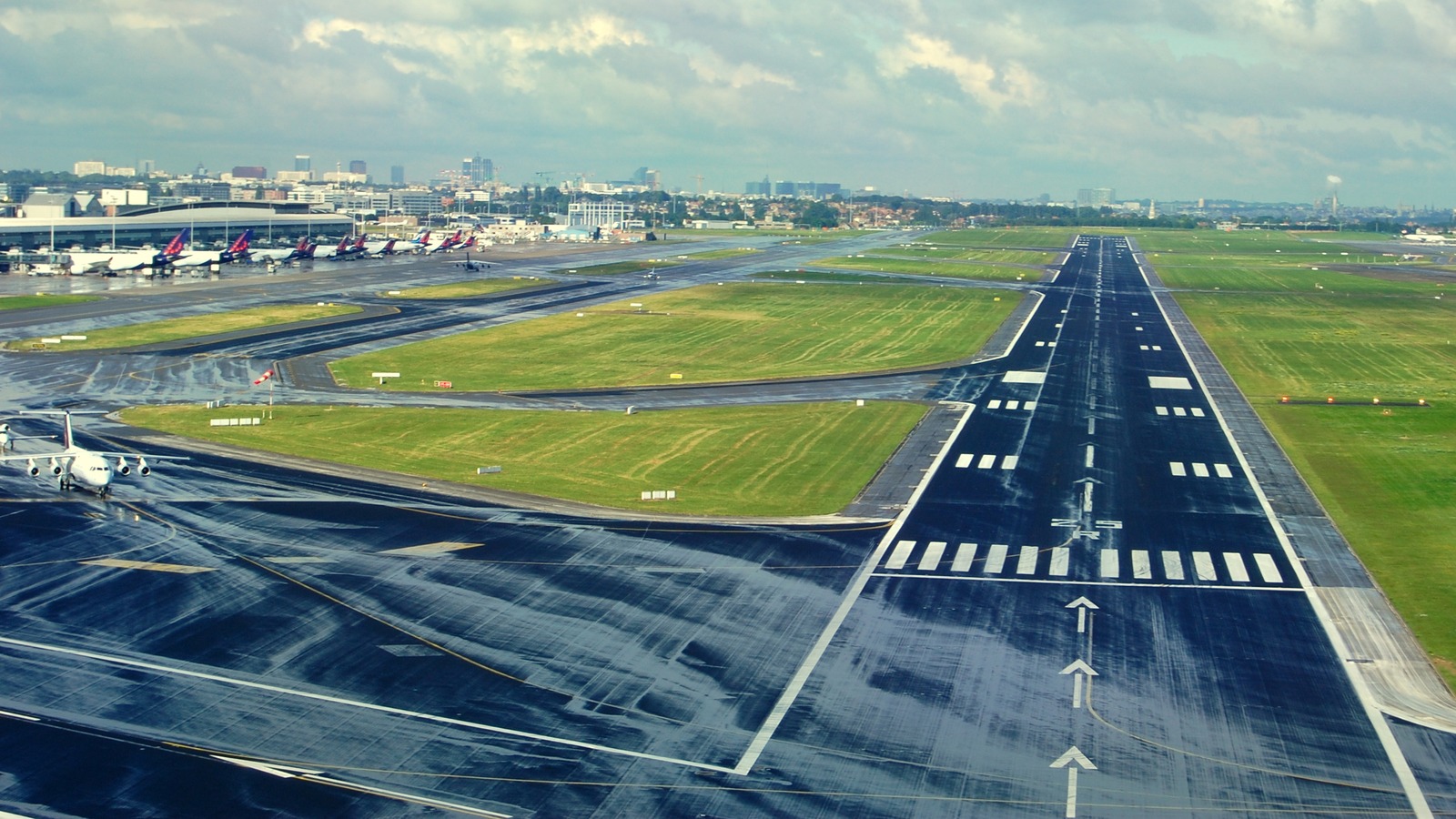
Brussels Airport Runway 25 R · Lucash · CC BY-SA 3.0 · cropped
Belgian air navigation provider Skeyes confirmed a drone near Brussels Airport on the evening of Saturday, September 12, 2026, the second consecutive night of drone activity over the airport. The sighting came at around 20:00 local time, and unlike the Friday night incident, this one left a technical trace: Skeyes says its drone detection equipment recorded the intrusion digitally, Aviation24.be reported.
If you are flying through Brussels this weekend, check your flight status before you leave for the airport and build in extra time. Friday night’s sighting halted landings for about 25 minutes and forced three inbound flights to divert, as reported in Brussels Airport Drone Diverts Three Flights September 11, so a second night of activity means further short notice holds remain possible.
- What happened: A drone was detected near Brussels Airport on Saturday, September 12, 2026, at around 20:00 local time.
- Why it matters: It is the second consecutive evening with drone activity, and the first case with a digital detection record from Skeyes equipment.
- Official source: Skeyes spokesman Kurt Verwilligen confirmed the incident to Belgian media via Aviation24.be.
- Traveler action: Check your flight status before leaving, keep airline notifications on, and allow buffer time at the airport.
Saturday September 12 Sighting Logged at 20:00
The new incident occurred at around 20:00 local time on Saturday evening, according to Skeyes spokesman Kurt Verwilligen. He confirmed the sighting plainly: there was indeed another drone incident near the airport. The timing matters because it puts drone activity over Brussels Airport on two running evenings, Friday and Saturday, after months without a comparable pair of consecutive events at the country’s busiest airport.
The decisive difference from Friday is the evidence. On Friday evening the drone was observed visually by an air traffic control supervisor and by Brussels Airport security staff. On Saturday the visual observation was backed by equipment. Verwilligen said the team not only saw the drone visually but also holds a digital registration of the incident, produced with the organization’s detection equipment. That technical record gives investigators something concrete to work with for the first time in this two day sequence.
Skeyes has not released details about the drone itself. Its type, flight characteristics, and who may have been operating it all remain unknown, and an investigation is underway. It is also not yet known whether Saturday’s drone was flown by the same operator or is otherwise connected to the drone reported near the airport on Friday. Xinhua reporting on September 12 independently confirmed the same core facts: a second incident in two days, detection both visually and by monitoring equipment, and an origin that remains unknown.
Friday September 11 Set the Pattern: 25 Minutes, 3 Diversions
Friday’s incident explains why Saturday’s confirmation carries operational weight. The first report on Friday came at about 21:45 local time, and landings were suspended until about 22:10, a halt of roughly 25 minutes. Arriving flights circled over the city while the runway stood empty, and three inbound aircraft gave up their approaches and diverted to Ostend and Liege.
Friday also carried an unusual admission. Early coverage left room for doubt about whether anything had actually been detected, with a first impression in some reports that the drone had never been found. Skeyes closed that gap the same evening: Verwilligen confirmed a drone was genuinely observed, naming two independent sets of witnesses in the tower and on the airport security team. Saturday’s digital record now removes even that residual doubt for the second night.
Skeyes Procedure Freezes Traffic Until 30 Minutes After Each Sighting
The standing Skeyes drone procedure is the mechanism travelers feel. When a serious sighting is confirmed, traffic at the affected runway stops and stays stopped until 30 minutes after the last sighting, a rule Reuters confirmed with the Skeyes spokesman after Friday’s disruption. On Friday that produced about a half hour of disruption from a single sighting window.
The procedure is deliberately conservative: controllers must verify that no further unauthorized overflight is underway before reopening. That means every confirmed sighting, even one that resolves without diversions, costs the airport a block of arrivals capacity and sends delay ripples through the evening bank of departures. With sightings on two consecutive evenings, travelers should treat further short holds as plausible rather than exceptional.
Drone operations near the airport are otherwise tightly restricted. Operators must register, plan flights in advance, and obtain authorization through Belgium’s DAA Planner system before flying in controlled airspace around the site. An unidentified craft inside that airspace therefore triggers the full safety response by default, regardless of its size or apparent intent.
What Brussels Travelers Should Do on September 13 and 14
The practical risk is concentrated in the evening hours, when both sightings occurred. If your flight departs or lands at Brussels Airport on September 13 or 14, check its status with your airline before leaving for the airport, and check again on arrival at the terminal. Short notice holds do not always appear in schedules until controllers act, so a flight that looks normal in the morning can still pick up an evening delay.
Allow more buffer than usual. Friday’s 25 minute runway halt plus the recovery of stacked arrivals stretched the disruption well beyond the suspension itself, and diverted passengers needed rebooking. Keep your airline’s app notifications switched on, keep your booking reference handy, and keep receipts for any extra spending if your journey is disrupted, since documented costs are far easier to sort out afterward than undocumented ones.
Connecting passengers face the sharpest edge. A 30 minute arrival hold can erase a tight connection, so travelers connecting through Brussels should confirm backup options with their airline in advance and know the next departure to their final destination. If a misconnection looks likely, speak to airline staff before the connection closes rather than after, when rebooking queues are longest.
Second Night Sharpens the Security Question
Two consecutive evenings change the character of the story from an isolated sighting to a pattern that investigators must explain. Belgium has recent history with airport drone shutdowns: Brussels Airport was temporarily halted by drone sightings in November 2025, with Liege Airport affected around the same period, and Reuters noted the Friday sighting came almost a year after a string of similar sightings that caused major concern in the country.
For now officials have not linked the two September nights to each other or to any earlier wave, and they have declined to speculate about the operator. The digital registration from Saturday is therefore doubly significant: it is both the first technical evidence in the current sequence and the starting point for an investigation that must determine whether Belgium faces a repeat visitor or two unrelated flights. Travelers need not follow that inquiry closely, but they should keep checking flight status nightly until the sequence clearly ends.
| If you… | What to do |
|---|---|
| Fly from Brussels on September 13 or 14 | Check your flight status before leaving, and recheck at the terminal given the September 12 second sighting. |
| Land at Brussels in the evening | Expect possible short holding and allow buffer for onward trains, pickups, or hotel check in times. |
| Connect through Brussels with under 90 minutes | Confirm backup connections with your airline now, since a 30 minute arrival hold can erase a tight transfer. |
| Already had a September 11 or 12 flight disrupted | Keep booking references and spending receipts together so any claim or rebooking is documented. |
September 13 and 14 departures are the first gate. Recheck your flight status the evening before and the morning of travel, because both sightings happened in the evening.
The next confirmed Skeyes statement is the second gate. Watch for word on the investigation or a third evening of activity before assuming the pattern has ended.
Any new sighting restarts the 30 minute clock. Each confirmed drone freezes runway traffic until half an hour after the last sighting, so one evening report can cascade into diversions.
Was there really a drone near Brussels Airport on September 12?
Yes. Skeyes spokesman Kurt Verwilligen confirmed a drone incident at around 20:00 local time, and this time the organization’s detection equipment produced a digital record alongside the visual sighting.
How is the September 12 sighting different from September 11?
Friday’s drone was confirmed by eyewitnesses in the tower and airport security. Saturday’s was also captured by detection equipment, giving investigators their first technical evidence, and it marks a second consecutive evening of activity.
Were flights diverted on September 12?
Skeyes has not released operational impact details for Saturday. On Friday, landings stopped for about 25 minutes and three inbound flights diverted, which shows what a single sighting can cost travelers.
Should I still fly through Brussels this weekend?
Yes, with precautions. Check your flight status before leaving, keep airline notifications on, allow extra buffer, and have a backup plan if you connect through Brussels on a tight transfer.
Who is investigating the drone flights?
Skeyes confirmed an investigation is underway. The drone’s type and operator remain unknown, and officials have not said whether the Friday and Saturday incidents are connected.