Pi.1415926535 · CC BY-SA 4.0 · cropped
On September 8, 2026, BART's September 8 update reported a 67 percent decline in crimes against riders per million trips between the end of 2024 and the latest quarter. Ridership rose over that span, so the figure is a rate, not a count of incidents, and it does not mean an individual rider's risk fell by 67 percent. For visitors weighing BART against other options, the result speaks to how station entry is being managed.
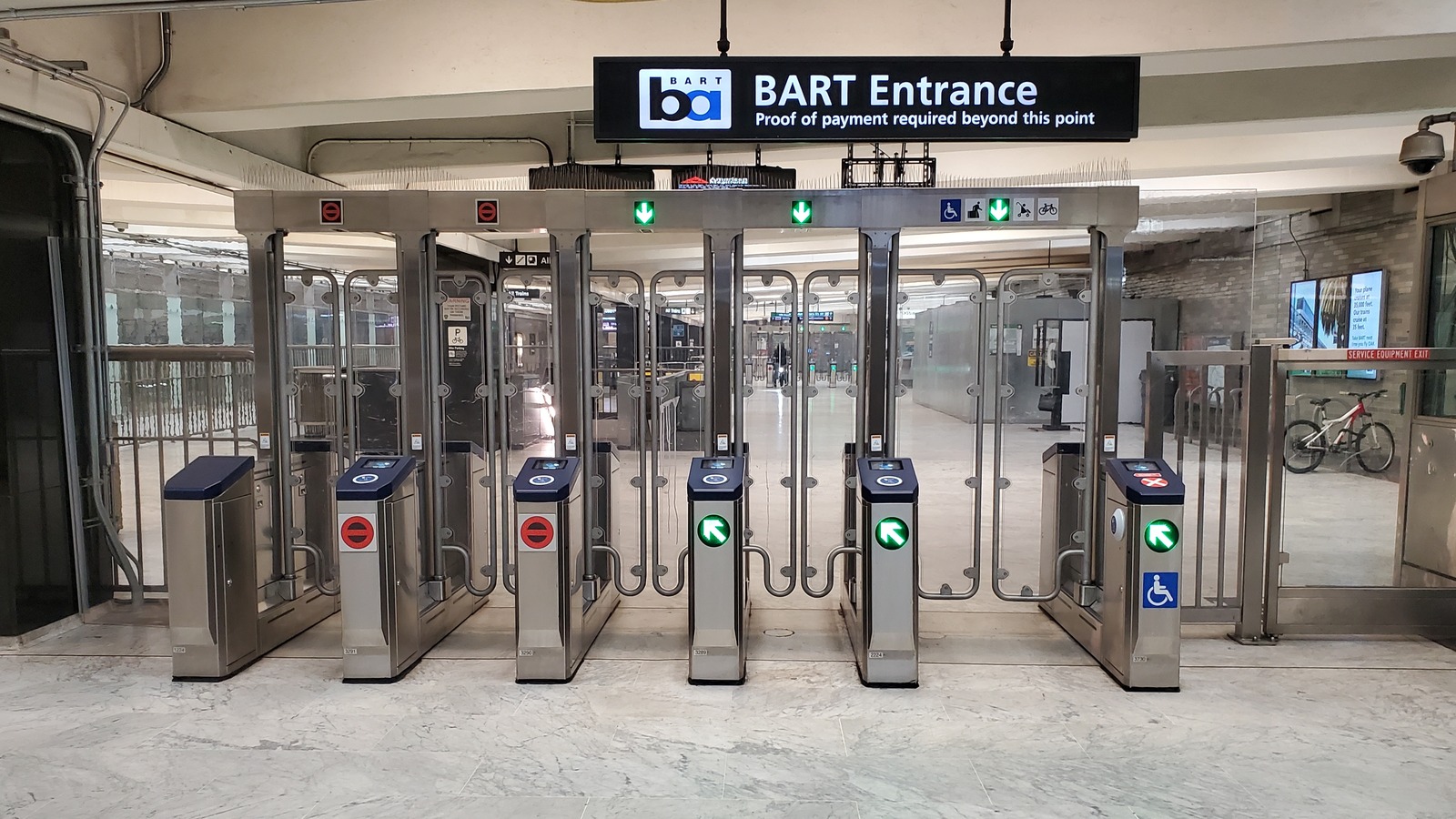
The same update says BART Police and safety-related delays fell 47 percent, a narrower category than all train delays, and marks one year since Next Generation Fare Gates reached all 50 stations. Gate hardware, accessibility and reliability shape whether BART suits a downtown stop or an airport run, and they are the parts of the system a rider actually meets.
- Main result: A 67 percent drop in crimes against riders per million trips, comparing the end of 2024 with the latest quarter, while ridership rose.
- Also reported: Police and safety-related delays fell 47 percent, a narrower category than all train delays.
- Installations: All 50 stations have Next Generation Fare Gates; final listed station Milpitas completed August 27, 2025.
- Revenue estimate: About $10 million in added annual revenue from less fare evasion, an early agency estimate, not audited cash.
- Capital funding: $90 million for the gate project: $16 million federal, $17 million state and $57 million local.
What the 67 Percent Figure Measures
The 67 percent figure covers crimes against riders measured per million trips, with ridership rising across the comparison. Because the denominator grew, the rate can fall even if the raw number of incidents moves differently. The metric also spans rider-directed crimes only, not every offense recorded in or around stations.
The agency separately reported 47 percent fewer BART Police and safety-related delays over the same period. That category covers delays tied to police activity and safety responses, not mechanical failures or every service interruption. Riders should treat the two figures as separate measures rather than a single service score.
The September 2026 announcement is a performance report on an installed system, not a new rollout. West Oakland's prototype opened December 28, 2023, and Milpitas, the final listed station, completed August 27, 2025, months ahead of the end-of-2025 deadline. Riders had been passing through the new arrays well before the results were published.
BART Police Chief Kevin Franklin says that as reports of fare evasion drop, it frees his team to respond more rapidly to emergencies. That is his stated operational explanation, not a measured response-time improvement. The same release credits new gates and high-visibility patrols on trains and in stations without giving a quantified change.
Why Station Entry and Accessibility Matter
Station entry is the first test of any transit trip, and the new hardware changes it physically. BART describes the whole array, meaning the gate, its console and the integrated barrier together, as at least 72 inches tall. The clear swing barriers are built to resist pushing, jumping and crawling.
BART's fare-gate project page says wide accessible gates are available at every station. It says 3D sensors identify wheelchairs, bikes, strollers and luggage so the barrier holds open longer, with LED lighting on barriers and pathways. These are designed features, not a guarantee that every pass will be seamless.
Travelers with luggage or a bike should aim for the wide accessible gate rather than a standard lane. Downtown San Francisco stations and the airport stations are among completed locations, and SFO's gates finished October 26, 2024, with the Oakland Airport Connector's on September 20, 2024. Those are installation dates, not new passenger services.
One practical change is easy to miss. The new readers do not calculate or display Clipper card balances at the gate, because balances are calculated in the Clipper back office. Riders can check a physical card at BART vending machines or a digital card in a phone wallet before entering.
What BART Credits and What the Data Cannot Prove
The agency credits new gates and visible patrols together as layers of security. Its public release does not isolate the causal effect of gates from policing or other changes, so the reported improvements are observational before-and-after results. They show association and an agency interpretation rather than a controlled test of gate hardware alone.
At West Oakland, the prototype trial compared three barrier builds: polycarbonate alone, polycarbonate framed with metal, and polycarbonate with a perforated metal insert. BART selected the metal-framed polycarbonate for the systemwide array, a design decision recorded on BART's fare-gate project page alongside the board's April 13, 2023 award to STraffic America of up to $47 million for implementation, part of the $90 million overall gate budget.
KQED's reporting added detail from the Powell Street announcement: the crime-rate comparison spans December 2024 to June 2026, and some evaders follow paying riders through gates. Officials described faster gate closing and planned additional sensors in response. The broadcaster also reported a 91 percent customer-satisfaction result, which BART's communications chief said comes from employees randomly interviewing riders on trains, not a poll of every Bay Area resident.
The agency is testing stronger motor gear systems at Coliseum and Pittsburg Center, a two-station pilot rather than a systemwide upgrade. In testing, gates fitted with those motors withstood 10,000 repeated impacts of roughly 926 pounds. What the results cannot establish is how much of the reported improvement comes from hardware, patrols or other changes happening at the same time.
Fare Evasion, Revenue and the Operating Gap
BART says the proportion of surveyed riders witnessing fare evasion fell 60 percent. Its early estimate is about $10 million in additional annual revenue through less fare evasion. That figure is an estimate, not an audited cash total, so it should be read as a projection rather than money already counted.
The gate project lists $90 million secured: $16 million federal, $17 million state and $57 million local. That is one-time capital funding for construction, not recurring operating money for daily service. The $10 million annual estimate and the $90 million capital total address different parts of the agency's finances and do not form a payback calculation.
KQED reported an up-to-$400 million structural deficit and warned of possible service cuts. A warning is distinct from an enacted timetable, and the roughly $10 million in estimated annual fare recovery is an early projection, not audited cash against an operating gap.
Deep Arrival's things to do in San Francisco guide is an optional way to choose city stops. Separately, BART recorded a 961-hour reduction in vandalism, graffiti, breakage and unusual cleanup work in paid station areas during six months after installation, a figure that explicitly excludes gate maintenance. It measures station upkeep rather than a crime total or a gate-repair saving.
- Motor pilot: The stronger-motor pilot covers Coliseum and Pittsburg Center only, not the full system.
- Planned sensors: Officials described faster gate closing and planned additional sensors after some evaders followed paying riders through gates, so entry arrangements may keep changing.
- Accessibility and feedback: BART says wide accessible gates are available at every station, and riders can send feedback through the agency's comment form. The new gates are designed to read wheelchairs, bikes, strollers and luggage, though that describes intended features rather than guaranteed performance.
- Clipper balances: New gate readers do not calculate or display card balances, which are handled in the Clipper back office. Riders can check a physical card at BART vending machines or a digital card in a phone wallet.