
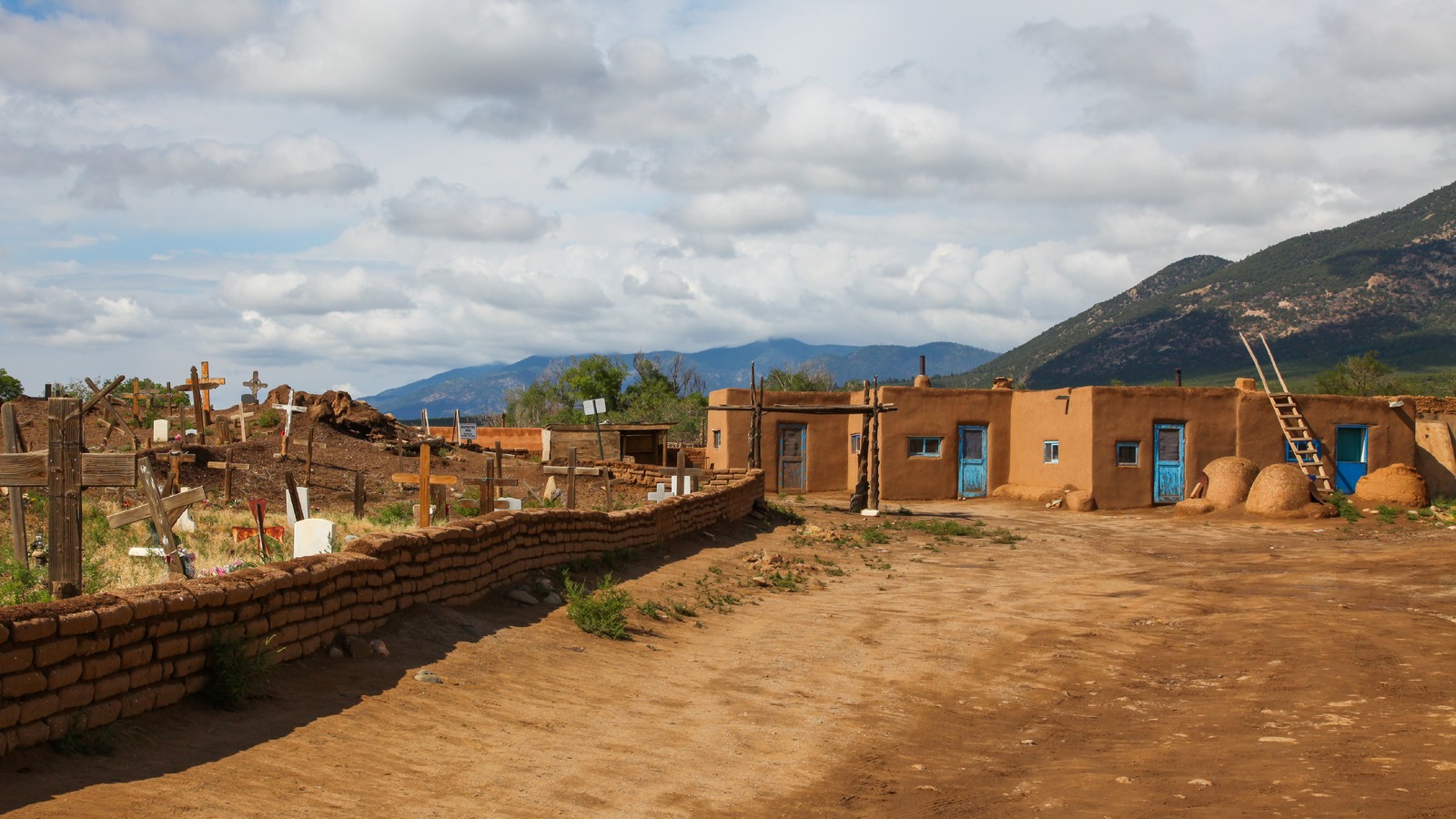
Taos packs a thousand year old pueblo, a Spanish colonial plaza and the most concentrated art colony in the Southwest into a valley you can cross in fifteen minutes, then hangs an 800 foot gorge off its western edge and a 12,000 foot ski mountain off its northern one. The trip that works here gives the walkable downtown and its cluster of artist house museums one full day and puts the pueblo, the gorge and the west mesa on another, because the two halves pull in opposite directions.
The top 15, ranked
Ranked by how consistently each pick appears across official Taos sources, the local destination marketing organization, and recent independent roundups.
- Top pick
1Best for Living history · #1 of 15
Taos Pueblo
Historic SiteNorth of town and the ski valleyOpen to visitors during daylight for most of the year, with ceremonial closures through the year and a longer closure in late winterTicketedThe multistory adobe house blocks at the foot of Taos Mountain have been lived in for roughly a thousand years, which makes this the only living Native American community carrying both UNESCO World Heritage status and National Historic Landmark designation. Families still occupy the historic core without electricity or running water, and visitors walk the plaza between the two great houses, the creek that supplies it and the ruined walls of the first mission church.
Local tipThis is a private community rather than a public park, so pay at the entrance station, stay on the plaza and out of doorways, and treat every posted limit on photography and closed ground as absolute.
- Top pick
2Best for Views · #2 of 15
Rio Grande Gorge Bridge
Neighborhood LandmarkThe gorge and the west mesaA public highway crossing open at all hours, with the walkways and rim trail best used in daylightFreeEight miles west of town on US 64, this steel deck truss carries the highway 650 feet above the Rio Grande and was the second highest span on the federal highway system when it opened in 1965. Walkways run along both sides out to viewing bays at the middle, and a rest area on the west end adds a rim trail and a small market of local vendors within a short walk of the parking.
Local tipPark in the west side lot and walk out rather than stopping on the bridge itself, and keep a hand on hats and phones because the updraft through the gorge is fierce.
- Top pick
3Best for Architecture · #3 of 15
San Francisco de Asis Church
Historic SiteRanchos de Taos and the south sideOpen to visitors during the day outside Mass and parish events, on a shorter pattern in winterDonation suggestedThe adobe mission church on the plaza at Ranchos de Taos, four miles south of the center, is best known from behind, where huge sculpted buttresses brace the apse in a form Georgia O'Keeffe painted and Ansel Adams photographed. It has served this parish since the early 1800s and is still an active church, replastered by hand each summer by families who have done that work for generations.
Local tipWalk around to the rear of the building before you go in, because the buttressed apse rather than the front facade is the shape that made the church famous.
-
4Best for Wandering · #4 of 15
Taos Plaza and the historic downtown
Neighborhood LandmarkThe Plaza and downtown TaosAn open public square with no gates or ticketing, busiest in the late afternoonFreeLaid out as a fortified Spanish quadrangle in the 1790s, the plaza still works as the center of town, a shaded square ringed by portals, galleries and shops. Most of the buildings around it date from a rebuild after fires in the 1930s, and the three short streets that meet here, Ledoux, Bent and Kit Carson, carry most of what a visitor actually comes to Taos to see.
Local tipLeave the car in a municipal lot a block off the square and cover Ledoux Street, Bent Street and Kit Carson Road on foot, because the whole downtown fits inside a few blocks.
-
5Best for Art · #5 of 15
Millicent Rogers Museum
MuseumNorth of town and the ski valleyOpen most days through the middle of the day, with one weekday closure and a short list of holiday closingsTicketedFour miles north of the plaza, this museum grew out of the personal collection of a Standard Oil heiress who settled in Taos in the 1940s and bought Native and Hispanic work at a time when few outsiders took it seriously. The holdings now run to thousands of objects across jewelry, pottery, weaving and santos, including a deep group of Maria Martinez blackware from San Ildefonso Pueblo.
Local tipThe jewelry and pottery rooms reward slow looking, so budget more time than the modest building suggests from the parking lot.
-
6Best for Mountains · #6 of 15
Taos Ski Valley
ParkNorth of town and the ski valleyA winter ski season running roughly from late autumn into spring, with a separate summer operating periodFree with paid optionsEighteen miles northeast of town up a tight canyon road, the resort climbs from around 9,200 feet to nearly 12,500 and built its reputation on steep expert terrain reached by hiking the ridge above the lifts. It is not only a winter place, because the same base village runs a summer season of scenic lift rides, mountain biking, a via ferrata route and the trailhead for the walk up to Williams Lake.
Local tipThe road up is paved but narrow and slow, so allow around forty minutes each way and check conditions before driving it in winter.
-
7Best for Art · #7 of 15
Harwood Museum of Art
MuseumThe Plaza and downtown TaosOpen several days a week through the middle of the day, closed at the start of the weekTicketedFounded in 1923 and now run by the University of New Mexico, the Harwood is the second oldest art museum in the state and occupies a John Gaw Meem building on Ledoux Street a short walk from the plaza. It covers a full century of work made here, from the founding society painters through the Taos Moderns, and gives one hushed octagonal room to seven paintings Agnes Martin chose and gave the museum herself.
Local tipSave the Agnes Martin gallery for last and sit down in it, because the room was designed to be occupied rather than walked through.
-
8Best for Something different · #8 of 15
Earthship Biotecture Visitor Center
MuseumThe gorge and the west mesaOpen daily during the day for self guided visits, with longer guided tours arranged separatelyTicketedOut on the west mesa a short drive past the gorge bridge, a whole subdivision of off grid houses stands built from packed earth, spent tires and glass bottles, heated by the sun and supplied by captured rainwater. The visitor center is one of these buildings, and a self guided route runs through the planted greenhouse, along the corridor that explains the water and power systems, and outside to see the roof catchment and the earliest house on the property.
Local tipThere is no shade and no services once you leave the highway, so carry water and fill the tank in town before making the drive out.
-
9Best for Landscape · #9 of 15
Rio Grande del Norte National Monument
ParkThe gorge and the west mesaOpen year round during daylight, with some access roads limited by winter weatherFree with paid optionsThe monument protects roughly 240,000 acres of the Taos Plateau, a volcanic tableland split by an 800 foot basalt gorge and punctuated by the cones of extinct volcanoes. Federal land managers run a visitor center on the highway south of town along with the West Rim Trail beside the bridge, the riverside campgrounds and boat ramps at Orilla Verde, and the steep switchback trails that drop from the rim to the water.
Local tipThe West Rim Trail from the bridge parking area is flat, wide and completely open, which makes it the easiest way to feel the scale of the gorge on foot.
-
10Best for Art · #10 of 15
Taos Art Museum at Fechin House
MuseumThe Plaza and downtown TaosOpen several days a week through the middle of the day, on a reduced pattern in the coldest monthsTicketedThe Russian painter Nicolai Fechin spent six years remaking an adobe house on Paseo del Pueblo Norte, hand carving the doors, beams, window frames and furniture in a blend of Russian folk craft and New Mexican form. It now holds a museum of the Taos Society of Artists and the painters who came after them, so the building and the collection carry roughly equal weight for most visitors.
Local tipLook at the woodwork as carefully as the canvases, because Fechin carved almost every fitting in the house himself.
-
11Best for History · #11 of 15
La Hacienda de los Martinez
Historic SiteRanchos de Taos and the south sideOpen on a limited weekly pattern that narrows further in the colder monthsTicketedBuilt in 1804 on Lower Ranchitos Road southwest of the plaza, this is one of the last Spanish colonial great houses left in the Southwest, twenty one rooms wrapped around two interior courtyards with no outside windows because the walls doubled as a fort. Severino Martinez traded here at the northern end of the Camino Real, and the rooms are furnished to show how a frontier trading household actually ran.
Local tipWalk the full circuit of both patios, because the blank outer walls and enclosed courtyards explain frontier life here better than any label does.
-
12Best for Adventure · #12 of 15
Rafting the Rio Grande
TourThe gorge and the west mesaA seasonal river operation running from spring snowmelt into early autumnTicketedTwo very different runs leave from this stretch of river, the full day Taos Box through sixteen miles of class IV water in the gorge below the bridge, and the shorter Racecourse near Pilar that suits families and first timers. Licensed outfitters based in town and down at Pilar run both under federal permit, supplying guides, boats and gear, and the season follows the snowmelt.
Local tipAim for the Taos Box in late spring when runoff is high, and keep the gentler Racecourse in reserve for later summer once flows drop.
-
13Best for Art history · #13 of 15
Couse-Sharp Historic Site
Historic SiteThe Plaza and downtown TaosInteriors by advance reservation on set days, with the gallery open to walk in visitors on a shorter scheduleDonation suggestedOn Kit Carson Road a block from the plaza, the adjoining homes and studios of E. I. Couse and J. H. Sharp survive almost untouched, with paint, props, costumes and unfinished canvases left where the two founders of the Taos Society of Artists put them down. The two acre campus also holds terraced gardens, a 1930s machine shop built by Couse's inventor son, and a research center devoted to the early art colony.
Local tipThe interiors can only be seen on a docent led tour arranged in advance, so book before you arrive rather than turning up at the gate.
-
14Best for History · #14 of 15
Kit Carson Home and Museum
MuseumThe Plaza and downtown TaosOpen most days through the middle of the day, year roundTicketedThis 1825 adobe on Kit Carson Road was bought by the frontiersman as a wedding gift for Josefa Jaramillo and stayed with the family for twenty five years. Now a National Historic Landmark and the oldest museum in town, it uses a handful of low ceilinged rooms and an audio tour to set his career as guide and army officer against the harder history of the Navajo removal he helped carry out.
Local tipThe rooms are few and small, so treat this as a short focused stop between other things rather than a full museum morning.
-
15Best for Art history · #15 of 15
E. L. Blumenschein Home and Museum
MuseumThe Plaza and downtown TaosOpen on a limited weekly pattern that narrows further in the colder monthsTicketedParts of this Ledoux Street compound date to 1797, and the painter Ernest Blumenschein, whose broken wagon wheel stranded him here in 1898 and effectively started the art colony, lived in it with his wife Mary and their daughter Helen. The rooms still hold the family furniture, European antiques and the canvases all three of them painted, which makes it the most domestic of the Taos artist houses.
Local tipPair it with the Harwood a few doors along the same block, since the walk between the two takes about a minute.
Where things cluster
Taos falls into four working zones, and keeping each day inside one of them saves a great deal of back and forth on the two roads that carry all the traffic.
- The Plaza and downtown TaosThe old Spanish quadrangle and the three short streets that meet it, Ledoux, Bent and Kit Carson, holding the Harwood, the Blumenschein and Couse-Sharp houses, the Kit Carson home and most of the galleries. Almost everything here is within a five minute walk of everything else, which is the strongest argument for sleeping downtown.
- North of town and the ski valleyPaseo del Pueblo Norte running out past the Fechin house to the pueblo turn, the Millicent Rogers Museum and the small village of Arroyo Seco, then the long climb up NM 150 to the ski valley. This is the mountain half of the valley and none of it works without a car.
- The gorge and the west mesaUS 64 west across the flats to the bridge, the rim trails on either side of it and the Earthship subdivision beyond. Wide open, treeless and far windier than town, with no fuel, food or shade once you leave El Prado behind.
- Ranchos de Taos and the south sideThe older settlement four miles south around the mission church, plus the Martinez hacienda on Lower Ranchitos Road and the highway running down the river canyon toward Pilar and the rafting put ins. Quieter than downtown and easy to fold into an arrival or departure day.
Make it a day
Pueblo first, plaza after
Go to Taos Pueblo early, while the light is still low on the adobe and before the tour vans arrive, and give it two unhurried hours. Spend the middle of the day on the plaza and Ledoux Street with one museum, either the Harwood or the Blumenschein house, then drive out to the gorge bridge for the last hour of daylight.
Downtown on foot, valley by car
Give day one entirely to the walkable center, taking the plaza, the Harwood, the Blumenschein house and a pre booked tour at Couse-Sharp, then finish at the mission church down in Ranchos de Taos. Use day two for the car, pairing Taos Pueblo with the Millicent Rogers Museum in the morning and the gorge bridge, the West Rim Trail and the Earthships through the afternoon.
Bridge, mesa, mountain
Start at the gorge bridge, where the drop does all the work and nobody has to walk far, then carry on to the Earthship visitor center so they can see houses built from bottles and tires. Give the afternoon to the ski valley, taking the scenic lift or the Williams Lake trail in summer and a beginner lesson on the lower slopes in winter.
Map
Best time to visit
F
M
A
M
J
J
A
S
O
N
D
Late spring and early autumn bring dry mild days and cold nights at seven thousand feet, with the aspens on the mountain roads turning gold through the back half of September and into early October. July and August carry the monsoon and its short hard afternoon storms along with the busiest weeks of the year, while winter belongs to the ski valley and leaves the town itself quiet and cold outside the holidays.
Staying over? Compare hotels in Taos at Expedia.
Deep Arrival earns a commission when you buy through partner links. It does not change the price you pay.
Taos things to do FAQ
Parking, timing, cost, and weather answers for a smoother visit.
How many days do you need in Taos?
Two full days is the honest minimum, one for the walkable downtown and its artist house museums and one for Taos Pueblo, the gorge and the west mesa. A third day lets you drive the Enchanted Circle or spend a morning on the river without cutting anything else short. Day trippers up from Santa Fe can manage the pueblo and the bridge, but they miss most of what makes the town itself worth the drive.
What should you know before visiting Taos Pueblo?
It is a living community rather than a museum, and families still occupy the old adobe houses in the historic core without electricity or running water. Pay at the entrance station, stay on the plaza and out of doorways, keep clear of the cemetery inside the ruined church walls, and follow the posted photography rules, which limit what can be shot and forbid commercial use without permission. The pueblo closes to visitors for ceremonial periods through the year, including a longer closure in late winter, so confirm access before you build a day around it.
Do you need a car in Taos?
Not for the downtown core, where the plaza, Ledoux Street and Kit Carson Road all sit within a few blocks of one another. For everything else, yes. Taos Pueblo, the gorge bridge, the Earthships, the mission church at Ranchos and the ski valley lie several miles apart in four different directions, and the local bus network is thin and slow by comparison.
What is the best free thing to do in Taos?
Walking out onto the Rio Grande Gorge Bridge costs nothing and delivers the single biggest view in northern New Mexico, 650 feet straight down to the river. The West Rim Trail from the same parking area turns that into a proper walk along the edge, flat and easy for as far as you care to go. In town, the plaza and the gallery streets around it are free to wander, and the mission church at Ranchos de Taos asks only for a donation.
Is Taos a good place to visit with kids?
Yes, as long as you lean on the outdoor half of the town. The gorge bridge, the Earthship visitor center and the summer lift at the ski valley all land well with children, and the gentler Racecourse rafting run takes families once the spring flood has dropped. The artist house museums are small, quiet and full of untouchable objects, so choose one rather than working through several.
How does the altitude affect a visit to Taos?
The town sits near seven thousand feet and the ski valley base is above nine thousand, high enough that people arriving from sea level often feel breathless, tired or headachy on the first day. Drink far more water than usual, go easy on alcohol the first night, and leave any real hiking until the second or third day. The sun is much stronger at this elevation, so sunscreen matters even on a cold clear winter morning.
Keep planning
Use these nearby guides to extend your Taos trip with a different pace and a clear next stop.
Hero image: Taos Pueblo, photograph by Bradley Weber, CC BY 2.0, via Wikimedia Commons. Cropped to 16:9.