
Things to Do in Santa Fe
Santa Fe concentrates almost everything a first visit needs inside a walkable half mile, where a 1610 plaza, the oldest public building in the country, two famous chapels and the O'Keeffe Museum sit within a few blocks of one another. The rest is a short drive out, galleries climbing Canyon Road, four state museums sharing one parking lot on Museum Hill, and an immersive art complex past the old rail yard, so the trips that work here pair one dense downtown day with one day on wheels.
The top 15, ranked
Ranked by how consistently each pick appears across official Santa Fe sources, the local destination marketing organization, and recent independent roundups.
- Top pick
1Best for History · #1 of 15
Santa Fe Plaza
Neighborhood LandmarkThe Plaza and downtownAn open public square with no gates and no ticketingFreeLaid out in 1610 when Governor Pedro de Peralta founded the city, this square has anchored Santa Fe for four centuries and marks the end of the Santa Fe Trail. It is a National Historic Landmark ringed by adobe storefronts, museums and restaurants, and under the long portal of the Palace of the Governors, Native artisans sell jewelry and pottery they made themselves.
Local tipThe portal is a juried program in which the makers sell their own work, so ask about materials and technique rather than trying to haggle.
- Top pick
2Best for Art · #2 of 15
Georgia O'Keeffe Museum
MuseumThe Plaza and downtownOpen daily during the day on timed entry that often sells out aheadTicketedThe galleries on Johnson Street hold the largest collection of Georgia O'Keeffe's work anywhere, thousands of paintings, drawings and photographs together with the archive of her long New Mexico life. Rotating installations draw on that depth instead of hanging a fixed greatest hits wall, so the rooms change between visits and the arc from her New York abstractions to the bones and landforms of the Southwest comes through clearly.
Local tipHer home and studio in Abiquiu sit about an hour northwest and are toured separately by reservation, so treat that as its own day rather than an afternoon add on.
- Top pick
3Best for Art · #3 of 15
Canyon Road
Neighborhood LandmarkCanyon Road and the east sideGalleries generally keep daytime hours and many close early in the weekFree with paid optionsA half mile of adobe compounds climbing east from Paseo de Peralta carries more than a hundred galleries, the densest concentration of art dealing in the United States. The work runs from early Taos and Santa Fe painters through Navajo weaving to large contemporary sculpture standing in the courtyards, and browsing costs nothing, which makes the street as much a walk as a shopping trip.
Local tipPark at the lower end near Paseo de Peralta and go uphill on foot, because the road is narrow, mostly one way and close to impossible to turn around on.
-
4Best for Family · #4 of 15
Meow Wolf House of Eternal Return
Family AttractionThe Railyard and MidtownOpen most days on timed entry, with later slots at weekendsTicketedAn artist collective turned a derelict bowling alley on Rufina Circle into a walk through installation of more than seventy rooms, entered through the refrigerator and the closets of an ordinary looking Victorian house. There is a missing family mystery buried in the letters and screens for anyone who wants to follow it, and a climbable, glowing, deliberately nonlinear playground for everyone who would rather not.
Local tipEntry runs on timed slots and the space is loud, dark and disorienting, so book ahead and take an early slot if anyone in the group is sensitive to that.
-
5Best for History · #5 of 15
Palace of the Governors and New Mexico History Museum
Historic SiteThe Plaza and downtownOpen daily through the warm months, with one closed weekday in winterTicketedThe low adobe block along the north side of the Plaza went up in 1610 and is the oldest continuously occupied public building raised by Europeans in the continental United States, having housed Spanish, Pueblo, Mexican and territorial governments in turn. A modern wing behind it carries the state history museum, along with a working press, a photo archive of roughly a million images and a research library.
Local tipA New Mexico CulturePass covers this museum and fourteen other state museums and historic sites, which pays for itself quickly once Museum Hill is on the list.
-
6Best for Art · #6 of 15
Museum of International Folk Art
MuseumMuseum Hill and the edges of townOpen daily in summer and closed one weekday through the winterTicketedFounded on Museum Hill in 1953, this holds the largest collection of folk art in the world, roughly one hundred and fifty thousand objects gathered from more than a hundred countries. Its heart is Multiple Visions, the designer Alexander Girard's enormous assembly of toys, figures and miniature villages arranged as one continuous panorama that rewards a slow second pass far more than a quick lap.
Local tipIt shares a parking lot with three other museums and the botanical garden, so plan a whole Museum Hill morning rather than driving out for a single building.
-
7Best for Architecture · #7 of 15
Cathedral Basilica of St. Francis of Assisi
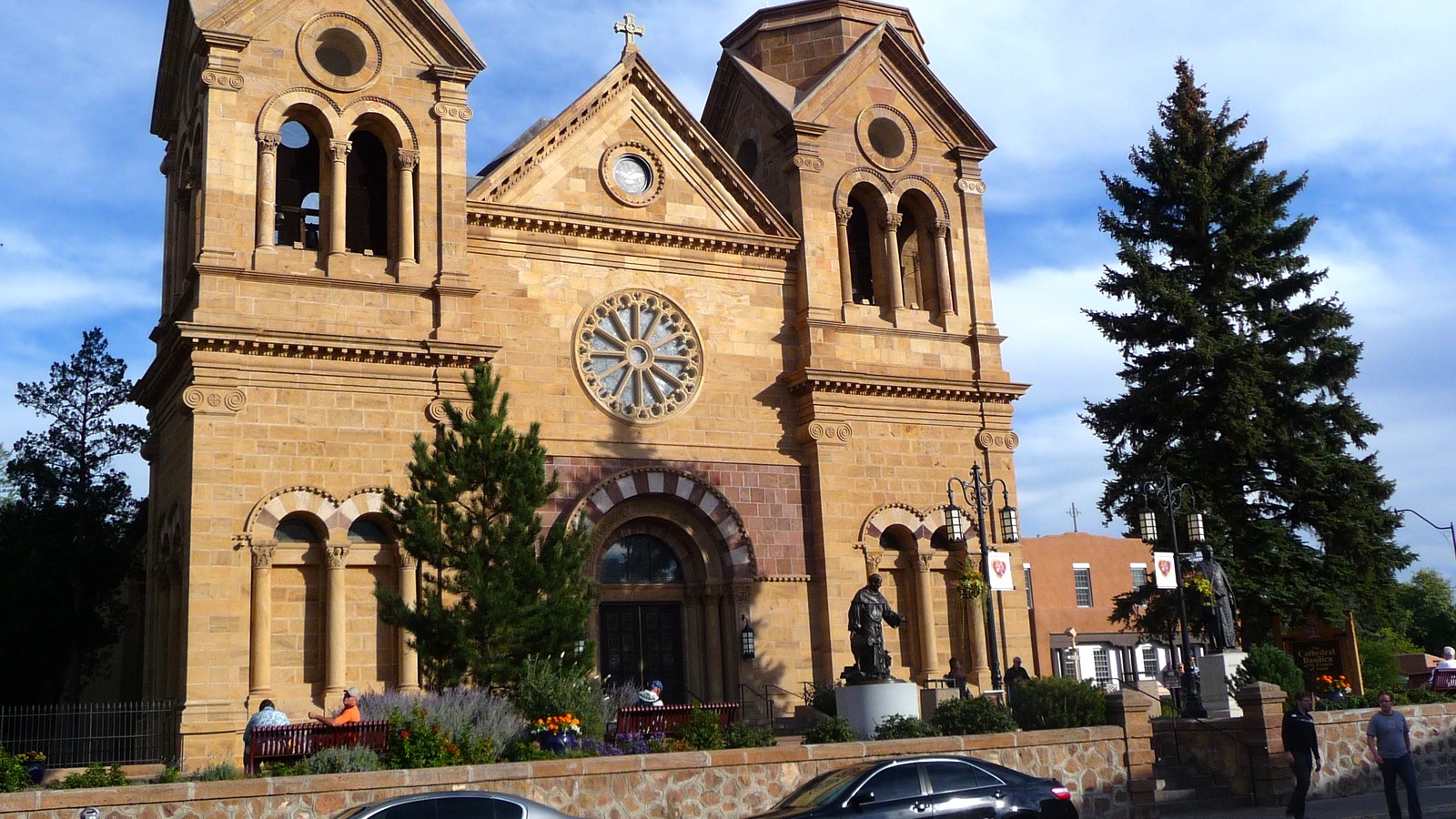
Historic SiteThe Plaza and downtownOpen to visitors on most days outside service timesDonation suggestedArchbishop Jean Baptiste Lamy raised this French Romanesque church between 1869 and 1886 around the older adobe parish already standing on the site, and its pale stone still reads as a deliberate contrast with the earth colored city around it. A small side chapel survives from that earlier building and holds La Conquistadora, a wooden Madonna carried north from Mexico in the 1620s and described as the oldest such figure in the country.
Local tipThis is an active parish and the seat of the archdiocese, so visiting works around Mass times and quiet is expected once inside.
-
8Best for History · #8 of 15
Museum of Indian Arts and Culture
MuseumMuseum Hill and the edges of townOpen daily in summer and closed one weekday in the colder monthsTicketedThe state museum of Native art and history on Museum Hill draws on the collections of the Laboratory of Anthropology, among the deepest holdings of Southwestern pottery, jewelry and weaving anywhere. Its core exhibition, Here, Now and Always, was rebuilt with Pueblo, Navajo and Apache advisors so that several hundred objects are explained in the words of the communities that made them rather than by outside curators.
Local tipGive the pottery galleries real time, because the way the regional forms are laid out in sequence is clearer here than in any other Southwest museum.
-
9Best for Architecture · #9 of 15
Loretto Chapel
Historic SiteThe Plaza and downtownOpen daily during the day, with occasional closures for weddingsTicketedA Gothic Revival chapel finished in 1878 for the Sisters of Loretto and modeled on Sainte Chapelle in Paris, which makes it a second deliberate French intrusion into an adobe city. Almost everyone comes for one object, a helix of a staircase that rises to the choir loft in two full turns with no center pole and no visible support, built by a carpenter who was never identified.
Local tipThe chapel is small, privately run and charges admission, so expect a short visit and a queue when the tour groups arrive in the middle of the morning.
-
10Best for Local life · #10 of 15
Santa Fe Railyard and the Farmers Market
MarketThe Railyard and MidtownThe district is open at all hours, the market runs on set mornings year roundFree with paid optionsFifty acres of former rail yard southwest of the Plaza, redeveloped into a district of contemporary galleries, a park, an open plaza and the covered pavilion that houses one of the oldest farmers markets in the country. The Rail Runner commuter train from Albuquerque terminates at the depot here, which makes the Railyard the arrival point for anyone reaching Santa Fe without a car.
Local tipThe market runs on set mornings year round in the pavilion, and turning up in the first hour is the difference between browsing and shuffling.
-
11Best for Art · #11 of 15
New Mexico Museum of Art
MuseumThe Plaza and downtownOpen daily in summer, with one closed weekday in winterTicketedThe 1917 building on the west corner of the Plaza is the founding statement of Santa Fe style, a Pueblo Revival design whose massed adobe forms and projecting roof beams set the template the rest of downtown was later required to follow. Inside sits the state collection of Southwestern art, strongest on the Taos and Santa Fe painters of the early twentieth century.
Local tipThe same museum runs Vladem Contemporary a short walk away in the Railyard, so check what is hanging in both buildings before deciding which one to give the time to.
-
12Best for Music · #12 of 15
Santa Fe Opera
Music VenueMuseum Hill and the edges of townPerformances run in a short summer season, with backstage tours offered while it is onTicketedAn open sided theater standing on a mesa about seven miles north of town, built so that the desert and the Jemez Mountains form the backdrop behind the stage while the sun goes down through the first act. The company has staged a long run of American and world premieres since 1957, and tailgating in the parking lot before curtain is a genuine local ritual rather than a marketing invention.
Local tipThe season is short and falls in high summer, the seats are open to wind and rain, and tickets go early, so book before fixing travel dates and pack a warm layer.
-
13Best for History · #13 of 15
San Miguel Chapel
Historic SiteThe Plaza and downtownOpen to visitors most days during the day, closing in the mid afternoonTicketedAn adobe box in the Barrio de Analco south of the river, put up around 1610 by Tlaxcalan laborers who travelled north with the Spanish, and generally described as the oldest church structure in the United States. It was burned during the Pueblo Revolt of 1680 and rebuilt afterwards, and the interior stays plain apart from a carved eighteenth century altar screen and a heavy old bell displayed near the door.
Local tipA small admission goes toward maintaining a privately owned adobe building, and the stop is short enough to fold into the walk between the Plaza and Canyon Road.
-
14Best for Outdoors · #14 of 15
Santa Fe Botanical Garden
GardenMuseum Hill and the edges of townOpen daily through the growing season with shorter days in winterTicketedA hillside garden on Museum Hill planted to show what actually thrives at seven thousand feet in high desert, with an orchard, walled courtyards and a section built around traditional acequia irrigation and Pueblo growing practice. Paths cross an arroyo on a footbridge and open onto a long view toward the Sangre de Cristo and Jemez ranges, which is most of the reason to walk it slowly.
Local tipShade is limited by design, so come early or late in summer and carry water, because the elevation dries people out faster than the temperature suggests.
-
15Best for Outdoors · #15 of 15
Dale Ball Trails
ParkCanyon Road and the east sideOpen daily from dawn until dusk, with no gate and no feeFreeRoughly twenty five miles of narrow dirt trail in the foothills immediately above the east side of town, held as public open space and signed with numbered junction markers that make the network unusually hard to get lost in. Trailheads on Hyde Park Road, Cerro Gordo and Camino Cruz Blanca put a real juniper and pine hike within ten minutes of the Plaza, and a connector climbs on to the Atalaya Mountain summit.
Local tipThe sun is fierce and the trailheads sit above seven thousand feet, so give the altitude a day before attempting anything long and start early in summer.
Where things cluster
Santa Fe splits into four working zones, and keeping each day inside one of them saves a great deal of driving and parking.
- The Plaza and downtownThe 1610 grid around the Plaza, holding the Palace of the Governors, the O'Keeffe Museum, the state art museum and both famous chapels. Almost everything here is within a ten minute walk of everything else, which is the strongest argument for paying to sleep downtown.
- Canyon Road and the east sideA half mile of adobe galleries climbing east from Paseo de Peralta, with the foothill trailheads waiting just beyond the top of the street. Narrow, mostly one way and short on parking, so it works far better on foot than from behind a windshield.
- The Railyard and MidtownThe redeveloped rail yard southwest of downtown, with the farmers market pavilion, contemporary galleries and the train in from Albuquerque, plus Meow Wolf a few minutes further out on Rufina Circle. This is where the city reads as current rather than historic.
- Museum Hill and the edges of townCamino Lejo southeast of downtown puts four museums and the botanical garden on one shared parking lot about ten minutes from the Plaza. The same zone covers the short drives out of town, north on the highway to the opera house and up Hyde Park Road toward the ski basin.
Make it a day
Plaza in the morning, Canyon Road at dusk
Start on the Plaza before the shops open, walk the portal at the Palace of the Governors, then give the middle of the morning to one downtown museum, either the O'Keeffe or the state art collection. Eat within a block or two, take the afternoon slowly up Canyon Road, and finish near the top of the street once the light turns the adobe walls orange.
Downtown first, hills second
Give day one entirely to the walkable center, pairing the Plaza and the Palace of the Governors with the O'Keeffe Museum, the cathedral and a long browse up Canyon Road. Use day two for the car, taking Museum Hill through the morning and closing with either the Dale Ball Trails or an evening curtain at the opera.
Meow Wolf first, folk art second
Book the earliest Meow Wolf slot and let the House of Eternal Return take the whole morning, because nothing else in the city competes with it for a child's attention. Spend the afternoon on Museum Hill, where the folk art collection of toys and miniature villages holds up better than it sounds, then let everyone loose in the Railyard park on the way back.
Map
Best time to visit
F
M
A
M
J
J
A
S
O
N
D
Late spring and early autumn deliver dry, mild days and cool nights, which suits a city where nearly everything worth doing means walking around at seven thousand feet. July and August are the busiest and priciest months because of the opera and the big summer markets, and they bring short heavy afternoon storms, while January and February turn cold and quiet away from the ski basin.
Staying over? Compare hotels in Santa Fe at Expedia.
Deep Arrival earns a commission when you buy through partner links. It does not change the price you pay.
Santa Fe things to do FAQ
Parking, timing, cost, and weather answers for a smoother visit.
How many days do you need in Santa Fe?
Two full days covers the Plaza, the downtown museums, Canyon Road and one Museum Hill morning without rushing any of it. Three days adds Meow Wolf, a hike in the foothills and enough slack to eat properly. A week is easy to fill if you treat Santa Fe as a base for the drives out into northern New Mexico.
Do you need a car in Santa Fe?
Not for the historic center, which is compact and walkable from the Plaza out to Canyon Road and the Railyard. A car helps for Museum Hill, the opera house and the foothill trailheads, although city buses and rideshare cover most of that. The Rail Runner train connects Albuquerque to the depot in the Railyard, so a car free trip works if you stay downtown.
What is the best free thing to do in Santa Fe?
Walking the Plaza and Canyon Road costs nothing and covers the two things the city is best known for, four centuries of adobe and the densest gallery district in the country. Every gallery on Canyon Road is free to walk into. The Dale Ball Trails in the foothills are free as well and open from dawn to dusk, so a full day without a ticket is easy to build.
Is Santa Fe good to visit with kids?
Meow Wolf is the strongest single answer, an immersive installation built to be climbed through and opened rather than looked at. The folk art museum on Museum Hill holds a huge collection of toys and miniature villages that lands well with younger children. Beyond those two, the city rewards short outdoor bursts, and the Plaza, the Railyard park and the foothill trails all break up museum time.
What should you know about the altitude in Santa Fe?
The city sits at roughly seven thousand feet, high enough that people arriving from sea level often feel breathless, tired or headachy on the first day. Drink much more water than usual, go easy on alcohol the first night, and save any serious hiking for the second or third day. The sun is far stronger at that elevation too, so sunscreen matters even in winter.
When is Santa Fe busiest?
July and August are the peak, driven by the opera season and the large summer art markets, with Indian Market in August filling the Plaza and most downtown hotel rooms. Fiesta de Santa Fe in early September and the Christmas Eve farolito walk on Canyon Road are the other two dates that book out well ahead. If crowds are the worry, late spring and the back half of October are the calmest windows with good weather.
Keep planning
Use these nearby guides to extend your Santa Fe trip with a different pace and a clear next stop.
Hero image: Cathedral Basilica of St. Francis of Assisi, photograph by Daniel Mayer (Mav), CC BY-SA 3.0, via Wikimedia Commons. Cropped to 16:9 and exposure adjusted.