
 Original editorial artwork by Deep Arrival · Deep Arrival original
Ireland trip planning
Things to Do in Ireland: Regions, Routes, and First Trips
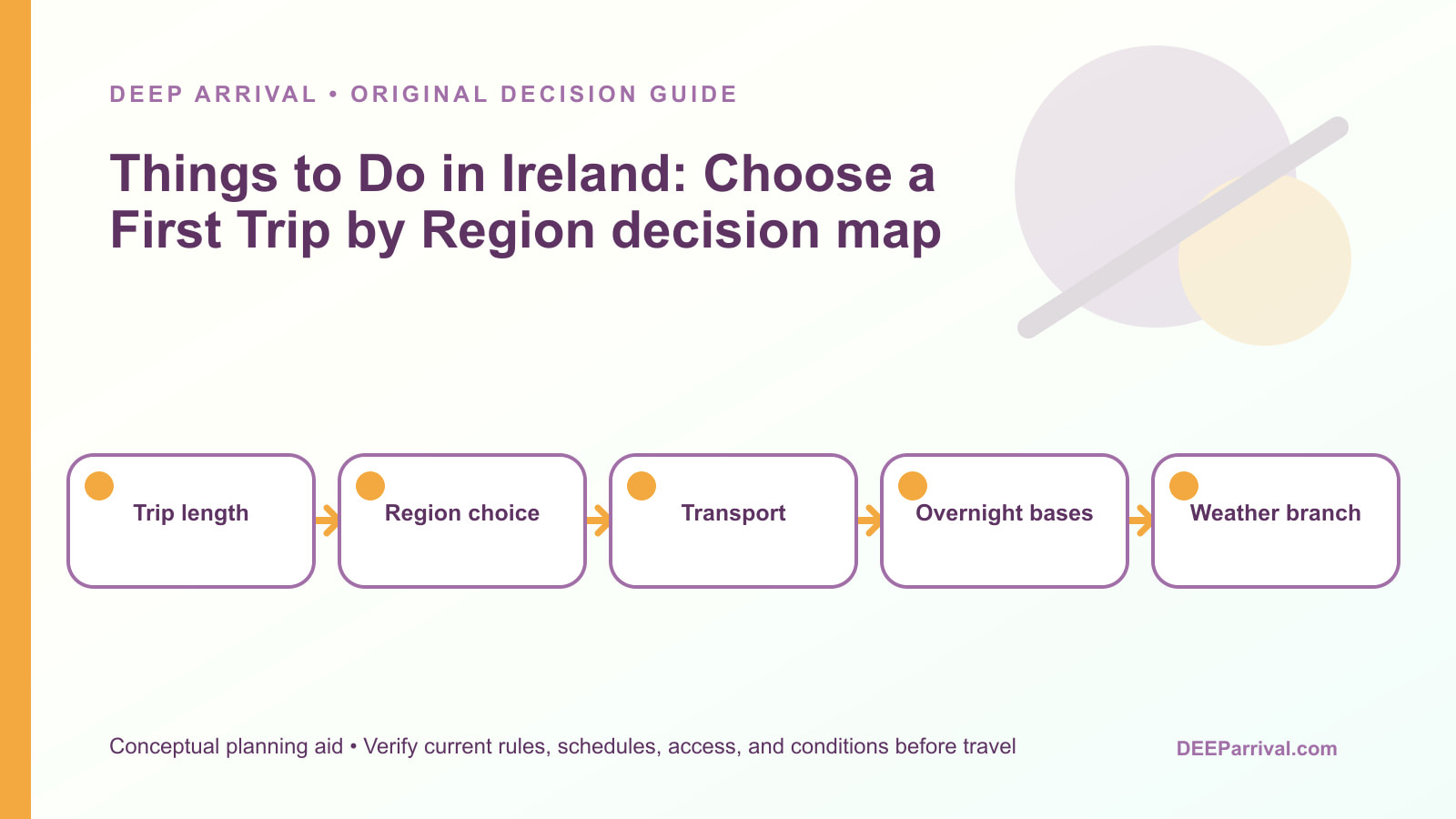
Ireland becomes much easier when a first trip has one regional center of gravity. Pair a city or arrival point with a nearby heritage, coast, or landscape anchor instead of trying to cross the island every day.
Ireland becomes much easier when a first trip has one regional center of gravity. Pair a city or arrival point with a nearby heritage, coast, or landscape anchor instead of trying to cross the island every day.
Fast read
What matters first
Use these three filters to choose the right shape before adding individual stops.
Choose a region first
Dublin and the east, the west, the southwest, Clare, or Belfast can each support a distinct first trip.
Build around one anchor
Give a museum, coastal walk, national park, or heritage site enough time, then add nearby stops only when the route remains simple.
Keep weather flexibility
Pair an outdoor plan with an indoor alternative and verify current conditions, tickets, and transport with the official operator before you go.
Decision matrix
Best things to do, by who you are
Start with the traveler type that matters most, then build the day around the named places in that row.
Orientation
Ireland by practical trip region
The island has more variety than a single checklist can show. Choose one or two connected regions, then use official visitor and transport information to verify current opening, sailing, and travel details before committing to a daily sequence.
Dublin and the east
Dublin is the clearest start for visitors who want urban culture, an easy first night, and a base for a selective east-coast or Boyne Valley extension.
Museums, neighborhoods, first arrivals
Boyne Valley and Ancient East
This compact eastern region works when historic sites matter as much as city time. Build around one major heritage anchor and check individual admission arrangements before traveling.
Early history, estates, river landscapes
Galway and Connemara
Galway makes the west manageable without forcing a different hotel every night. Connemara deserves a dedicated weather-aware day rather than a rushed loop between distant coasts.
West-coast atmosphere, music, mountain and shore
Kerry and West Cork
The southwest rewards a slower route. Choose either a Killarney-centered national-park plan or a West Cork coastal plan when time is short, because the road mileage accumulates.
Longer scenic drives, small towns, national-park time
Clare and the Burren
Clare pairs exposed Atlantic sites with the Burren's limestone landscape. It is strongest with an overnight nearby, not as a hurried cross-country detour.
Coastal views, geology, short walks
Belfast and Northern Ireland
Belfast provides a distinct city break and a practical northern base. It can stand alone or become a carefully planned extension after a separate southern itinerary.
City history, maritime heritage, northern coast
Lay of the land
Ireland route anchors
Use this broad map only to compare regions. Confirm the final route with official visitor, road, rail, ferry, and attraction sources.
- Dublin east
- Galway west
- Killarney southwest
- Clare coast west
- Belfast north
 Original editorial artwork by Deep Arrival · Deep Arrival original
Make the map smaller
One route can feel like a fuller Ireland trip
A coast, a market town, a heritage site, and a walk are more satisfying when they share the same part of the country. That grouping creates time for a slow meal, a weather change, or a stop that deserves longer than expected.
Use Dublin, Galway, Killarney, Cork, or Belfast as an overnight base rather than treating every named attraction as a separate destination. A base also gives a public-transport traveler a clearer choice of what can fit comfortably.
Top stops
Grouped by what you came for
These are planning groups, not a single ranked list. Pick one anchor group and one nearby complement. Named stops link to official place pages when a stable visit URL exists.
Dublin culture and city texture
- National Museum of Ireland: Natural History official site Dublin
A central indoor anchor when weather changes. Verify current access and opening details with the museum. - Dublin neighborhoods Dublin
Choose one walkable district around the day's main museum or historic stop instead of crossing the city for every item.
Eastern history
- Boyne Valley heritage east
A useful regional anchor for visitors who want archaeology and landscape beyond Dublin. Use official visitor information to choose the exact site. - Malahide Castle and Gardens north Dublin
A castle-and-gardens option for a Dublin-based day. Check current visiting arrangements before setting the timetable.
West and Atlantic landscape
- Connemara west
Use a Galway base and choose one coast, mountain, or village focus for the day, with weather as the deciding factor. - Clare coast and Burren Clare
Combine a coastal viewpoint with a short Burren stop only when the route and conditions make it realistic.
Southwest and northern add-ons
- Killarney National Park Kerry
A strong southwest anchor for walking, lakes, and a slower day. Review official park information before visiting. - Bunratty Castle County Clare
A heritage stop that can complement a Shannon or Clare itinerary when the visit fits the day's route. - Belfast maritime quarter Belfast
Use Belfast for a separate urban and maritime-focused day, then verify current venue access directly with the operator.
Build the trip
A strong day, and an easy weekend
Both plans keep nearby stops together and leave room for the museum or outdoor anchor to take longer than expected.
One day: Dublin with one nearby anchor
- Morning: start at one museum or historic site in central Dublin so the day has a dependable indoor core.
- Midday: walk or eat within the same neighborhood rather than scheduling a distant attraction immediately afterward.
- Afternoon: choose one nearby park, coastal, or heritage extension only if its official timetable and transport connection still work.
- Evening: return to the city base, leaving any long regional drive for a different day.
Long weekend: one region, not the whole island
- Day one: arrive in Dublin, Galway, Cork, Killarney, or Belfast and keep the first evening local.
- Day two: make the major outdoor or heritage anchor the only non-negotiable stop and retain an indoor weather backup.
- Day three: add a second place in the same region, keeping the return route simple and checking transport or driving conditions.
- Departure day: use the final morning near the base instead of relying on a long cross-country transfer before a flight or ferry.
Logistics
Getting around and when to go
Use stable area logic and check official attraction pages before the visit for current access details.
Getting around
- Choose the base before the stops. An overnight in the right region saves more time than a long daily loop from Dublin.
- Use official transport tools. Transport for Ireland is the place to verify current public-transport planning; check operator details for the final journey.
- Treat road time cautiously. Scenic or local roads can make a short map distance take longer than expected, especially when parking or weather is involved.
Weather, tickets, and timing
- Keep an indoor alternative. A museum, historic house, or food-focused neighborhood can rescue a wet or windy day without a long detour.
- Verify current visitor details. Opening hours, timed entry, access conditions, and seasonal services can change, so use the official site just before the visit.
- Leave arrival and departure days light. A nearby walk or one flexible stop is safer than a region-changing excursion tied to transport connections.
Planning traps
Mistakes to avoid
A good Ireland trip leaves space for weather, road time, and one memorable anchor each day. The most useful correction is usually reducing the number of regions, not adding another stop.
Ireland's regions are varied enough that repeated long return journeys dilute the time at the places you traveled to see.
Wind, rain, visibility, and traffic can change the experience, so keep one indoor or lower-commitment alternative nearby.
A route is useful for orientation, but one viewpoint, a walk, and a town can make a more complete day than a string of rushed pullovers.
Use current official information for admission, access, parking, transport, and tickets instead of relying on an old itinerary.
Sources checked
Official and supporting references
Ireland.com, Discover Ireland, Transport for Ireland, and the Irish government visitor portal underpin the regional and practical planning advice below. Visit individual operator pages for current access details.
Landing abroad? Set up a Yesim eSIM before you fly.
Deep Arrival earns a commission when you buy through partner links. It does not change the price you pay.
FAQ
Common planning questions
What is the best way to plan things to do in Ireland?
Can Ireland be visited without renting a car?
How many regions work for a first Ireland trip?
Does a whole trip need a Dublin base?
What works when the weather changes?
Where is current visiting and transport information available?
Continue planning