
Things to Do in Albuquerque
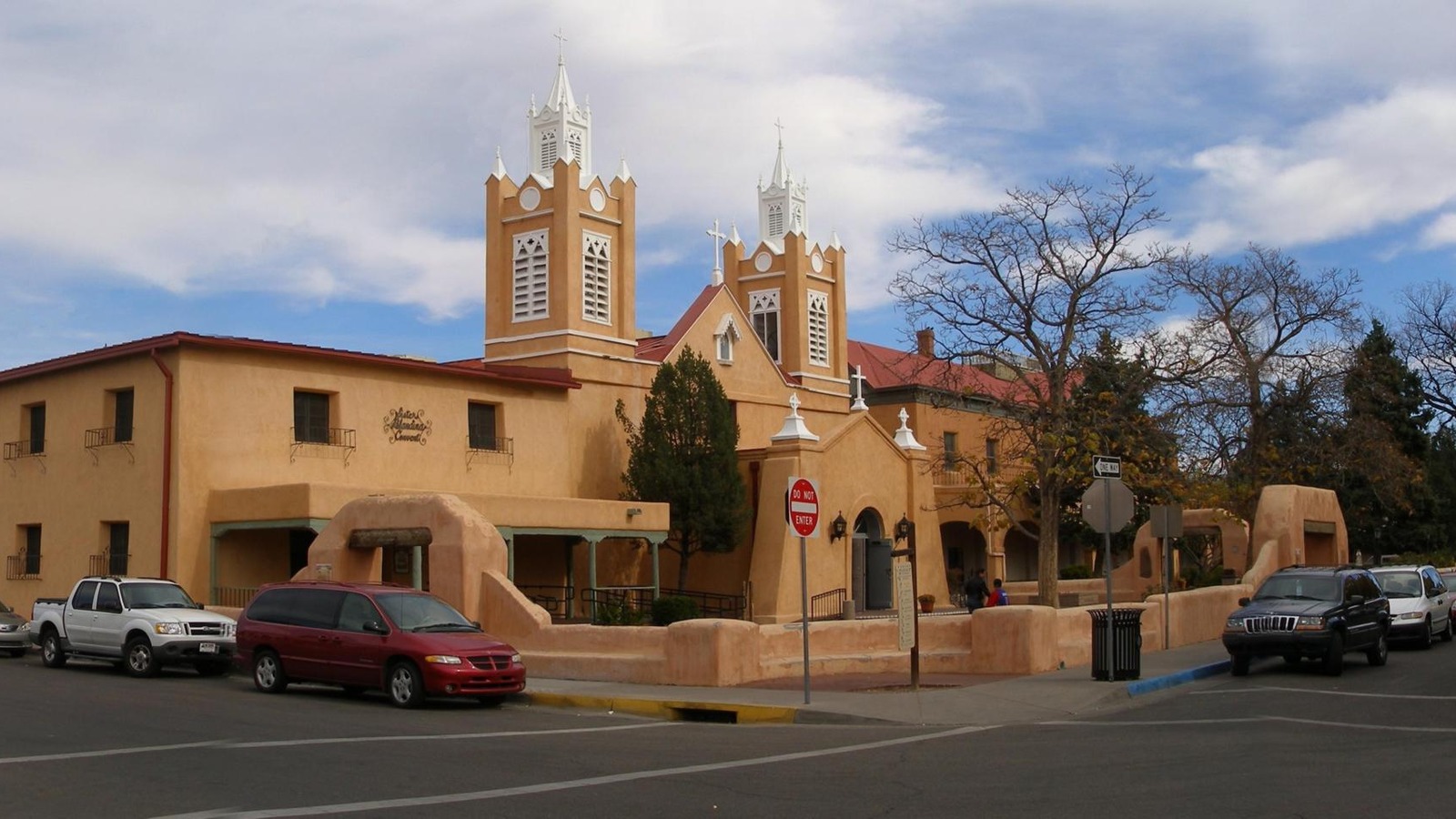
Albuquerque is a long, low city spread across a river valley and pressed up against a ten thousand foot mountain wall, which means the attractions sit far apart and the trips that work here group them by geography rather than by theme. Old Town and its museum blocks carry the history in one walkable cluster, the tramway and the west mesa petroglyphs hold the two extremes of the landscape, and Central Avenue still runs the old Route 66 line straight through the middle.
The top 15, ranked
Ranked by how consistently each pick appears across official Albuquerque sources, the local destination marketing organization, and recent independent roundups.
- Top pick
1Best for History · #1 of 15
Old Town Albuquerque
Neighborhood LandmarkOld Town and the museum blocksAn open public plaza at all hours, with shops and museums keeping daytime hoursFree with paid optionsSpanish families laid out this plaza in 1706, seventy years before the Declaration of Independence, and the ten square blocks around it still follow the original grid of low adobe buildings and shaded portals. San Felipe de Neri Church has stood on the north side since 1793, and more than a hundred shops, galleries and restaurants fill the surrounding lanes and hidden courtyards.
Local tipThree major museums sit within two blocks of the plaza, so park once on the edge of the district and cover the whole cluster on foot.
- Top pick
2Best for Views · #2 of 15
Sandia Peak Aerial Tramway
TourThe Sandias and the east sideRuns daily into the evening, weather permitting, with occasional shutdowns for high wind or maintenanceTicketedOpened in 1966, the tram climbs 3,819 feet from the desert foothills to a crest station at 10,378 feet in about fifteen minutes, crossing a span between the second tower and the summit that remains among the longest in the world. The ride passes over canyons no road reaches, and the observation deck at the top looks out across thousands of square miles of New Mexico.
Local tipThe summit sits above ten thousand feet and runs far colder and windier than the parking lot, so carry a jacket even in midsummer.
- Top pick
3Best for History · #3 of 15
Petroglyph National Monument
ParkThe river and the West MesaTrail areas open in daylight hours with staggered closing times, and the visitor center keeps shorter hoursFree with paid optionsA seventeen mile ridge of black volcanic basalt along the western edge of the city carries an estimated twenty four thousand carved images, most of them made by ancestral Pueblo people and later Spanish settlers between four hundred and seven hundred years ago. Four separate trail areas open onto it, from the short paved climbs at Boca Negra Canyon to the longer sand tracks at Rinconada and Piedras Marcadas.
Local tipThe trailheads are scattered across several miles of road and the visitor center itself holds no petroglyphs, so choose which canyon you want before setting out.
-
4Best for Family · #4 of 15
ABQ BioPark
Family AttractionThe river and the West MesaOpen daily through most of the year with shorter winter hours and a few holiday closuresTicketedThe city runs four linked sites along the Rio Grande under one name, a 64 acre zoo holding more than 250 species, an aquarium built around a 285,000 gallon ocean tank, a 36 acre botanic garden with a glass conservatory, and the fishing lakes at Tingley Beach. Together they draw roughly a million and a half visitors a year, and the zoo sits far enough from the aquarium and garden that most families pick two rather than attempting all four.
Local tipA combined ticket covers the zoo, aquarium and garden, and a shuttle links the aquarium side to the zoo, which saves moving the car twice.
-
5Best for Culture · #5 of 15
Indian Pueblo Cultural Center
MuseumOld Town and the museum blocksOpen daily during the day, with dance performances concentrated at weekendsTicketedOwned and run by the nineteen Pueblos of New Mexico and standing on land that once held the Albuquerque Indian School, this is where Pueblo people set out their own history rather than having it interpreted for them. The permanent gallery We Are Of This Place runs from ancestral times to the present, and a courtyard hosts dance groups from individual Pueblos through much of the year.
Local tipCome here before visiting any Pueblo itself, because the center explains the etiquette around photography, feast days and which villages welcome outside visitors.
-
6Best for History · #6 of 15
Albuquerque Museum
MuseumOld Town and the museum blocksOpen Tuesday through Sunday during the day and closed on MondaysTicketedThe city museum on Mountain Road holds about ten thousand works of art, thirty five thousand historical objects and a photo archive running past a hundred and thirty thousand images, which together carry four centuries of the middle Rio Grande. A free sculpture garden wraps the building, and the same institution runs Casa San Ysidro, a restored rancho out in Corrales shown by guided tour.
Local tipThe sculpture garden and the lobby are free to walk into, so the site is worth a look even on a day when the paid galleries are closed.
-
7Best for History · #7 of 15
National Museum of Nuclear Science and History
MuseumThe Sandias and the east sideOpen daily during the day, closing on a small number of major holidaysTicketedChartered by Congress in 1991 and affiliated with the Smithsonian, this is the only national museum devoted to the atomic age, and it stands beside Kirtland Air Force Base where a great deal of that work was done. Sixteen indoor galleries cover the Manhattan Project, medicine and energy, while nine acres of Heritage Park outside hold a B-29, a B-52, missiles and the sail of a nuclear submarine.
Local tipHeritage Park is open gravel with almost no shade, so walk the aircraft first on a hot day and keep the air conditioned galleries for the afternoon.
-
8Best for Family · #8 of 15
New Mexico Museum of Natural History and Science
MuseumOld Town and the museum blocksOpen daily during the day for most of the year, with occasional closed weekdays in the quieter monthsTicketedThe state natural history museum runs from the formation of the universe to the ice age across a linked sequence of halls, and its strength is New Mexico's own fossil record, unusually dense in dinosaurs pulled from the San Juan Basin. A recent renovation reworked about a quarter of the permanent galleries, and the building also carries a planetarium, a large format theater and the Evolator, a simulated elevator ride through geologic time.
Local tipThe planetarium and the large format theater are ticketed separately from the galleries, so decide at the desk rather than doubling back later.
-
9Best for Family · #9 of 15
Explora Science Center and Children's Museum
Family AttractionOld Town and the museum blocksOpen daily during the day, with a later public start on some mornings reserved for toddler sessionsTicketedMore than two hundred and fifty hands on exhibits fill this building across Mountain Road from the natural history museum, arranged so that almost nothing sits behind glass and almost everything expects to be pulled, poured or pedaled. The audience skews young, but the high wire bicycle and the water tables hold teenagers too, and a separate maker space next door adds woodworking, welding and 3D printing.
Local tipTiguex Park sits directly behind the building with grass and a playground, which is the easiest way to break up a long morning indoors.
-
10Best for Art · #10 of 15
National Hispanic Cultural Center
MuseumDowntown, Barelas and Central AvenueThe art museum opens Tuesday through Saturday during the day, and performances run on their own calendarFree with paid optionsA large campus in the Barelas neighborhood south of downtown given over to Hispanic, Chicano and Latin American art and performance, with an art museum, a genealogy library and the Roy E. Disney Center for Performing Arts. Its singular object is the Torreon, a tower whose curved interior carries a four thousand square foot buon fresco by Frederico Vigil tracing three thousand years of Hispanic history.
Local tipTorreon tours run on a limited schedule with small group sizes, so reserve a place rather than turning up and hoping for one.
-
11Best for Architecture · #11 of 15
KiMo Theater
Historic SiteDowntown, Barelas and Central AvenueOpens to the public around performances and screenings rather than on fixed daytime hoursFree with paid optionsBuilt on Central Avenue in 1927, when that street carried Route 66 through Albuquerque, this is the surviving masterwork of Pueblo Deco, a short lived style that grafted Art Deco geometry onto Pueblo and Navajo motifs. Longhorn skulls with glowing eye sockets frame the proscenium, plaster ceiling beams stand in for vigas against a painted night sky, and Carl von Hassler's lobby murals imagine the Seven Cities of Cibola.
Local tipThe interior is the whole point and it opens reliably only when something is programd, so pair a look at the facade with a ticket to whatever is showing.
-
12Best for Family · #12 of 15
Anderson Abruzzo Albuquerque International Balloon Museum
MuseumThe river and the West MesaOpen most days during the day, with one closed weekday in some parts of the yearTicketedNamed for Maxie Anderson and Ben Abruzzo, the Albuquerque pilots who made the first balloon crossing of the Atlantic in 1978, this city museum stands beside Balloon Fiesta Park and covers lighter than air flight from the Montgolfiers onward. Real gondolas and envelopes that set world records hang in a hall built tall enough to take them, alongside the international ballooning hall of fame and a run of hands on wind and buoyancy exhibits.
Local tipIt stays open year round, which makes it the reliable way to understand why this valley became a ballooning capital whatever month you visit.
-
13Best for Outdoors · #13 of 15
Rio Grande Nature Center State Park
ParkThe river and the West MesaGrounds open daily from morning until early evening, and the visitor center closes earlierFree with paid optionsA state park on Candelaria Road opens onto the bosque, the cottonwood forest that follows the Rio Grande through the middle of the city, with a half buried visitor center whose window wall looks straight into a wildlife pond. From here the Paseo del Bosque Trail runs sixteen paved miles north to south without crossing a single road, which makes it the easiest long walk or ride in Albuquerque.
Local tipWinter mornings bring sandhill cranes and geese down onto the ponds, so carry binoculars if the trip falls between late autumn and early spring.
-
14Best for History · #14 of 15
Maxwell Museum of Anthropology
MuseumDowntown, Barelas and Central AvenueOpen Tuesday through Saturday during the day and closed on Sundays and MondaysFreeThe University of New Mexico's anthropology museum on the north side of campus is free to enter and holds archaeology, ethnology, osteology and archive collections built up since 1932. Its permanent galleries set out the deep human record of the Southwest alongside a wider survey of human origins, and the store carries work bought directly from Native artists rather than through wholesalers.
Local tipCampus parking is metered and enforced, so use the visitor lot off University Boulevard rather than hunting for a space on the street.
-
15Best for Family · #15 of 15
American International Rattlesnake Museum
MuseumOld Town and the museum blocksOpen most days during the day, with fewer opening days outside the summer monthsTicketedA single storefront a few steps off the Old Town plaza holds what is billed as the largest collection of live rattlesnake species on public display anywhere, more than thirty of them, alongside turtles, lizards and a wall of rattlesnake imagery drawn from advertising and folk art. The tone is conservation rather than sideshow, and the staff spend most of their time correcting what visitors think they already know about snakes.
Local tipIt is essentially one room, so treat it as a twenty minute stop folded into an Old Town walk rather than a destination in its own right.
Where things cluster
Albuquerque spreads across a wide valley, so grouping each day inside one of these four zones is what keeps the driving manageable.
- Old Town and the museum blocksThe 1706 plaza and the two streets behind it, where the Albuquerque Museum, the state natural history halls, Explora and the rattlesnake museum all sit within a few minutes on foot. The Indian Pueblo Cultural Center is a short drive north, which makes this the one zone where a car can stay parked most of the day.
- Downtown, Barelas and Central AvenueThe old highway line through the middle of the city, carrying the KiMo Theater and downtown neon, the university and Nob Hill further east, and the National Hispanic Cultural Center in Barelas just south. The rapid transit buses run the length of it, so this is the easiest part of Albuquerque to see without driving.
- The river and the West MesaThe Rio Grande corridor and the volcanic escarpment beyond it, holding the BioPark, the bosque trails, the balloon museum on the north edge and the petroglyph canyons out west. Distances here are real, and the west mesa trailheads are a good twenty minutes from Old Town.
- The Sandias and the east sideThe eastern half of the city rising toward a granite wall that tops out above ten thousand feet, reached by the tramway from the foothills. The nuclear museum sits out this way too, near Kirtland Air Force Base, so the two pair naturally into one day.
Make it a day
Old Town first, tramway at sunset
Start on the Old Town plaza before the shops open, then give the middle of the day to the museum blocks a street away, choosing between the Albuquerque Museum, the natural history halls and Explora depending on who is along. Drive northeast in the late afternoon and take the tramway up, so the ride back down happens while the light is going off the Rio Grande valley.
City center first, edges second
Give day one to Old Town, the museum blocks and the Indian Pueblo Cultural Center, then finish along Central Avenue for the KiMo Theater and the Route 66 neon. Use day two for the perimeter, pairing a morning on the petroglyph trails out on the west mesa with the tramway or the nuclear museum on the eastern side of town.
Explora, dinosaurs, then animals
Open with Explora, where more than two hundred and fifty exhibits are built to be handled, and cross Mountain Road to the natural history museum when attention starts to fade. Spend the afternoon at the BioPark, taking either the zoo or the aquarium and garden pair rather than trying to force all four sites into one day.
Map
Best time to visit
F
M
A
M
J
J
A
S
O
N
D
Spring and autumn deliver warm dry days and cool nights at around five thousand feet, which is the right weather for a city where most of the best things involve being outside. July and August bring the hottest afternoons and short heavy monsoon storms, while the first half of October is both the finest weather of the year and the most expensive, because the balloon fiesta fills hotel rooms across the metro area.
Staying over? Compare hotels in Albuquerque at Expedia.
Deep Arrival earns a commission when you buy through partner links. It does not change the price you pay.
Albuquerque things to do FAQ
Parking, timing, cost, and weather answers for a smoother visit.
How many days do you need in Albuquerque?
Two full days covers Old Town and its museum blocks, the tramway and Petroglyph National Monument without rushing any of it. Three days lets you add the BioPark or the nuclear museum and still keep an afternoon free for the bosque. Many visitors treat the city as a base and give a fourth day to Santa Fe or the Turquoise Trail, which the interstate makes straightforward.
Do you need a car in Albuquerque?
Effectively yes. The city covers a very large area and the main sights sit far apart, with the petroglyphs out on the west mesa, the tramway in the northeast foothills and the nuclear museum beside Kirtland Air Force Base. The rapid transit line along Central Avenue links downtown, Old Town, the university and Nob Hill, which covers a useful slice of the list but not the rest.
What is the best free thing to do in Albuquerque?
Walking Old Town costs nothing, and the plaza, San Felipe de Neri Church and the sculpture garden at the Albuquerque Museum are all open without a ticket. Petroglyph National Monument charges nothing to hike its trails, although the Boca Negra parking lot takes a small fee. The Maxwell Museum of Anthropology at the university is free, and the sixteen mile Paseo del Bosque Trail along the river is free end to end.
Is Albuquerque good to visit with kids?
It is unusually strong for families. Explora is built entirely around touching things, the state natural history museum next door leads with dinosaurs, and the ABQ BioPark packs a zoo, an aquarium and a botanic garden onto one combined ticket. The tramway ride and the shorter petroglyph trails both work well as outdoor breaks between indoor stops.
When is the Balloon Fiesta and should you plan a trip around it?
The International Balloon Fiesta runs for nine days in early October at Balloon Fiesta Park on the north edge of the city, and the dawn mass ascensions are genuinely worth seeing once. It also fills hotels across the whole metro area and pushes room rates to their annual peak, so either book many months ahead or avoid those dates entirely. The balloon museum beside the park tells the same story year round for anyone visiting in another season.
How far is Santa Fe from Albuquerque?
Santa Fe sits about sixty miles north, roughly an hour up Interstate 25, and the Rail Runner commuter train covers the same route for anyone without a car. It works as a day trip, though the city has more than enough to fill two days of its own. If you have a spare day and no fixed schedule, the Turquoise Trail along New Mexico 14 is the slower and far more scenic way north.
Keep planning
Use these nearby guides to extend your Albuquerque trip with a different pace and a clear next stop.
Hero image: Old Town Albuquerque, photograph by Svobodat, CC BY-SA 3.0, via Wikimedia Commons. Cropped to 16:9.