
Original editorial artwork by Deep Arrival
NYC road trip chooser
Road Trips From New York City by Drive Time
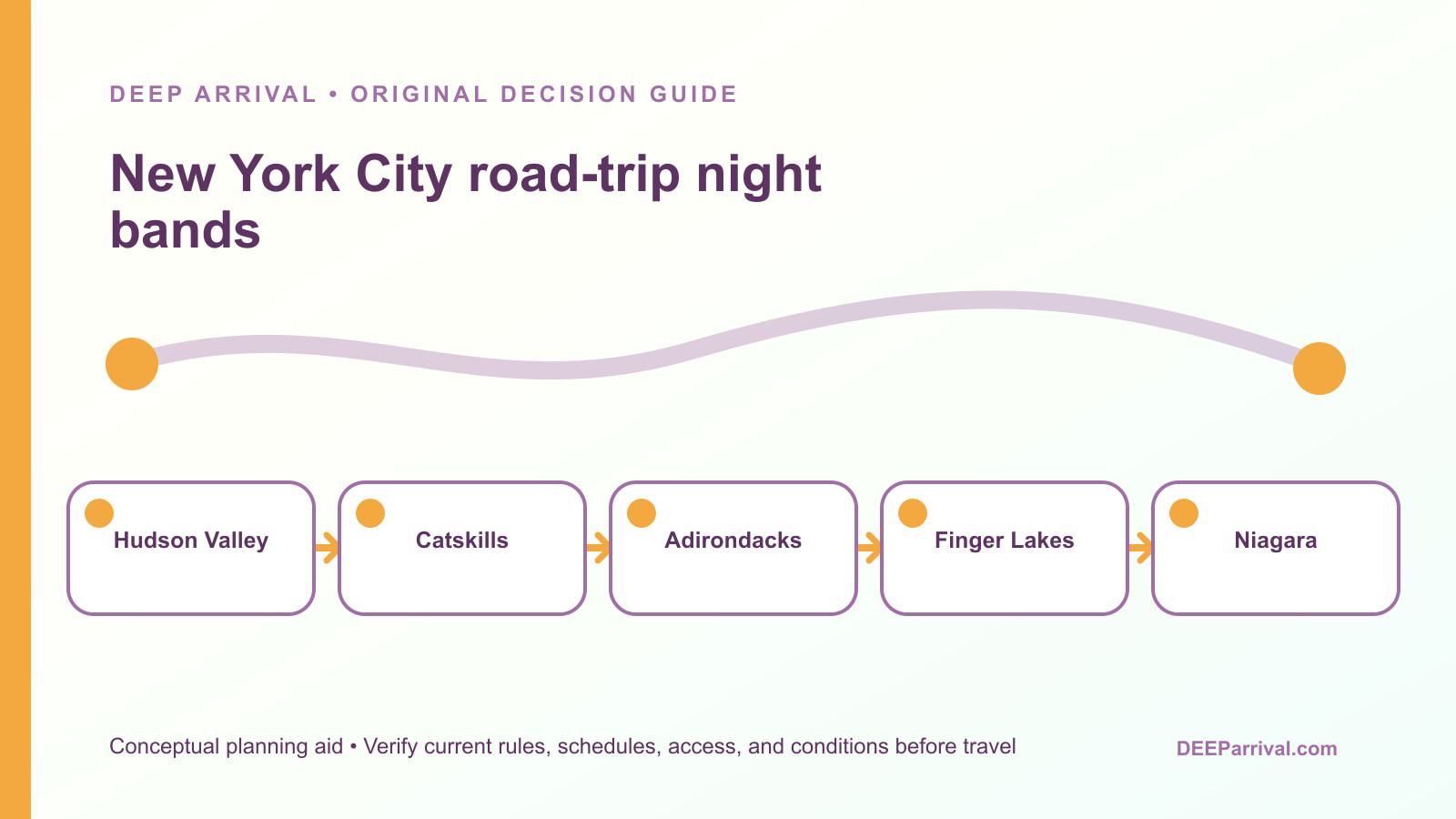
The best road trip from New York City is the route that fits the nights you truly have after rental pickup, city traffic, and the return. Use a close Hudson Valley or Catskills base for a short escape, save the Adirondacks or Finger Lakes for more nights, and make Niagara a real multi-day journey rather than a rushed turnaround.
The best road trip from New York City is the route that fits the nights you truly have after rental pickup, city traffic, and the return. Use a close Hudson Valley or Catskills base for a short escape, save the Adirondacks or Finger Lakes for more nights, and make Niagara a real multi-day journey rather than a rushed turnaround.
Fast read
What matters first
Use this page as the practical filter before you open booking pages, maps, or official policy documents.
One or two nights
Choose one close region, usually the Hudson Valley or a focused Catskills base. I LOVE NY describes the Hudson Valley as roughly one to three hours and the Catskills as roughly two to four hours by car, depending on destination.
Three or four nights
Use one primary region with a limited second stop. The Adirondacks are a larger commitment, while the Finger Lakes work best when the trip protects time around one lake cluster.
Five to seven nights
A Finger Lakes plus Buffalo or Niagara route becomes more defensible, or use the time for a deeper Adirondacks loop. Keep the final return shorter than the trip's biggest sightseeing day.
Decision system
The planning sequence
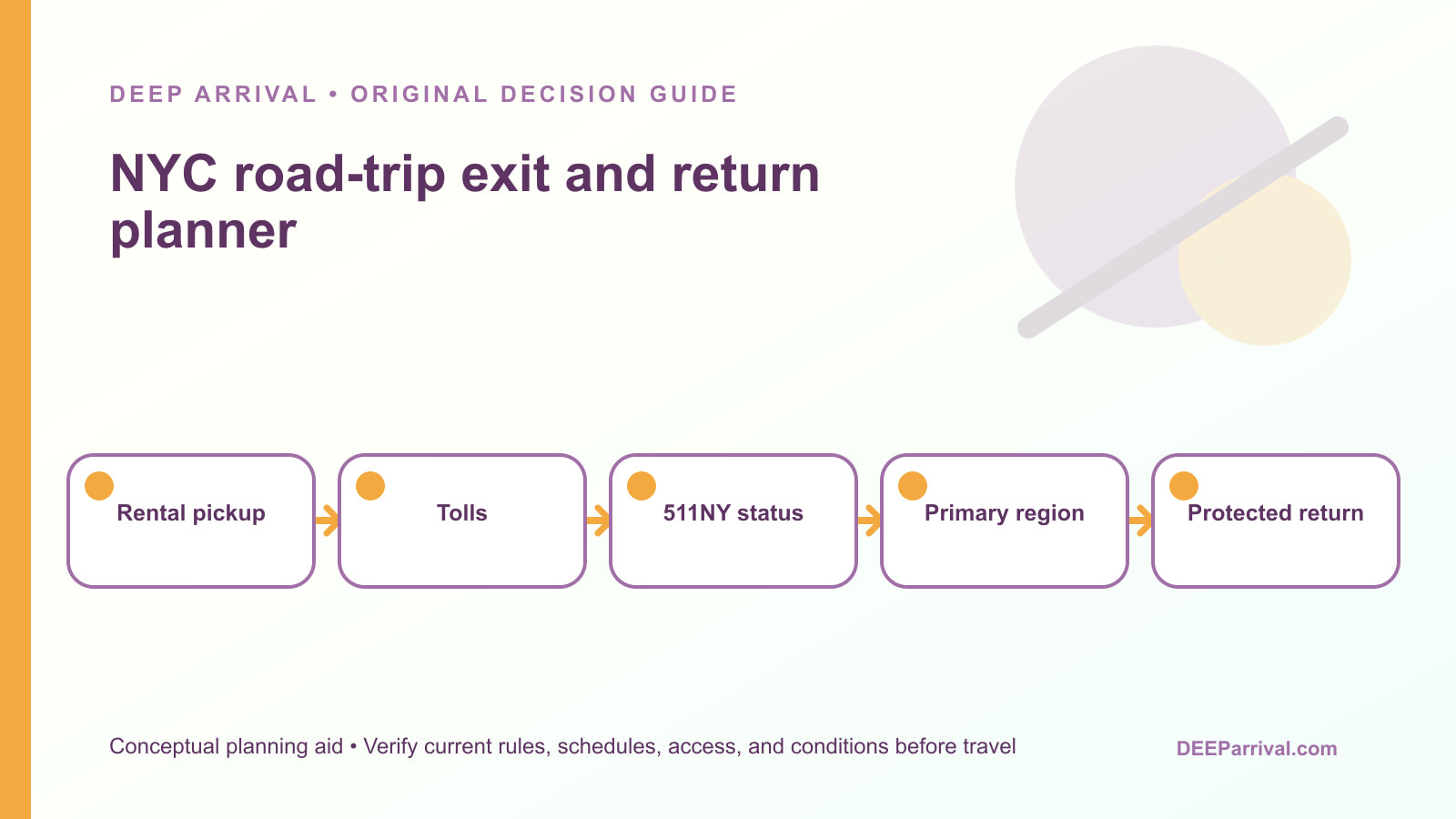
Use the sequence below to decide how this should shape the trip.
The city exit is part of the route
A road trip begins when the car is usable, not when the reservation starts
Rental pickup, luggage loading, bridge or tunnel traffic, toll setup, and the first fuel stop can consume the trip's opening block. Choose the first overnight with that real departure in mind.
On the return, protect the same urban margin. A western New York drive that reaches the city at the exact rental deadline has no recovery path for construction, weather, or a slow crossing.
Define the trip by usable nights
A road-trip booking can overstate the time available. Count from when the vehicle leaves with every traveler and bag until it must be returned or parked. A late flight, city pickup line, or early final commitment can remove most of a day. Then assign a band: one or two nights for a close region, three or four for a deeper single-region trip, and five to seven for western or northern combinations. Do not begin with a list of attractions. The usable-night count determines how many hotel changes, long drives, and recovery branches fit without making the route feel like transportation between checklists.
Choose the rental location as an itinerary decision
A Manhattan pickup may be convenient before departure but can add city driving, toll crossings, parking rules, and a slower exit. A rail-to-suburb rental can reduce urban driving for some routes but adds luggage handling, train timing, and vehicle availability. Compare the full sequence for the chosen direction rather than assuming one location is universally best. Confirm operating hours, after-hours return, toll-device terms, fuel rules, and the exact vehicle class. The page does not recommend one rental company. It asks whether the car becomes usable early enough and returns safely enough to support the route. If not, move the first overnight closer or remove a region.
Use the Hudson Valley for a short, resilient trip
I LOVE NY describes Hudson Valley destinations as roughly one to three hours by car from New York City, depending on the specific place. That range makes the region a strong one or two-night choice, but it does not mean every river town, estate, trail, and restaurant belongs in one weekend. Select one base or one side of the river. A Saugerties-centered trip can focus on the northern valley and Catskills edge, while a closer river-town plan can reduce driving further. Check bridge, park, and attraction hours independently. A short route succeeds when the destination time clearly exceeds the city exit and hotel-transfer time.
Treat the Catskills as a region, not one point
I LOVE NY estimates the Catskills at roughly two to four hours by car from New York City, depending on destination. The broad range matters because towns, trailheads, and lodging can be far apart even after reaching the region. Choose a base near the primary activity and add only stops that fall on a coherent approach or return. Seasonal weather, trail access, and weekend traffic can alter the usable route. If the trip has one night, avoid crossing the region twice to collect distant highlights. If it has three nights, a second base can work only when the move creates a better return rather than consuming the middle day.
Give the Adirondacks several nights
I LOVE NY places Adirondacks destinations roughly four to six hours by car from New York City. That covers the approach, not travel within the park. A three or four-night trip should select one Adirondacks zone, not attempt a complete circuit. Confirm lodging, seasonal roads, trail conditions, and daylight. Fort Ticonderoga supports a history-focused eastern approach; other goals create different entry points. The return to New York City is a major drive, so protect the final day or use an intermediate stop. Do not pair the Adirondacks with Niagara on a short trip merely because both are in New York.
Build the Finger Lakes around one cluster
The Finger Lakes region contains multiple lakes, cities, parks, wineries, and long north-south drives. Start with the activity that controls the trip, then choose the nearest practical lake cluster and overnight base. A three or four-night trip can explore one cluster well. A five to seven-night trip can add a second cluster or continue toward Buffalo and Niagara, but every addition must preserve the return. Check tasting reservations, designated-driver plans, seasonal park access, and lodging before drawing the final line. Do not use the region name as if all destinations share one center. Geographic discipline is what turns a broad Finger Lakes idea into a usable road trip.
Make Niagara a multi-day western objective
Niagara Falls is far enough from New York City to treat the drive as part of a longer western New York route, not a casual weekend turnaround. I LOVE NY describes Greater Niagara as a longer escape and provides air, rail, and regional rental options. For a road trip, combine the falls with a Finger Lakes or Buffalo stop only when the nights support it. Keep border plans separate unless the trip intentionally enters Canada and every traveler has the required documents. A US-side Niagara visit does not require crossing the international border. Protect the final return with an intermediate overnight when the city deadline is fixed.
Use 511NY at three points
Check 511NY while choosing the route, again before leaving New York City, and again before the return. The official system shows traffic speeds, incidents, closures, construction, winter conditions, major crossing times, cameras, and other travel layers. Use it to identify a current problem, not to guarantee a future arrival. Save the route but remain willing to change the departure time or remove a stop. When the trip enters another state, add that state's official road source. For local park roads, check the responsible park. A navigation app can help with turns, but 511NY and the road owner provide the official context for closures and restrictions.
Plan tolls and crossings before the city exit
The New York City region includes tolled crossings and cashless systems that can interact with rental-company fees. Review the rental agreement and official toll guidance before driving. Do not choose a bridge or tunnel only by the shortest map line; traffic and the direction of the route matter. Keep the toll plan consistent so charges do not become a post-trip surprise. If using a personal transponder, confirm that the plate and account setup are valid for the rental. The exact toll amount belongs on the official source because rates change. The evergreen decision is to know who bills the toll, which device is active, and how the return crossing fits the deadline.
Reserve only the route-controlling elements
Popular lodging, timed attractions, tours, and seasonal events can require advance reservations. Identify the one or two items that would make the route impossible if unavailable, then book those after current road and seasonal feasibility clears. Keep meals, secondary stops, and scenic pauses movable. A chain of nonrefundable reservations across distant regions converts one traffic delay into several losses. Record cancellation windows and keep confirmations offline. If an attraction forces an unsafe drive from the prior overnight, change the overnight or release the attraction. The purpose of advance booking is to protect a scarce experience, not to eliminate every decision the traveler could make based on weather and energy.
Build a weather branch for every season
New York road trips face different seasonal constraints: winter road conditions, spring mud or flooding, summer crowds and storms, and fall foliage traffic. The branch should preserve the region while changing the activity or departure time. A town, museum, food, or history day can replace an exposed hike. A closer overnight can replace a long winter approach. Use 511NY for road conditions and the responsible park or attraction for access. Do not force a scenic route because it was saved months earlier. A good itinerary names the primary experience, the conditions it needs, and one alternate that uses the same lodging without creating a new long transfer.
Return to New York City backward from the deadline
Start with the rental return, garage reservation, train, flight, or work commitment. Add fuel, unloading, inspection, city crossing, and current traffic margin. Then determine when the final overnight must be left. If that departure erases the last destination day, move the final overnight closer to the city instead of hoping the road remains clear. A route from Finger Lakes, Buffalo, Niagara, or the Adirondacks deserves a recovery plan because the distance and number of potential delays are larger. The final day should rarely contain the trip's most important attraction. It exists to complete the route without turning every slow segment into a crisis.
Keep destination pages and the origin chooser distinct
This page helps a traveler choose a region and route band from New York City. It does not replace the destination guides for Saugerties, Niagara Falls, Buffalo, Fort Ticonderoga, or the Finger Lakes. After the route family is selected, use those pages for activity depth and the official sources for current access. The national road-trip hub answers a broader inspiration question, while this page answers the NYC-origin decision. Maintaining that boundary avoids duplicate content and keeps the recommendation useful: choose nights, region, conditions, reservations, and return first, then open the specific destination material needed to execute the chosen route.
Planning traps
Mistakes to avoid
These are the small decisions that quietly derail an otherwise good plan.
Rental pickup and the final deadline can remove most of two calendar days.
Hudson Valley, Catskills, Adirondacks, Finger Lakes, and Niagara are not interchangeable nearby stops.
Crossings, tolls, rental procedures, and traffic belong inside the route calculation.
Official ranges vary by destination, and live 511NY conditions can change the day.
A fixed city deadline makes the final day the least resilient part of the trip.
Sources checked
Official and supporting references
Use these references to confirm live prices, dates, rules, and operating details before money changes hands.
Staying over? Compare hotels for this trip at Expedia.
Deep Arrival earns a commission when you buy through partner links. It does not change the price you pay.
FAQ
Common planning questions
What is a good weekend road trip from New York City?
How many days do you need for a Finger Lakes road trip from NYC?
Can you road trip from NYC to Niagara Falls?
How long does it take to drive from NYC to the Adirondacks?
Where should I check New York road conditions?
Should I rent a car in Manhattan for a road trip?
Continue planning