
Original editorial artwork by Deep Arrival
Arizona route planner
Arizona Road Trip: A Seven Day Desert and Canyon Loop
A workable Arizona road trip is a bounded loop with a small number of overnight bases, not a long checklist of desert stops. This seven day framework connects Phoenix, Sedona, Flagstaff, and Grand Canyon planning while leaving room for current road, weather, heat, and park-access checks.
A workable Arizona road trip is a bounded loop with a small number of overnight bases, not a long checklist of desert stops. This seven day framework connects Phoenix, Sedona, Flagstaff, and Grand Canyon planning while leaving room for current road, weather, heat, and park-access checks.
Fast read
What matters first
Use this page as the practical filter before you open booking pages, maps, or official policy documents.
Best use
A first Arizona loop with Phoenix arrival, Sedona, Flagstaff, and Grand Canyon.
Before booking
Check the current Arizona road network and Grand Canyon access.
Do not promise
A fixed scenic road, park entry, or drive time when current conditions differ.
Decision system
The planning sequence
Use the sequence below to decide how this should shape the trip.
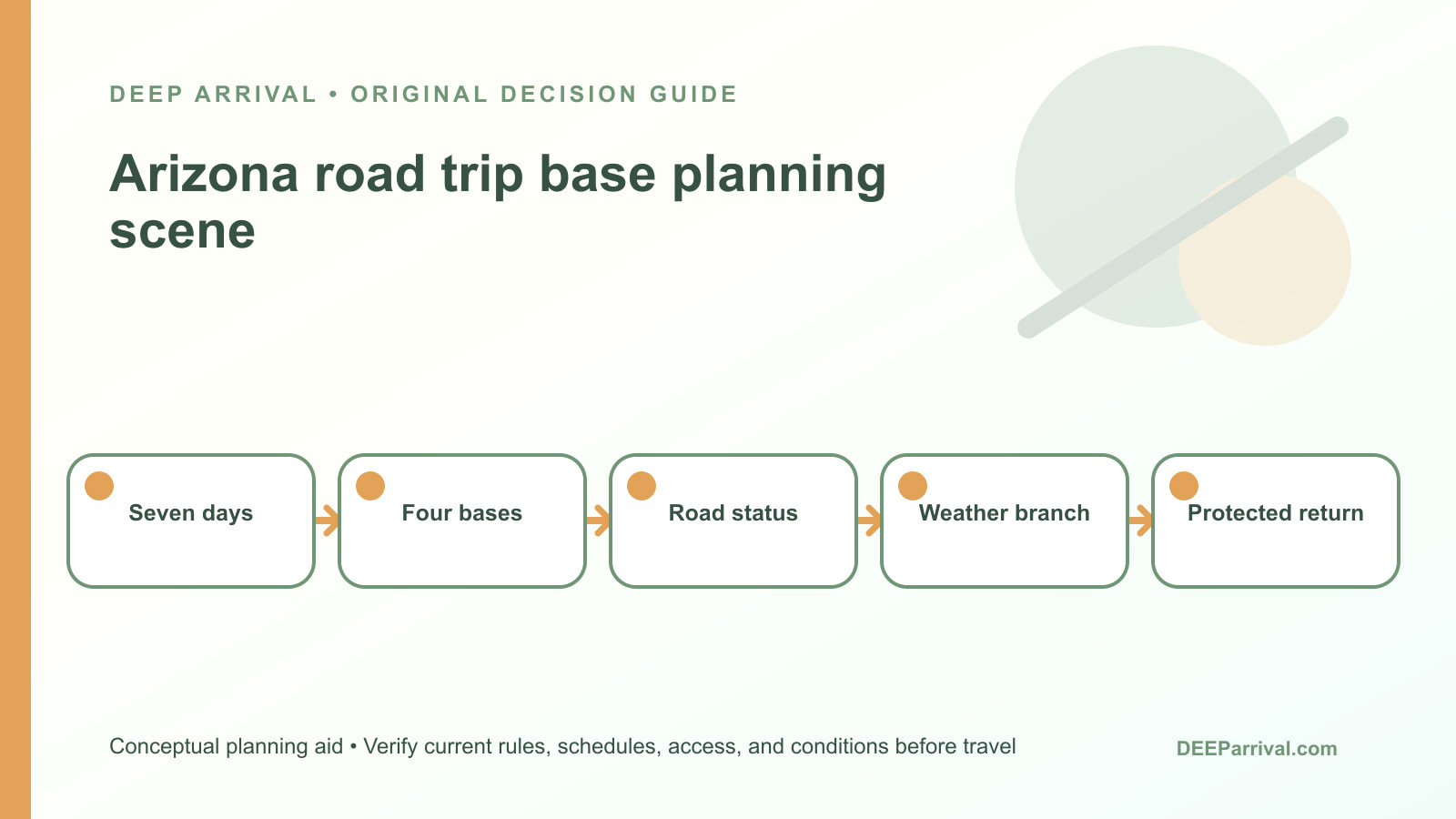
Build the whole travel chain
Four bases make the loop readable
A workable Arizona road trip is a bounded loop with a small number of overnight bases, not a long checklist of desert stops. This seven day framework connects Phoenix, Sedona, Flagstaff, and Grand Canyon planning while leaving room for current road, weather, heat, and park-access checks.
This guide covers a seven day Arizona loop between Phoenix, Sedona, Flagstaff, and Grand Canyon. The map is only the starting point. Confirm the live source, protect the handoff, and keep a recovery branch before committing to the most fragile part of the day.
Set the loop before adding stops
Start by fixing a Phoenix arrival, a Sedona overnight, a Flagstaff overnight, and a Grand Canyon decision before adding a fifth stop. That order makes the route readable and prevents an eastern extension from dictating the whole week.
Set the loop before adding stops in practice
Put flight timing, car pickup, and the final departure in the same view. If the available nights are fewer than seven, remove a base or shorten the canyon portion instead of converting every day into a transfer day.
Use Phoenix as an arrival buffer
Phoenix is most useful as an arrival and departure buffer. A late landing, rental-car delay, grocery stop, or hot first evening is a poor moment to begin a long desert drive.
Use Phoenix as an arrival buffer in practice
Sleep near the airport or the chosen outbound corridor, then leave with daylight and a full fuel plan. The linked Phoenix page can supply city ideas, but this route uses the city mainly to protect the first driving morning.
Give Sedona a real overnight
Sedona works better as a true overnight than as a quick photograph between Phoenix and Flagstaff. Select lodging and parking expectations before treating a trailhead or scenic pullout as fixed.
Give Sedona a real overnight in practice
A hot afternoon, weekend traffic, or weather notice can make the shorter map distance feel much longer. Keep one modest activity near the base and leave the rest optional, so a late arrival does not erase the value of the stop.
Respect Flagstaff elevation
Flagstaff changes the trip's temperature, storm, and clothing assumptions. Pack for the high-country overnight rather than relying on Phoenix forecasts, and make sure fuel and food plans fit the road actually being used.
Respect Flagstaff elevation in practice
A traveler who arrives tired from Sedona can keep the evening simple and still preserve the next day. Flagstaff is a base for a cooler reset, not merely a sign that the route has reached the canyon region.
Approach Grand Canyon by the right rim
Choose the Grand Canyon rim and approach after reading the National Park Service planning page, not from a generic map label. The access chain, lodging choices, and next-day drive can differ sharply by rim.
Approach Grand Canyon by the right rim in practice
Confirm current park information before reserving a hard-to-change overnight or committing to a sunrise plan. The linked Grand Canyon page can answer park-specific questions after the loop has established which rim and approach are realistic.
Keep transfer days bounded
A scenic Arizona route can hide slow park approaches, construction, weather cells, fuel gaps, and daylight loss. Give each transfer day one principal drive and one optional stop rather than stacking several attractions across the map.
Keep transfer days bounded in practice
Leave the car loaded before the hottest part of the day when possible, and identify a town where an early stop remains comfortable. A shorter day is often the reason the next base stays enjoyable.
Build a weather-safe branch
Open Arizona 511 before every long drive and recheck National Park Service notices before entering the canyon area. Monsoon rain, snow, wind, heat, or a closure can change a usable route without changing the value of the trip.
Build a weather-safe branch in practice
Keep a lower-risk alternative such as another night in the current base, a shorter local drive, or a removed optional extension. Do not replace a current notice with an old scenic-road promise.
Hand off to destination pages
This seven-day framework uses the order of Phoenix, Sedona, Flagstaff, and Grand Canyon. Use the Phoenix, Flagstaff, and Grand Canyon links once the overnight sequence is settled.
Hand off to destination pages in practice
They are better places for restaurant, attraction, trail, and park detail. Keeping those decisions separate lets a traveler adjust one base when road conditions change without rebuilding every part of the Arizona itinerary.
Protect the seven-day loop
Choose the car and lodging as route-control decisions, not as details left until the final week. Confirm the rental pickup, fuel range, return hours, and each base before assigning a remote viewpoint or high-country detour to the last day.
Protect the seven-day loop in practice
A vehicle comfortable in Phoenix still needs a different fuel and weather margin near Flagstaff or the selected Grand Canyon approach. Reserve the nights that prevent a difficult after-dark arrival, then leave individual attractions flexible around the bases.
Protect the seven-day loop when plans change
A changeable Sedona activity is easier to recover than a missed canyon-area lodging window after weather slows the drive. Compare each transfer with sunrise, sunset, fuel stops, and the expected time at the next lodging instead of accepting a bare map estimate.
Protect the seven-day loop before departure
Optional Petrified Forest planning needs its own current park check because it should never remove the core loop's recovery margin. Place the final night where airport return, fuel refill, and the rental-car handoff are manageable, rather than where one last attraction appears closest on a map.
Run a final driving-day reset
Before each departure, compare the current road notice, weather forecast, fuel plan, lodging address, and daylight remaining against the route actually chosen that morning. If one element has changed, shorten the drive or remove an optional stop before leaving rather than trying to regain time at the next base.
Leave space for conditions
Arizona rewards a route with unused time because heat, weather, road notices, and the chosen canyon approach can alter a day without warning. Treat that unused time as part of the itinerary, then use it for a slower base evening or an optional stop only after current checks still support the plan.
Planning traps
Mistakes to avoid
These are the small decisions that quietly derail an otherwise good plan.
The loop loses its recovery margin.
Arizona routes can change with weather or maintenance.
Flagstaff and desert bases need different preparation.
Access and drive chains differ.
Sources checked
Official and supporting references
Use these references to confirm live prices, dates, rules, and operating details before money changes hands.
Staying over? Compare hotels for this trip at Expedia.
Deep Arrival earns a commission when you buy through partner links. It does not change the price you pay.
FAQ
Common planning questions
How many days are enough for an Arizona road trip?
Should you start in Phoenix?
Can you drive the whole route in winter?
Do you need a car?
Where should you sleep near Grand Canyon?
Is Sedona a day trip from Phoenix?
Continue planning